TPO Roof Installation in Miami: Complete Guide for Building Owners
The TPO Installation Guide for Miami Building Owners
If you own a commercial building in Miami with a flat or low-slope roof, TPO is probably the right choice for your next replacement. I've installed hundreds of TPO roofs across Miami-Dade since 2004, from 5,000 square foot strip malls in Kendall to 100,000+ square foot distribution centers in Medley and Doral.
This post covers the full TPO installation process for commercial buildings in Miami, including how to choose the right thickness and installation method, real 2026 pricing, the HVHZ-specific requirements that most out-of-area contractors miss, and how to verify your contractor is doing the work correctly. For a broader overview of TPO as a material, read my TPO roofing Miami commercial post in the roofing types section.
What Is TPO Roofing?
TPO is a single-ply roofing membrane composed of thermoplastic polyolefin polymer with reinforcing scrim (typically polyester or fiberglass). The material is manufactured in large rolls. typically 10, 12, or 20 feet wide. and heat-welded together on-site to create a completely seamless, watertight roof system.
TPO vs. Other Commercial Roofing Systems
TPO vs. EPDM (Rubber Roofing) :
- TPO reflects heat; EPDM absorbs it (black surface)
- TPO heat-welded seams are stronger than EPDM glued or taped seams
- TPO costs slightly more but provides better energy efficiency in Miami's climate
- EPDM offers better puncture resistance but worse Miami heat performance
TPO vs. PVC :
- TPO costs 15-30% less than PVC
- PVC offers slightly better chemical resistance (important for restaurant exhaust areas)
- Both provide excellent heat reflection and weld strength
- Performance differences minimal for standard commercial applications
TPO vs. Modified Bitumen :
- TPO lighter weight and faster installation
- Modified bitumen requires torch application (fire safety concerns)
- TPO superior energy efficiency with white reflective surface
- Modified bitumen better for high foot traffic areas
TPO vs. Built-Up Roofing (BUR) :
- TPO significantly lighter (important for older buildings)
- BUR requires hot tar (health and safety issues)
- TPO easier maintenance and repairs
- BUR longer track record but declining popularity
Compare all commercial roofing options to find the best fit for your building.
Why TPO Roofing Dominates Miami's Commercial Market
Miami building owners choose TPO for specific performance advantages in our subtropical climate.
Superior Heat Reflection
TPO's bright white surface reflects up to 87% of solar radiation, dramatically reducing cooling costs. In Miami's intense sun, this translates to:
- 15-25% reduction in cooling costs compared to dark-colored roofs
- Surface temperatures 50-60°F cooler than black EPDM roofs
- Extended HVAC equipment life due to reduced strain
- Improved tenant comfort in upper-floor spaces
Energy Star and CRRC (Cool Roof Rating Council) certifications verify TPO's thermal performance, potentially qualifying your building for FPL energy rebates.
Excellent Hurricane Performance
Miami-Dade County's strict building codes require commercial roofs to withstand extreme wind events. Quality TPO systems provide:
- Miami-Dade NOA (Notice of Acceptance): Required for legal installation in hurricane-prone zones
- Wind uplift ratings to 210+ mph: When mechanically attached with appropriate fastener patterns
- Seam strength exceeding membrane strength: Heat-welded seams are actually stronger than the membrane itself
- No blow-off risk from failed adhesives: Mechanical attachment provides consistent performance
Extreme Roofing exclusively installs Miami-Dade approved TPO systems with documented wind ratings meeting or exceeding code requirements.
Cost-Effective Installation
TPO offers excellent value compared to other commercial systems:
- Lower material costs: Than PVC or metal roofing
- Faster installation: Large membrane rolls cover more area with fewer seams
- Minimal disruption: Most installations completed without closing buildings
- Lower weight: Typically doesn't require structural reinforcement
Average Miami TPO installation costs range from $8-$15 per square foot depending on roof complexity, membrane thickness, and attachment method.
Long Service Life with Minimal Maintenance
Quality TPO systems properly installed in Miami typically provide:
- 15-25 year service life: With appropriate maintenance
- 10-20 year manufacturer warranties: Available on most systems
- Minimal maintenance requirements: Annual inspections and basic cleaning
- Easy repairs: Heat-welding patches provides permanent repairs
- No periodic recoating: Unlike modified bitumen or BUR systems
Environmental and Health Benefits
TPO offers advantages beyond performance:
- Recyclable material: At end of service life
- No chlorine compounds: Unlike PVC (better for environment)
- No plasticizers to leach: Maintains membrane integrity longer
- VOC-free installation: No adhesive fumes or torch application concerns
TPO Membrane Specifications and Selection
Not all TPO membranes perform equally. Understanding specifications helps building owners make informed choices.
Membrane Thickness Options
TPO is available in three standard thicknesses:
45 mil (1.14mm) : Budget option for simple roofs with minimal traffic
- Lower cost but shorter lifespan
- Appropriate for residential applications
- Not recommended for commercial buildings in Miami's harsh climate
60 mil (1.52mm) : Standard commercial grade
- Good balance of cost and performance
- Suitable for most Miami commercial applications
- Typical 15-20 year service life
80 mil (2.03mm) : Premium commercial grade
- Maximum durability and puncture resistance
- Recommended for high-traffic roofs or demanding environments
- 20-25+ year service life potential
- Higher upfront cost but better long-term value
Extreme Roofing Recommendation : We specify 60 mil minimum for Miami commercial installations, with 80 mil for buildings with rooftop equipment, high foot traffic, or premium warranty requirements.
Reinforcement Types
TPO membranes use different reinforcing scrims that affect performance:
Polyester Reinforcement :
- Most common in commercial applications
- Excellent dimensional stability
- Strong seam welding characteristics
- Best all-around performance for Miami installations
Fiberglass Reinforcement :
- Lower cost but less durable
- More susceptible to shrinkage over time
- Not recommended for Miami's thermal cycling
Fleece-Backed Membranes :
- Includes additional polyester fleece layer on underside
- Better for fully-adhered installations
- Improved walkability for service traffic
- Higher cost but easier installation in some applications
Color Considerations
While white is standard and recommended for Miami, TPO is available in other colors:
White TPO (Recommended):
- Maximum solar reflectance (87%+)
- Lowest roof surface temperatures
- Best energy efficiency
- Most common and most affordable
Tan/Gray TPO :
- Aesthetic preference for some buildings
- Significantly reduced energy efficiency
- Higher surface temperatures
- Generally not recommended for Miami climate
TPO Installation Methods
Installation method significantly impacts performance, cost, and longevity.
Mechanically Attached TPO
Process : Membrane secured with plates and screws through insulation into deck at regular intervals (typically 12-16 inches on-center), then seam edges heat-welded.
Advantages :
- Lower cost than fully-adhered
- Faster installation
- Better performance on moving substrates
- Easier repairs and modifications
- Works well with various insulation types
Best Applications :
- New construction commercial buildings
- Metal deck structures (most common in Miami)
- Buildings requiring high wind ratings
- Budget-conscious projects
Wind Performance : Can achieve very high wind ratings (180-210+ mph) with appropriate fastener patterns, making it ideal for Miami hurricane requirements.
Fully Adhered TPO
Process : Membrane bonded directly to substrate using specialized adhesives across entire roof surface.
Advantages :
- Quieter during wind events (no "billowing")
- Potentially longer lifespan
- Better aesthetics (flatter appearance)
- No fastener penetrations
- Better for occupied buildings sensitive to noise
Disadvantages :
- 20-30% higher cost than mechanically attached
- More weather-sensitive installation
- Requires pristine substrate conditions
- More complex repairs
- Adhesive compatibility issues with some insulations
Best Applications :
- Residential buildings where aesthetics matter
- Occupied buildings needing quiet performance
- Concrete deck structures
- Projects with larger budgets prioritizing premium appearance
Ballasted TPO (Rare in Miami)
Process : Membrane laid loosely over roof and held down with stone or pavers.
Note : Rarely used in Miami due to:
- Hurricane wind concerns (ballast becomes projectiles)
- Structural load requirements (250+ pounds per square)
- Miami-Dade building code restrictions
- Liability concerns in hurricane-prone areas
The TPO Installation Process: What to Expect
Understanding the installation process helps building owners plan and manage projects effectively.
Phase 1: Assessment and Planning (Week 1-2)
Initial Inspection :
- Existing roof condition evaluation
- Structural capacity assessment
- Drainage evaluation
- Penetration and equipment inventory
- Code compliance review
Design Development :
- Membrane specification selection
- Insulation type and thickness determination
- Attachment method specification
- Detail design for penetrations and transitions
- Wind uplift calculations
Permitting :
- Miami-Dade building permit application
- Engineering calculations (if required)
- NOA product approval verification
- 2-4 week permit approval timeline
Learn more about our commercial roofing services and assessment process.
Phase 2: Tear-Off and Substrate Preparation (3-7 Days)
For re-roofing projects:
Existing Roof Removal :
- Complete tear-off to deck (most common approach)
- Debris containment and removal
- Deck inspection and repairs
- Proper disposal of old materials
Substrate Preparation :
- Deck cleaning and inspection
- Fastener installation or replacement
- Wood nailer installation at perimeters
- Structural repairs if needed
- Moisture testing and dry-out period
Note : Some Miami commercial roofs can accommodate "recover" installations (new system over old), reducing costs and installation time. However, building codes limit the number of roof layers, and most older buildings have reached this limit.
Phase 3: Insulation Installation (2-4 Days)
Insulation Types Common in Miami :
Polyisocyanurate (Polyiso) : Most popular choice
- High R-value per inch (R-6.5)
- Lightweight
- Cost-effective
- Available with various facers for different attachment methods
Expanded Polystyrene (EPS) : Budget option
- Lower R-value (R-4.0 per inch)
- Excellent moisture resistance
- Lower cost
- More thickness required for equivalent insulation
Insulation Attachment :
- Mechanically fastened with plates and screws
- Number and spacing based on wind uplift calculations
- Critical for overall system wind rating
- Must meet Miami-Dade NOA specifications
Typical Miami Insulation Thickness : 2-3 inches of polyiso provides R-13 to R-20, meeting most energy code requirements while managing costs.
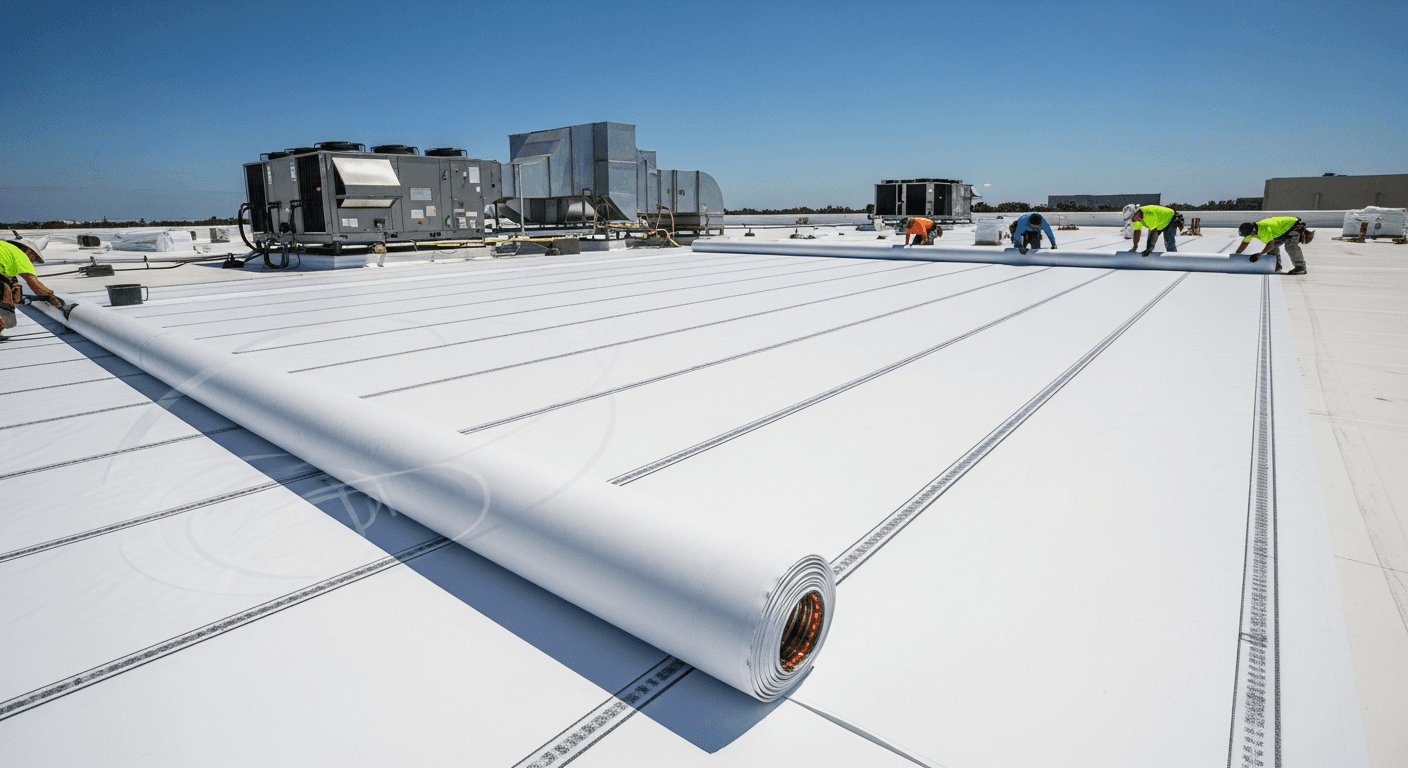
Phase 4: TPO Membrane Installation (3-5 Days)
Membrane Rollout and Positioning :
- Large membrane rolls positioned across roof
- Orientation planned to minimize seams
- Overlap areas marked for welding
- Temporary fasteners hold membrane during installation
Seam Welding :
- Hot-air welders (typically 400-600°F) melt membrane edges
- Pressure roller creates permanent bond
- Seams stronger than membrane itself when properly welded
- Quality control testing verifies seam integrity
Mechanical Attachment :
- Fastener plates installed through membrane and insulation into deck
- Spacing per engineering calculations (typically 12-16 inches)
- Must use approved fastener types per NOA
- Extremely critical for wind performance
Detail Work :
- Flashing at walls, curbs, and penetrations
- Drain integration and waterproofing
- Equipment curb flashings
- Edge terminations and securement
- Walk pad installation at traffic areas
Phase 5: Final Details and Inspection (1-2 Days)
Quality Control :
- Complete seam testing (probe testing or electrical testing)
- Detail inspection and touch-up
- Drainage testing
- Leak testing around penetrations
Building Department Inspection :
- Schedule final roof inspection
- Address any inspector concerns
- Obtain certificate of completion
- Critical for permit closure and warranty activation
Owner Documentation :
- Warranty certificates
- Maintenance guidelines
- As-built drawings
- Product specifications
- Care and maintenance instructions
Total Timeline
Typical Miami commercial TPO installation timeline:
- Small building (5,000-10,000 SF): 1-2 weeks
- Medium building (10,000-30,000 SF): 2-4 weeks
- Large building (30,000+ SF): 4-8 weeks
Weather delays are common during Miami's summer rainy season; schedule major installations during dry season (November-April) when possible.
TPO Roofing Costs in Miami
Understanding cost factors helps building owners budget appropriately and evaluate proposals.
Material Cost Factors
- Membrane thickness: 60 mil vs. 80 mil impacts pricing
- Membrane brand: GAF, Carlisle, GenFlex, etc. vary in price
- Insulation type and thickness: Polyiso vs. EPS, R-value requirements
- Warranty level: Basic vs. premium warranty affects material selection
Installation Cost Factors
- Roof complexity: Simple rectangles cost less than complex shapes
- Penetrations: HVAC units, vents, skylights increase labor
- Building height: Multi-story buildings require more safety equipment
- Access: Difficult material access increases costs
- Tear-off requirements: Complete removal vs. recover installation
- Structural repairs: Deck replacement or repairs add costs
Average Miami TPO Installation Costs (2026)
Budget System ($8-$10/SF):
- 60 mil TPO membrane
- Basic polyiso insulation (R-13)
- Mechanically attached
- Standard 10-year warranty
- Simple roof configuration
Standard System ($10-$13/SF):
- 60-80 mil TPO membrane
- Enhanced polyiso insulation (R-20)
- Mechanically attached
- 15-20 year warranty
- Moderate roof complexity
Premium System ($13-$15+/SF):
- 80 mil TPO membrane
- Maximum insulation (R-25+)
- Fully adhered or enhanced mechanical attachment
- 20-25 year warranty
- Complex roof with numerous penetrations
Additional Costs :
- Tear-off: Add $1.50-$3.00/SF
- Deck repairs: $15-$30/SF for damaged areas
- Structural upgrades: Variable, requires engineering
- Enhanced drainage: $500-$2,000 per drain
- Equipment curb replacement: $500-$1,500 per unit
Request a detailed estimate for accurate pricing specific to your building.
Energy Efficiency and Cost Savings
TPO roofing provides measurable energy benefits that offset installation costs over time.
Cooling Cost Reduction
Miami building owners typically see:
- 15-25% reduction in summer cooling costs
- 10-15% reduction in annual energy costs
- Faster ROI in buildings with poor existing insulation
- Improved HVAC performance and extended equipment life
Example : 20,000 SF office building with $3,000 monthly summer cooling costs might save $500-$750 monthly (June-October), totaling $2,500-$3,750 annually. Over 20-year roof life, that's $50,000-$75,000 in savings.
Available Rebates and Incentives
FPL Commercial Energy Conservation Program :
- Rebates for qualifying cool roof installations
- Requirements include minimum solar reflectance and thermal emittance
- TPO systems typically qualify
- Application through approved contractors
Federal Tax Benefits :
- 179D Commercial Buildings Energy Efficiency Tax Deduction
- Up to $5.00 per square foot for qualifying improvements
- Requires certification from licensed engineer
- Consult tax professional for current regulations
Energy Code Compliance
Miami building codes require minimum insulation R-values for commercial buildings:
- Typical requirement: R-20 to R-25 for low-slope roofs
- Climate Zone 1 (Miami): Lower requirements than northern climates
- Above-deck insulation: Most common approach for TPO systems
- Continuous insulation: No thermal bridging through deck
TPO Maintenance and Lifespan
Proper maintenance maximizes TPO roof lifespan and performance.
Recommended Maintenance Schedule
Quarterly Inspections (Every 3 Months):
- Visual inspection for obvious damage
- Drain cleaning and debris removal
- Equipment curb inspection
- Seam spot-checking in high-stress areas
Bi-Annual Professional Inspections (May and November):
- Pre and post-hurricane season comprehensive assessment
- Detailed seam inspection
- Flashing condition evaluation
- Drainage system testing
- Membrane condition documentation
Annual Deep Maintenance :
- Complete roof cleaning
- Drain system professional cleaning
- Minor repairs and touch-ups
- Seam reinforcement if needed
- Documentation for warranty compliance
Learn more about maintenance programs designed for Miami commercial properties.
Common TPO Maintenance Issues
Seam Splitting :
- Cause: Thermal stress, poor installation, or material defects
- Prevention: Quality installation and regular inspections
- Repair: Heat-welded patches, typically under warranty
Punctures :
- Cause: Foot traffic, hail, or dropped tools
- Prevention: Walk pads at high-traffic areas
- Repair: Simple heat-welded patches, inexpensive
Flashing Failures :
- Cause: Thermal movement, poor installation, or sealant degradation
- Prevention: Quality detail work during installation
- Repair: Reflashing or seam reinforcement
Shrinkage :
- Cause: Low-quality membranes or extreme thermal cycling
- Prevention: Specify quality membranes from reputable manufacturers
- Solution: May require edge detail modifications, rare with modern TPO
Expected Lifespan
60 Mil TPO with Proper Maintenance : 15-20 years
80 Mil TPO with Proper Maintenance : 20-25 years
Factors Reducing Lifespan :
- Poor installation quality
- Deferred maintenance
- Extreme weather exposure without repairs
- Chemical exposure (near restaurant exhaust)
Factors Extending Lifespan :
- Quality installation by certified contractors
- Regular professional maintenance
- Prompt repair of minor issues
- Walk pads protecting high-traffic areas
Warranties and Manufacturer Certifications
Understanding warranty coverage protects your investment.
Manufacturer Material Warranties
Standard Warranties (10-15 years):
- Cover manufacturing defects
- Pro-rated coverage (declining value over time)
- Included with most systems
Extended Warranties (15-25 years):
- Require certified contractor installation
- May include labor coverage
- Often include periodic inspections
- Higher material costs but better protection
NDL (No Dollar Limit) Warranties :
- Premium warranty with full coverage
- Includes labor costs for repairs
- Requires certified contractor and specified system
- Most expensive but most comprehensive protection
Contractor Workmanship Warranties
Separate from manufacturer warranties:
- Extreme Roofing Standard: 5-year workmanship warranty
- Extended Options: 10-year workmanship available
- Coverage: Labor and materials for installation defects
- Requirements: Must follow maintenance guidelines
GAF Master Elite Certification
Extreme Roofing's GAF Master Elite status means:
- Top 3% of roofing contractors nationwide
- Enhanced warranty options available
- Factory training and quality standards
- Proven track record and financial stability
Learn about our certifications and warranties.
Choosing a TPO Roofing Contractor in Miami
Contractor selection is the most important factor in successful TPO installation.
Essential Qualifications
State Licensing :
- Florida General Contractor or Roofing Contractor license required
- Verify through Florida Department of Business & Professional Regulation
- License number should appear on all proposals and contracts
Insurance Coverage :
- Minimum $2M general liability insurance
- Workers' compensation for all employees
- Builder's risk insurance for project
- Request current certificates for verification
Manufacturer Certifications :
- GAF Master Elite, Carlisle, or other major manufacturer programs
- Certification ensures training, quality standards, and warranty access
- Verified through manufacturer websites
Local Experience :
- Miami-specific commercial roofing experience
- Understanding of Miami-Dade building codes and NOA requirements
- References from local building owners
- Track record through multiple hurricane seasons
Red Flags to Avoid
- Contractors without proper Florida licensing
- Pressure for immediate decisions or deposits
- "Storm chasers" without local presence
- Proposals without detailed specifications
- Unusually low bids (often indicate shortcuts)
- Inability to provide current insurance certificates
- No manufacturer certifications
- Poor communication or unprofessional presentation
Questions to Ask Potential Contractors
- How many commercial TPO installations have you completed in Miami?
- Can you provide three recent references from building owners?
- What specific TPO membrane brands do you install?
- What warranty options are available for my building?
- How do you handle weather delays and scheduling?
- What safety protocols do you follow?
- How do you protect occupied buildings during installation?
- What's included in your workmanship warranty?
- Do you handle all permitting and inspections?
- What maintenance do you recommend post-installation?
Conclusion: Is TPO Right for Your Miami Building?
TPO roofing offers Miami building owners an excellent combination of performance, value, and durability. For most commercial flat or low-slope roof applications, TPO provides:
- Superior energy efficiency reducing cooling costs in Miami's climate
- Excellent hurricane resistance meeting strict building codes
- Cost-effective installation with good long-term value
- Minimal maintenance requirements compared to other systems
- Proven performance backed by 20+ years of real-world data
TPO is Ideal For :
- Commercial office buildings
- Retail centers and strip malls
- Warehouse and distribution facilities
- Multi-family residential buildings
- Medical and professional buildings
- Schools and institutional facilities
Consider Alternatives If :
- Your building needs extensive structural repairs (explore metal roofing options)
- Heavy chemical exposure exists (PVC might be better)
- Aesthetics drive decisions for visible roofs (consider standing seam metal)
- Extreme foot traffic expected (modified bitumen more durable)
Ready to explore TPO roofing for your Miami building? Extreme Roofing Inc. has installed hundreds of TPO systems across South Florida since 2004. Our GAF Master Elite certification, comprehensive warranties, and proven track record give building owners confidence in their investment.
Contact us at 305-225-1535 or request your free assessment and quote. We provide detailed proposals with transparent pricing, product specifications, and honest recommendations for your specific building needs.
Frequently Asked Questions
How long does TPO roofing last in Miami's climate?
Quality TPO roofing systems typically last 15-25 years in Miami when properly installed and maintained. 60 mil membranes average 15-20 years, while premium 80 mil systems can exceed 25 years. Lifespan depends on maintenance quality, installation workmanship, and specific exposure conditions. Regular inspections, prompt repairs, and professional maintenance significantly extend service life. Extreme Roofing installs TPO systems with comprehensive warranties and provides maintenance programs to maximize longevity.
What does TPO roof installation cost in Miami?
Miami TPO installation costs range from $8-$15 per square foot depending on membrane thickness (60 vs. 80 mil), insulation requirements, attachment method, roof complexity, and warranty level. Budget systems start around $8-$10/SF, standard systems run $10-$13/SF, and premium installations with enhanced warranties cost $13-$15+/SF. Add $1.50-$3.00/SF for tear-off of existing roofs. For accurate pricing specific to your building, request a detailed quote including specifications, warranty terms, and timeline.
Is TPO roofing good for hurricane protection in Miami?
Yes, TPO roofing provides excellent hurricane protection when properly installed to Miami-Dade building code requirements. Mechanically attached systems can achieve wind ratings of 180-210+ mph. well above hurricane requirements. Heat-welded seams are stronger than the membrane itself, preventing wind-driven rain infiltration. All Extreme Roofing TPO installations use Miami-Dade NOA approved systems with documented wind ratings. Proper installation by certified contractors is critical. poor workmanship negates even the best materials.
How much can I save on energy costs with a white TPO roof?
Miami building owners typically save 15-25% on summer cooling costs with white TPO roofing compared to dark-colored roofs. For a 20,000 SF building spending $3,000 monthly on summer cooling, savings range from $500-$750 monthly (June-October), totaling $2,500-$3,750 annually. Over a 20-year roof life, that's $50,000-$75,000 in energy savings. Actual savings depend on existing insulation, HVAC efficiency, building usage, and utility rates. TPO systems may also qualify for FPL energy rebates.
What maintenance does TPO roofing require in Miami?
TPO roofing requires minimal maintenance: quarterly visual inspections and debris removal, bi-annual professional inspections before and after hurricane season, and annual deep cleaning with minor repairs. Drain systems should be cleaned quarterly to prevent ponding water. Most maintenance focuses on keeping the roof clean, addressing minor issues promptly, and verifying seam integrity. Annual maintenance costs typically run $0.15-$0.30 per square foot. Extreme Roofing offers maintenance contracts with scheduled inspections, priority service, and detailed documentation for warranty compliance.
Need Roofing Help?
Whether you need an inspection, repair, or full replacement, our team of licensed roofing professionals is ready to help. Serving South Florida since 2004.
Related Articles
Discover why standing seam metal roofing is Miami's premium residential choice. Learn about benefits, costs, installation, hurricane ratings, energy efficiency, and long-term value of concealed-fastener metal roofing systems.
Read More
Everything Miami homeowners need to know about professional roof inspections . what inspectors check, how much it costs, how often you need one, and how inspections save you thousands in preventable damage.
Read More