
Metal Roofing in Miami: Benefits, Costs, and Hurricane Ratings
Why Metal Is the Fastest-Growing Residential Roof in Miami
Ten years ago, metal roofing in Miami was mostly commercial buildings, warehouses, and a handful of modern architect-designed homes. Today it's the fastest-growing residential category in Miami-Dade. I'm installing 3 to 4 times more metal roofs per year now than I was in 2015, and most of that growth is homeowners who went through Irma in 2017 and Ian in 2022 and decided they wanted the highest wind rating they could buy.
This post covers the full metal roofing picture: every product type, real 2026 pricing, honest material selection by Miami zip code, energy savings, insurance credits, and the installation differences between standing seam, metal shingles, exposed fastener panels, and premium copper or zinc. If you want a deep dive on just standing seam specifically, read my standing seam cost guide. This post is the broader overview of all metal options.
The Four Metal Roof Types I Install in Miami
Not every metal roof is created equal. When a client says "I want a metal roof," my next question is always "what kind?" Because the four categories I install perform differently, cost differently, and look completely different on your house.
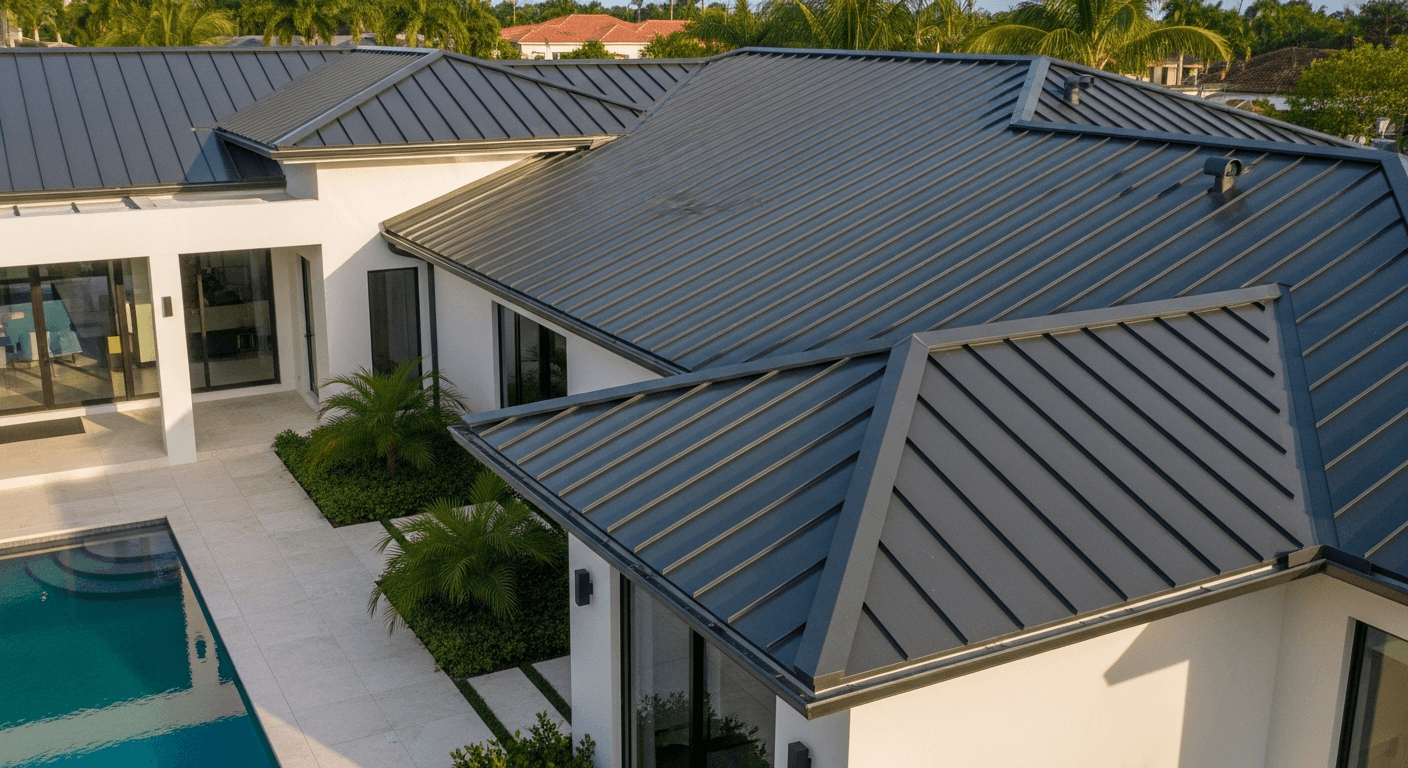
Standing seam. The top-tier residential metal system. Interlocking vertical panels running from ridge to eave, connected through raised seams with concealed clips. No exposed fasteners on the panel surface. Wind ratings of 160 to 180+ mph with Miami-Dade NOAs. Lifespan 40 to 60 years depending on the alloy. Installed cost $16 to $25 per square foot. This is what I recommend for most Miami homes that want metal.
Stamped metal shingles. Individual shingle-sized panels stamped in dies to mimic traditional materials (Spanish tile, slate, wood shake, architectural shingle). Four-way interlocking design creates wind resistance. Lighter than real tile or slate, installs faster, costs less. Wind ratings 130 to 150 mph. Lifespan 40 to 60 years. Installed cost $12 to $18 per square foot. Good for homeowners who want a traditional look with metal performance.
Exposed-fastener panels (R-panel, PBR, corrugated). The budget option. Wide panels screwed directly to the deck through rubber-gasketed fasteners. No concealed clips, no interlocking seams. Wind ratings 110 to 140 mph. Lifespan 20 to 35 years (the exposed fastener gaskets fail long before the metal does). Installed cost $8 to $12 per square foot. I install these on detached garages, outbuildings, and agricultural structures. I do not install them on houses in Miami where HVHZ wind performance matters.
Copper and zinc architectural metal. The luxury tier. Both develop a protective patina over time (copper turns green, zinc turns gray). Both last 70 to 100+ years. Both cost $25 to $45 per square foot installed. I see these on historic restoration work in Coral Gables, landmark buildings, and a handful of custom luxury homes in Miami Beach, Star Island, and Fisher Island. For most Miami homeowners, the premium over standing seam aluminum isn't worth it unless you're specifically matching existing architecture.
2026 Metal Roof Pricing by System and Home Size
Real numbers I'm quoting right now in Miami-Dade:
| Home Size | Standing Seam Galvalume | Standing Seam Aluminum | Stamped Metal Shingles | Copper (20 oz) |
|---|---|---|---|---|
| 1,500 sq ft | $24,000 - $28,500 | $27,000 - $33,000 | $18,000 - $24,000 | $42,000 - $60,000 |
| 2,000 sq ft | $32,000 - $38,000 | $36,000 - $44,000 | $24,000 - $32,000 | $56,000 - $80,000 |
| 2,500 sq ft | $40,000 - $47,500 | $45,000 - $55,000 | $30,000 - $40,000 | $70,000 - $100,000 |
| 3,000 sq ft | $48,000 - $57,000 | $54,000 - $66,000 | $36,000 - $48,000 | $84,000 - $120,000 |
| 4,000 sq ft | $64,000 - $76,000 | $72,000 - $88,000 | $48,000 - $64,000 | $112,000 - $160,000 |
Numbers include tear-off, deck re-nail to HVHZ code, self-adhered underlayment, panels, clips, seaming, flashing, ridge and hip trim, permit, and final inspection. Add 15 to 30 percent for complex roofs with lots of valleys and dormers, or for three-story homes.
If you're getting quotes under $14 per square foot installed for "standing seam metal," you're almost certainly looking at exposed-fastener R-panel being sold as standing seam. Check the specific product, NOA number, and ask to see the clip attachment method.
Material Selection by Miami Zip Code
This is the part most national roofing blogs can't tell you. Miami's coastal zones, salt air, and building codes make material selection a lot more nuanced than "pick whatever you like."
Within 1 mile of open water (Bal Harbour, Sunny Isles, Key Biscayne, Fisher Island, Star Island, Golden Beach, Miami Beach barrier): Aluminum standing seam only. Skip Galvalume entirely. The salt spray will rust Galvalume within 10 years no matter what coating is on it. Budget $18 to $25 per square foot minimum.
1 to 2 miles from coast (Coconut Grove waterfront, Coral Gables waterfront sections, Aventura, Hollywood Beach): Aluminum standing seam is safest. Galvalume with Kynar 500 finish is acceptable but expect 35 to 45 year lifespan instead of 55+. Use stainless steel fasteners and clips regardless of panel material.
2 to 5 miles from coast (most of Coral Gables, Pinecrest, South Miami, Miami Shores, Biscayne Park): Galvalume 24-gauge standing seam is fine. Aluminum is optional but not necessary. Budget $16 to $19 per square foot.
More than 5 miles inland (Kendall, Doral, Hialeah, Miami Lakes, Homestead, Redland, Palmetto Bay, Cutler Bay): Galvalume 24-gauge is the standard recommendation. 22-gauge for extra durability. Budget $14 to $17 per square foot. Metal shingles are also a good value option here.
The cost difference between aluminum and Galvalume runs about 25 percent. On a $36,000 project, that's $9,000. If you're not in a coastal zone, save the money. If you are, don't.
The Real Insurance Credit for Metal Roofs
Metal roofs earn the highest wind mitigation credits on Florida's OIR-B1-1802 inspection form. Here's what that actually means on a Miami policy:
For a typical Miami home with a $5,500 annual insurance premium (wind portion around $3,300), a Miami-Dade NOA standing seam metal roof with full documentation on the wind mitigation form saves:
- Roof covering credit: 28 to 35 percent off wind premium ($925 to $1,155 per year)
- Secondary water resistance credit (if self-adhered underlayment covers the whole deck): additional 3 to 5 percent ($100 to $165 per year)
- Roof-to-wall connection (clips or wraps): additional 5 to 10 percent ($165 to $330 per year)
- Hip geometry (if applicable): additional 5 to 10 percent ($165 to $330 per year)
Total annual savings for a fully-credited metal roof installation typically runs $1,200 to $2,000 per year. Over 40 years, that's $48,000 to $80,000 in cumulative insurance savings. Add that to the energy savings and longevity, and the math heavily favors metal over almost any other option.
Energy Savings in Miami's Actual Climate
Studies by the Florida Solar Energy Center and Oak Ridge National Laboratory show metal roofs reduce cooling costs by 15 to 25 percent in hot climates. Here's how that plays out in Miami:
A typical 2,200 square foot Miami home running air conditioning 10 to 11 months per year spends $2,800 to $3,600 annually on cooling (average FPL rates in 2026). A metal roof with Kynar 500 cool-color coating reduces cooling load by:
- 15 percent savings (dark-colored metal with IR-reflective pigments): $420 to $540 per year
- 22 percent savings (medium-colored metal): $616 to $792 per year
- 28 percent savings (light-colored metal with Energy Star certification): $784 to $1,008 per year
Over a 50-year metal roof lifespan, those savings compound to $20,000 to $50,000 depending on color and climate patterns. That's real money that never shows up on the installation quote.
Why I Don't Recommend Exposed Fastener Panels on Houses
Exposed-fastener panels (R-panel, PBR, corrugated) are cheap and they install fast. They work great on barns, sheds, and industrial buildings. On houses in Miami-Dade, I refuse to install them for three reasons:
- The rubber gaskets fail. Every exposed fastener panel has a rubber washer under each screw head. Miami's UV degrades these gaskets within 8 to 12 years. When they fail, water gets under the screw head and into the roof system. Every hole becomes a potential leak. A 2,200 square foot home has 2,000 to 3,000 fasteners. That's 2,000 to 3,000 potential leaks.
- Lower wind ratings. Most exposed fastener panels are rated to 110 to 140 mph at best. Miami-Dade HVHZ code requires higher. Some exposed fastener panels carry HVHZ-compliant NOAs, but their rated lifespan and maintenance requirements make them impractical for residential use.
- They look agricultural. On a Kendall ranch or Homestead single-family, an exposed-fastener panel roof looks like a warehouse. Resale value suffers. I've done appraisals where exposed-fastener metal knocked $15,000 to $25,000 off the listing price compared to a standing seam alternative on similar homes.
If budget is your primary constraint and you're comparing exposed fastener metal to Class 4 impact-resistant shingles, the shingles are a better value. Better wind rating (130 mph), better insurance credit, better resale value, and no gasket maintenance. Skip the cheap metal.
Installation Timeline: 6 to 10 Days for Standing Seam
Metal roof installations are faster than tile roof installations because the material is lighter, the panels cover more area per piece, and there's no per-tile fastening. A standard 2,200 square foot standing seam job runs 6 to 10 days:
Day 1-2: Tear-off and deck inspection. Remove existing roofing to bare deck. Inspect for damage and mark repair areas.
Day 3: Deck repair and re-nail to HVHZ code (6-inch on edges, 6-inch in field, ring-shank nails).
Day 4: Self-adhered synthetic underlayment installation across full deck. Polyglass Polystick TU-P Plus or Grace HT.
Day 5: Drip edge, rake metal, underlayment inspection. Miami-Dade inspector comes out for sign-off.
Days 6-8: Panel installation. Panels either arrive pre-cut or get roll-formed on-site using a portable machine. Clips attach to the deck, panels snap to clips, seams get locked (snap-lock) or seamed (mechanical).
Day 9: Trim, flashing, and penetrations. Custom ridge caps, hip caps, valley flashing, chimney flashing, pipe boots, skylight curbs.
Day 10: Final cleanup and inspection. Magnet sweeper through the yard, final walk-through, Miami-Dade final inspector closes out the permit.
Copper and zinc installations take longer (10 to 15 days) because of the hand-formed detailing and specialized seaming. Metal shingle installations are faster (5 to 7 days) because the pieces are smaller and overlap-install quickly.
Ready for a Real Quote?
Call us at 305-225-1535 or request a free estimate. We'll walk the roof, recommend the right metal system for your specific location and budget, pull the matching Miami-Dade NOA, and give you an itemized quote with material, gauge, alloy, color, and fastening method all specified. No exposed fastener bait-and-switch, no skipped structural work, and no surprise change orders mid-install.
Frequently Asked Questions
How much does a metal roof cost in Miami?
Metal roof costs in Miami range from $5 to $16 per square foot installed, depending on the type. Exposed fastener panels cost $5-$8/sq ft, metal shingles cost $7-$12/sq ft, and standing seam systems cost $10-$16/sq ft. A typical 2,000-square-foot home costs $10,000 to $32,000 depending on material and profile. Premium metals like copper or zinc cost $18-$35/sq ft.
Can metal roofs withstand Miami hurricanes?
Yes. Standing seam metal roofs installed to Miami-Dade County standards can withstand sustained winds of 140-160 mph (Category 4-5 hurricanes). Interlocking metal shingles are rated for 130-150 mph. Concealed fastener systems and high-wind clips provide superior wind uplift resistance. All major metal roofing manufacturers offer Miami-Dade NOA-approved systems.
How long does a metal roof last in South Florida?
Metal roofs last 40-60 years for galvalume steel and aluminum, 60-80 years for stainless steel, 70-100+ years for copper, and 80-100+ years for zinc. This is 2-5 times longer than asphalt shingles (15-20 years) and comparable to or exceeding tile roofs. Proper maintenance can extend lifespan even further.
Does metal roofing really save on energy costs?
Yes. Metal roofs with cool roof coatings reduce cooling costs by 15-30% in Miami's climate by reflecting 60-85% of solar radiation and releasing heat quickly. On a home with $2,400 annual cooling costs, that's $360-$720 in annual savings. more than $10,000 over 30 years. Energy Star-certified metal roofs may qualify for tax credits and utility rebates.
Is metal roofing noisy during rainstorms?
No. Properly installed metal roofs with solid decking, underlayment, and attic insulation (standard in Miami) are no noisier than shingle or tile roofs during rain. The underlayment and insulation dampen sound effectively. Most homeowners cannot hear any difference between metal and other roofing materials during storms.
Need Roofing Help?
Whether you need an inspection, repair, or full replacement, our team of licensed roofing professionals is ready to help. Serving South Florida since 2004.
Related Articles

Discover why standing seam metal roofing is Miami's premium residential choice. Learn about benefits, costs, installation, hurricane ratings, energy efficiency, and long-term value of concealed-fastener metal roofing systems.
Read More
Compare hurricane resistant roofing options for Miami homes including standing seam metal, concrete tile, and impact shingles. Real wind ratings, costs, and installation requirements for the HVHZ.
Read More