Hurricane Resistant Roofing in Miami: Materials, Costs, and What Actually Survives
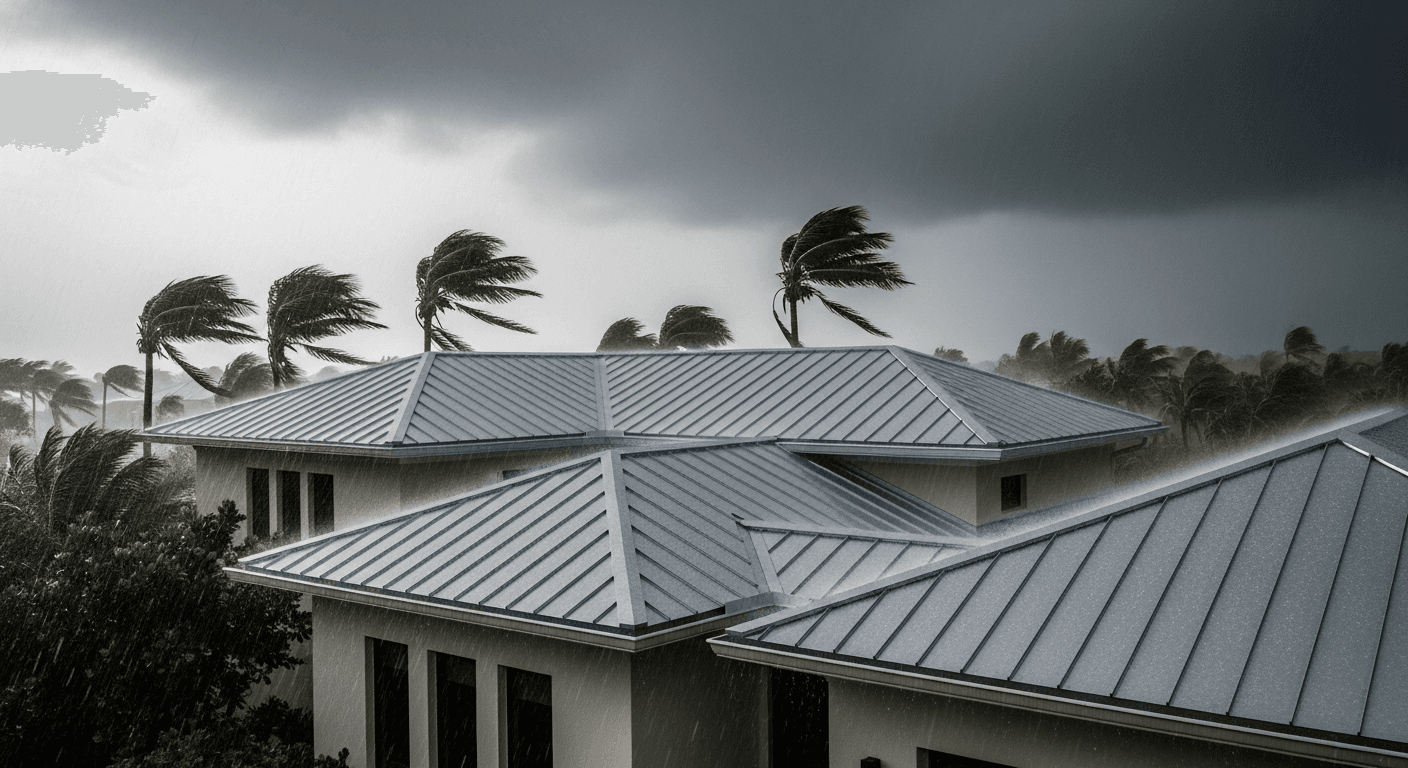
What "Hurricane Resistant" Actually Means in Miami-Dade
"Hurricane resistant" is a marketing term that contractors throw around constantly, but in Miami-Dade it has a specific legal definition. It means the roofing product carries a Miami-Dade Notice of Acceptance (NOA) from the county's Product Control Division, it's been tested to 180+ mph design wind speeds, and it passes the large missile impact test (a 9-pound 2x4 fired at 50 feet per second into the roof surface). Any product that doesn't meet all three requirements is not legally "hurricane resistant" in Miami, regardless of what the marketing says.
I install hurricane-resistant roofing systems across Miami-Dade every week. Standing seam aluminum, Miami-Dade NOA barrel tile, Class 4 impact-resistant shingles, and fully-adhered TPO systems are all legitimately hurricane resistant when installed correctly. Everything else is either non-HVHZ compliant or won't pass Miami-Dade inspection.
This post covers which materials actually qualify as hurricane-resistant under Miami-Dade standards, how installation quality affects real-world performance, and which products I recommend for different Miami neighborhoods and home types.
What Makes Roofing "Hurricane Resistant" in Miami
The term "hurricane resistant" has a specific, testable meaning in Miami-Dade County. A roofing system is hurricane resistant when it meets all of the following criteria:
- NOA certification: The product has passed Miami-Dade County's independent testing protocol
- 180+ mph wind rating: The system can withstand the HVHZ design wind speed without failure
- Large-missile impact resistance: The material survives impact from a 9-lb 2x4 fired at 50 feet per second
- Code-compliant installation: Installed per the manufacturer's NOA-specified methods by a licensed HVHZ contractor
- System integration: Works with compatible underlayment, fasteners, flashing, and structural connections
A roofing material that passes wind testing but fails impact testing is not hurricane resistant. A product with a valid NOA installed by a contractor who skips the specified fastener pattern is not hurricane resistant. The system only works when every component meets the standard.
Hurricane Resistant Roofing Materials Compared
Standing Seam Metal: Maximum Protection
Standing seam metal roofing delivers the highest measured hurricane resistance of any residential roofing material available in South Florida.
Why it leads:
- Interlocking panel seams create a monolithic surface with no individual pieces for wind to catch
- Concealed clip attachment distributes wind forces across the full deck area
- Panels cannot shatter into projectiles like tile or blow off individually like shingles
- Thermal expansion/contraction is accommodated by floating clips, preventing fatigue failures
Performance data:
| Specification | Rating |
|---|---|
| Wind resistance | 160 - 200+ mph |
| Impact rating | Excellent (dents but does not breach) |
| Weight per square | 100 - 150 lbs |
| Lifespan | 40 - 70 years |
| Installed cost | $12 - $22 per sq ft |
| NOA availability | Multiple manufacturers (Englert, ATAS, Berridge) |
Post-hurricane track record: After Hurricanes Andrew (1992), Wilma (2005), Irma (2017), and Ian (2022), post-storm damage surveys consistently found standing seam metal roofs had the lowest failure rates of any residential roofing type. FEMA post-disaster assessments have specifically noted standing seam metal's superior performance.
Ideal for: Coastal properties, homes in open exposure areas, homeowners seeking maximum long-term value, modern and contemporary architecture.
Concrete Tile: South Florida's Standard
Concrete tile dominates the Miami-Dade residential market and delivers strong hurricane performance when installed to current HVHZ specifications with mechanical fasteners.
Why it works:
- Mass (900-1,100 lbs per square) provides natural uplift resistance
- Durable against UV, salt air, and tropical climate degradation
- Wide availability of NOA-approved products from major manufacturers
- Repair-friendly, individual damaged tiles can be replaced
Performance data:
| Specification | Rating |
|---|---|
| Wind resistance | 150 - 180 mph (mechanically fastened) |
| Impact rating | Good (cracks under large impacts) |
| Weight per square | 900 - 1,100 lbs |
| Lifespan | 40 - 50 years |
| Installed cost | $10 - $18 per sq ft |
| NOA availability | Boral, Eagle, MonierLifetile |
Critical installation detail: Concrete tiles in the HVHZ must be mechanically fastened with wire ties, clips, or adhesive systems meeting the product NOA. Mortar-set installations do not meet current code and have dramatically higher failure rates in hurricanes. If your existing concrete tile roof is mortar-set, it is significantly more vulnerable than it appears.
Ideal for: Traditional South Florida homes, cost-conscious homeowners who want strong protection, neighborhoods where tile is the standard aesthetic.
Impact-Resistant Shingles: Budget Entry Point
Modern impact-resistant shingles provide genuine hurricane resistance at the lowest cost per square foot. The best products combine Class 4 impact resistance with enhanced wind warranties.
Performance data:
| Specification | Rating |
|---|---|
| Wind resistance | 130 - 150 mph |
| Impact rating | Class 4 (highest UL 2218 rating) |
| Weight per square | 200 - 350 lbs |
| Lifespan | 25 - 40 years |
| Installed cost | $6 - $12 per sq ft |
| NOA availability | Select product lines from GAF, Owens Corning, Atlas |
The honest assessment: Impact-resistant shingles are a legitimate hurricane-resistant option for Category 1 through 3 storms. However, their 130-150 mph wind rating means they have less margin of safety against Category 4 and 5 hurricanes compared to metal or tile. In the HVHZ, shingles must be installed with a minimum of 6 nails per shingle (versus the standard 4) to achieve rated wind performance.
Ideal for: Budget-conscious homeowners, lighter-framed structures that cannot support tile weight, neighborhoods where shingles are the standard aesthetic.
Clay Tile: Heritage With Performance
Clay tile roofing provides timeless aesthetics and respectable hurricane resistance, particularly popular in Coral Gables, Coconut Grove, Pinecrest, and Key Biscayne.
Performance data:
| Specification | Rating |
|---|---|
| Wind resistance | 125 - 150 mph |
| Impact rating | Moderate (more brittle than concrete) |
| Weight per square | 600 - 800 lbs |
| Lifespan | 50 - 75 years |
| Installed cost | $14 - $25 per sq ft |
| NOA availability | MCA, Ludowici, US Tile |
Ideal for: Historic and Mediterranean-style homes, neighborhoods with tile aesthetic requirements, homeowners prioritizing architectural character.
Flat Roof Systems: TPO and PVC
For flat and low-slope roofs common in mid-century modern Miami homes and commercial buildings:
| Specification | Rating |
|---|---|
| Wind resistance | 100 - 140 mph (fully adhered) |
| Impact rating | Good (flexible, absorbs energy) |
| Lifespan | 20 - 30 years |
| Installed cost | $7 - $14 per sq ft |
Fully adhered systems outperform mechanically attached systems in hurricanes because they eliminate the flutter effect that peels membranes in high winds.
Installation Factors That Determine Real-World Performance
The materials above achieve their rated wind resistance only when installed correctly. These installation factors determine whether your roof reaches its potential:
Roof Deck Attachment
The deck is the foundation for everything above it:
- Ring-shank nails: Required in the HVHZ; resist withdrawal 40% better than smooth-shank
- Nail spacing: 6 inches on center at panel edges in field zones, 4 inches in perimeter and corner zones
- Plywood vs. OSB: Both are code-compliant, but plywood holds nails better when wet
- Panel staggering: Avoid aligned joints that create continuous weak lines
Secondary Water Barrier
Required on all new and re-roofing projects in the HVHZ:
- Self-adhering modified bitumen membrane over the entire deck or at all panel joints
- Provides waterproofing even if all primary roofing material is removed by wind
- Adds $1.50 to $3.00 per square foot but prevents $30,000+ in interior damage
Structural Connections
Your roofing material cannot perform if the roof structure fails:
- Hurricane straps at every truss-to-wall connection: Continuous straps preferred over clips
- Ring beam at wall tops: Provides solid anchor for roof connections in masonry construction
- Truss bracing: Lateral and diagonal bracing prevents domino collapse
Edge and Corner Treatment
Roof edges and corners experience 2 to 3 times the wind pressure of the center field:
- Enhanced fastening schedules in perimeter and corner zones
- Metal drip edge face-nailed and sealed
- Starter strips cemented to deck on shingle roofs
- Wind clips at tile eaves locking first course to fascia
Cost vs. Protection Analysis
For a typical 2,000 sq ft Miami-Dade home, here is the full cost comparison including all system components:
| System | Material + Install | Straps Retrofit | SWB | Total | Annual Insurance Savings | 30-Year Net Cost |
|---|---|---|---|---|---|---|
| Impact Shingles | $12,000-$24,000 | $2,000-$5,000 | $3,000-$6,000 | $17,000-$35,000 | $1,000-$3,000 | -$13,000 to +$5,000 |
| Concrete Tile | $20,000-$36,000 | $2,000-$5,000 | $3,000-$6,000 | $25,000-$47,000 | $1,500-$4,500 | -$20,000 to +$2,000 |
| Standing Seam Metal | $24,000-$44,000 | $2,000-$5,000 | $3,000-$6,000 | $29,000-$55,000 | $2,000-$6,000 | -$31,000 to +$25,000 |
| Clay Tile | $28,000-$50,000 | $2,000-$5,000 | $3,000-$6,000 | $33,000-$61,000 | $1,500-$4,500 | -$16,000 to +$26,000 |
*30-year net cost = total installed cost minus cumulative insurance savings over 30 years. Negative numbers indicate the insurance savings exceed the cost.*
The analysis shows that hurricane resistant roofing, when you account for insurance wind mitigation credits, is often less expensive over its lifespan than non-resistant alternatives that carry higher premiums and have shorter lifespans.
Insurance Benefits of Hurricane Resistant Roofing
Florida law requires insurers to provide wind mitigation credits for hurricane resistant features. A Wind Mitigation Inspection verifying your roof qualifies can generate these annual savings:
- FBC-compliant roof covering: 5% to 15% premium reduction
- Enhanced deck attachment: 5% to 10% reduction
- Hurricane strap connections: 10% to 30% reduction
- Secondary water barrier: 5% to 10% reduction
- Hip roof geometry: Additional credit
- Combined maximum: 20% to 45% reduction in wind premium
On a Miami-Dade County homeowners policy with a typical wind premium of $5,000 to $15,000, these credits save $1,000 to $6,750 per year.
Choosing the Right Hurricane Resistant Roof for Your Home
Consider these factors in order of importance:
- Structural capacity: Can your home's framing support the material's weight? Concrete and clay tile require significantly stronger framing than metal or shingles.
- Budget: What is your upfront budget, and how do you weigh long-term savings? Metal costs more upfront but saves more over time.
- Risk tolerance: Do you want Category 3 protection (shingles) or Category 5 protection (metal)?
- Aesthetic requirements: HOA rules, historic district guidelines, or personal preference may narrow your options.
- Maintenance commitment: Metal requires the least maintenance; tile requires periodic inspection for cracked or shifted units.
Whatever material you choose, ensure it carries a valid Miami-Dade NOA, is installed by a licensed HVHZ contractor, and includes a secondary water barrier over the full deck. These three factors are non-negotiable for genuine hurricane resistance in Miami.
Extreme Roofing Inc. installs all major hurricane resistant roofing systems across Miami-Dade, Broward, and Palm Beach counties. We use only NOA-approved materials and provide full documentation for your wind mitigation inspection.
Call 305-225-1535 or request a free estimate to discuss hurricane resistant roofing options for your home.
Frequently Asked Questions
What is the most hurricane resistant roofing material for Miami?
Standing seam metal roofing is the most hurricane resistant material available, with tested wind ratings of 160 to 200+ mph and the lowest post-hurricane failure rates in FEMA damage assessments. Its interlocking panel design and concealed clip system distribute wind forces across the entire deck. Mechanically fastened concrete tile is the second-best performer at 150 to 180 mph.
How much does hurricane resistant roofing cost in Miami?
A complete hurricane resistant roofing system for a 2,000 sq ft Miami home costs $17,000 to $35,000 for impact shingles, $25,000 to $47,000 for concrete tile, $29,000 to $55,000 for standing seam metal, or $33,000 to $61,000 for clay tile. These costs include the roof covering, secondary water barrier, and hurricane strap retrofit. Insurance wind mitigation credits of $1,000 to $6,750 per year offset these costs significantly.
Do hurricane resistant shingles really work in Miami?
Impact-resistant shingles rated Class 4 with 130 to 150 mph wind ratings provide genuine hurricane resistance for Category 1 through 3 storms. They must be installed with 6 nails per shingle in the HVHZ to achieve rated performance. However, for Category 4 and 5 protection in Miami-Dade County, standing seam metal or mechanically fastened concrete tile provides a wider safety margin.
Can I save on insurance with hurricane resistant roofing in Florida?
Yes, Florida law requires insurers to offer wind mitigation credits for hurricane resistant features. A fully compliant HVHZ roof with proper deck attachment, hurricane straps, and a secondary water barrier can reduce your wind premium by 20% to 45%. On a typical Miami-Dade policy, that translates to $1,000 to $6,750 in annual savings that compound over the 30 to 70 year life of the roof.
Need Roofing Help?
Whether you need an inspection, repair, or full replacement, our team of licensed roofing professionals is ready to help. Serving South Florida since 2004.
Related Articles
Understand which roofing materials are approved for Miami-Dade County HVHZ installation, how the NOA system works, and why using non-approved products puts your home at risk.
Read MoreLearn how to identify hurricane roof damage in Miami, document it properly for insurance claims, and choose the right repair strategy for your South Florida home.
Read MoreEverything Miami homeowners need to know about storm damage roof repair, from emergency response and insurance claims to choosing a licensed contractor and understanding repair timelines.
Read More