
Storm Damage Roof Repair in Miami: Complete Homeowner's Guide
The Right Way to Handle Storm Damage Roof Repair in Miami
Storm damage roof repair in Miami is a minefield for homeowners who don't know the local rules. Between the HVHZ code requirements, Florida's 25 percent rule, insurance claim traps, and storm chasers descending on Miami after every hurricane, there are a dozen ways to get this wrong. I've watched hundreds of Miami homeowners make expensive mistakes trying to rush their storm damage repairs.
I've been handling Miami storm damage work since 2004, through Andrew aftermath cleanup, Katrina, Wilma, Irma, Michael, and Ian. The process that works is always the same: document everything first, file the insurance claim properly, hire a licensed local contractor, insist on HVHZ-code-compliant materials, and never pay cash upfront for repairs. Do those five things and you'll navigate storm damage repair successfully. Skip any of them and you'll regret it.
This post covers the complete storm damage repair process for Miami homeowners, including how to find a real contractor, how to handle insurance, and how to avoid the most common scams.
The Storm Damage Repair Process: Step by Step
Step 1: Emergency Stabilization (0 to 48 Hours)
The first priority after any storm that damages your roof is preventing additional damage. In Miami's climate, where afternoon thunderstorms can dump inches of rain within hours, even a small roof breach can lead to catastrophic interior water damage.
Emergency stabilization includes:
- Roof tarping to cover exposed areas (learn more about emergency tarping)
- Board-up of damaged skylights, vents, or structural openings
- Interior water mitigation, buckets, fans, dehumidifiers, wet insulation removal
- Electrical safety, turning off power to affected areas where water contacts wiring
Professional emergency tarping in Miami typically costs $500 to $2,500 depending on the area covered. These costs are usually covered by your homeowners insurance as part of the temporary repair provision.
Step 2: Documentation and Insurance Filing (24 to 72 Hours)
Before any permanent repair work begins, complete documentation is essential:
- Photograph all damage from multiple angles with scale references
- Record a narrated video walkaround of the exterior and interior
- Create a written inventory of all damaged areas and materials
- File your insurance claim immediately, even before full assessment is complete
- Request your claim number and assigned adjuster's contact information
Your insurance company is required to acknowledge your claim within 14 days and make a coverage decision within 90 days under Florida law. However, after major hurricanes, these timelines can stretch significantly.
Step 3: Professional Inspection and Estimate (1 to 3 Weeks)
A licensed roofing contractor should perform a detailed inspection that includes:
- Complete roof surface evaluation via ladder access or drone
- Decking assessment by checking for soft spots, water saturation, and structural integrity
- Underlayment inspection where accessible
- Flashing and penetration evaluation at every vent, pipe, and edge
- Structural assessment of visible truss and rafter connections
- Moisture mapping using infrared technology to detect trapped water
The contractor's written estimate should itemize every component, including:
| Estimate Line Item | What It Covers |
|---|---|
| Tear-off and disposal | Removing damaged materials |
| Deck repair or replacement | OSB or plywood panels, ring-shank nails |
| Underlayment and SWB | Secondary water barrier, synthetic underlayment |
| Roof covering | Tiles, shingles, metal panels (NOA-approved) |
| Flashing | Drip edge, valley, wall, vent, and chimney flashing |
| Ridge and hip | Cap tiles, ridge vent, hip materials |
| Accessories | Vents, pipe boots, skylight re-seal |
| Permit and inspection | Miami-Dade County building permit fees |
Step 4: Insurance Adjuster Coordination (2 to 6 Weeks)
Your insurance company will send an adjuster to inspect the damage. Best practices for this visit:
- Have your contractor present to walk the adjuster through all damage areas
- Provide your documentation, photos, video, written inventory, contractor estimate
- Point out hidden damage that may not be visible on a surface inspection
- Ask for the adjuster's line-item estimate before they leave
- Compare the adjuster's estimate to your contractor's estimate item by item
If the adjuster's estimate is significantly lower than your contractor's, you have the right to:
- Request a re-inspection with a different adjuster
- Submit a supplemental claim with additional documentation
- Hire a public adjuster to negotiate on your behalf
- File a complaint with the Florida Department of Financial Services
- Invoke the appraisal clause in your policy for disputed amounts
Step 5: Repair Execution (2 to 8 Weeks)
Once your claim is approved and your contractor is scheduled, the repair process follows Miami-Dade County's required sequence:
- Permit application with NOA-approved product specifications
- Material procurement (lead times vary; 1 to 4 weeks after major storms)
- Tear-off of damaged materials and deck inspection
- Deck inspection by Miami-Dade County (required before proceeding)
- Deck repair or replacement as needed
- Secondary water barrier and underlayment installation
- Dry-in inspection by Miami-Dade County (required before roof covering)
- Roof covering installation per NOA specifications
- Flashing, accessories, and detail work
- Final inspection by Miami-Dade County
Skipping any of these steps, particularly the county inspections, creates serious legal, insurance, and safety risks.
Common Storm Damage Repair Scenarios in Miami
Scenario 1: Scattered Tile Damage (Minor)
Typical cause: Wind-driven debris impact, minor uplift
Repair scope: 10 to 50 individual tiles replaced
Estimated cost: $1,500 to $5,000
Timeline: 1 to 2 weeks after materials arrive
Insurance: Often falls within or near your hurricane deductible
The challenge with tile repair is matching. Concrete and clay tiles weather and fade over time, and new tiles may not match the existing roof. An experienced contractor can source close matches or strategically relocate visible tiles to minimize color differences.
Scenario 2: Section Damage With Underlayment Breach (Moderate)
Typical cause: Sustained wind uplift removed tiles and tore underlayment in one area
Repair scope: One or two roof slopes, including deck repair and new underlayment
Estimated cost: $8,000 to $20,000
Timeline: 2 to 4 weeks
Insurance: Typically exceeds hurricane deductible; strong claim
This scenario requires careful assessment of the deck underneath the removed materials. If the plywood or OSB has been exposed to rain for more than 48 hours, it may need replacement. Ring-shank nails at HVHZ spacing must be used for all deck panel re-attachment.
Scenario 3: Major Structural Damage (Severe)
Typical cause: Category 3+ winds, failed roof-to-wall connections, major tree strike
Repair scope: Full roof replacement plus structural framing repairs
Estimated cost: $25,000 to $60,000+
Timeline: 4 to 12 weeks
Insurance: Major claim; consider public adjuster
Structural damage almost always triggers the 25% rule, requiring the entire roof to meet current Florida Building Code HVHZ standards. While this increases cost, it also means your entire roof will carry the highest wind and impact ratings available, and you will qualify for maximum insurance wind mitigation credits.
Choosing a Storm Damage Repair Contractor in Miami
After every major storm, Miami-Dade County is flooded with out-of-state contractors, many unlicensed, uninsured, and unfamiliar with HVHZ requirements. Choosing the wrong contractor can result in failed inspections, voided insurance coverage, and a roof that will not survive the next storm.
Contractor Verification Checklist
- Florida roofing contractor license: Verify at myfloridalicense.com
- Active liability insurance: Minimum $1 million general liability
- Workers compensation insurance: Required in Florida for roofing contractors
- Miami-Dade County registration: Contractor must be registered to pull permits in the county
- HVHZ experience: Ask specifically about NOA product knowledge and HVHZ installation methods
- Local references: At least 5 completed projects within 20 miles
- Written warranty: Minimum 5-year workmanship warranty in addition to manufacturer warranties
Red Flags to Avoid
- Contractors who knock on your door unsolicited after a storm
- Cash-only payment demands or requests for full payment upfront
- Offers to cover your insurance deductible (this is fraud in Florida)
- Pressure to sign an Assignment of Benefits (AOB) immediately
- No local business address or out-of-state phone numbers
- Inability to provide a Florida contractor license number
- Quotes significantly lower than other licensed contractors
Payment Structure
Standard payment terms for storm damage roof repair in Miami:
- Deposit: 10% to 33% upon contract signing (never more than one-third)
- Progress payment: 33% to 40% at dry-in inspection completion
- Final payment: Remaining balance upon final inspection and your satisfaction
Never pay the full amount before the final inspection is passed. Florida law provides specific protections for homeowners regarding contractor payments.
Storm Damage Repair Costs in Miami-Dade County (2025-2026)
| Repair Type | Cost Range | Notes |
|---|---|---|
| Individual tile replacement | $25 - $50 per tile | Plus labor; matching tiles may cost more |
| Shingle section repair | $350 - $700 per square | Includes tear-off and new materials |
| Flashing repair | $200 - $800 per area | Depends on location and complexity |
| Deck repair (plywood) | $3 - $5 per sq ft | OSB or plywood with ring-shank nails |
| Ridge/hip cap replacement | $15 - $30 per linear ft | Mortar or mechanical attachment |
| Emergency tarping | $500 - $2,500 | Based on area covered |
| Full replacement (shingles) | $6 - $12 per sq ft | Including all layers and permits |
| Full replacement (tile) | $10 - $18 per sq ft | Including all layers and permits |
| Full replacement (metal) | $12 - $22 per sq ft | Including all layers and permits |
These ranges reflect current pricing in Miami-Dade and Broward counties. After major hurricanes, expect prices to increase 15% to 30% due to demand and material shortages.
Timeline Expectations After a Major Storm
| Phase | Normal Conditions | After Major Hurricane |
|---|---|---|
| Emergency tarping | 1-3 days | 3-14 days |
| Insurance adjuster visit | 1-2 weeks | 2-8 weeks |
| Claim approval | 2-4 weeks | 4-12 weeks |
| Material procurement | 1-2 weeks | 2-8 weeks |
| Permit processing | 1-2 weeks | 2-6 weeks |
| Repair execution | 1-3 weeks | 2-6 weeks |
| Total | 6-14 weeks | 12-40+ weeks |
After Hurricane Irma in 2017, some Miami-Dade homeowners waited 8 to 12 months for permanent roof repairs due to contractor backlogs, material shortages, and insurance delays.
Preventive Measures for Future Storms
Once your storm damage repair is complete, invest in prevention:
- Schedule annual roof inspections before June 1 each year
- Upgrade to [hurricane-resistant materials](/blog/hurricane-resistant-roofing-miami) if your current roof is near end-of-life
- Install hurricane straps if your home lacks proper roof-to-wall connections
- Add a secondary water barrier during any re-roofing project
- Maintain detailed documentation of your roof's condition for future claims
- Review your insurance annually to ensure adequate coverage
Extreme Roofing Inc. has been repairing storm-damaged roofs across Miami-Dade, Broward, and Palm Beach counties since 2004. We carry all required licenses and insurance, use only Miami-Dade approved materials, and stand behind every repair with our workmanship warranty.
Call Extreme Roofing Inc. at 305-225-1535 or request a free estimate to schedule your storm damage inspection.
Frequently Asked Questions
How long does storm damage roof repair take in Miami?
Under normal conditions, storm damage roof repair in Miami takes 6 to 14 weeks from initial damage through completed permanent repair. After a major hurricane, timelines extend to 12 to 40 weeks or longer due to contractor demand, material shortages, insurance delays, and permit backlogs. Emergency tarping provides temporary protection within the first 1 to 3 days while permanent repairs are planned.
Should I use my insurance or pay out of pocket for storm damage roof repair?
Always file an insurance claim for storm damage, even if you think the damage is minor. Your policy covers both temporary emergency repairs and permanent repairs. The only scenario where paying out of pocket might make sense is when the total repair cost is close to or less than your hurricane deductible, typically 2% to 5% of your dwelling coverage. A $400,000 home with a 2% deductible would have an $8,000 deductible.
Do I need a permit for storm damage roof repair in Miami-Dade County?
Yes, most storm damage roof repairs in Miami-Dade County require a building permit. Full replacements, structural repairs, and repairs exceeding approximately 100 square feet require permits. Emergency temporary repairs like tarping do not require permits, but all permanent work does. Your contractor should handle the permit process as part of their scope of work.
What happens if my storm damage repair triggers the 25% rule?
If storm damage repairs involve more than 25% of your total roof area in Miami-Dade County, the entire roof must be brought up to current Florida Building Code HVHZ standards. While this increases the project scope and cost, it also means your entire roof will meet the latest 180+ mph wind rating requirements and you will qualify for maximum insurance wind mitigation credits that can save $1,000 to $6,750 per year.
How do I avoid storm chaser roofing scams after a hurricane in Miami?
Verify the contractor's Florida license at myfloridalicense.com, confirm active liability and workers compensation insurance, check for a local business address, get a written estimate before any work begins, never pay more than one-third upfront, and refuse any offer to cover your insurance deductible. Legitimate contractors like Extreme Roofing Inc. have verifiable local history and do not pressure you into immediate decisions.
Need Roofing Help?
Whether you need an inspection, repair, or full replacement, our team of licensed roofing professionals is ready to help. Serving South Florida since 2004.
Related Articles
Learn how to identify hurricane roof damage in Miami, document it properly for insurance claims, and choose the right repair strategy for your South Florida home.
Read MoreYour Miami roof is leaking or damaged, here is exactly what to do. Step-by-step emergency roof repair guide covering safety, temporary fixes, insurance, and finding a licensed contractor fast.
Read More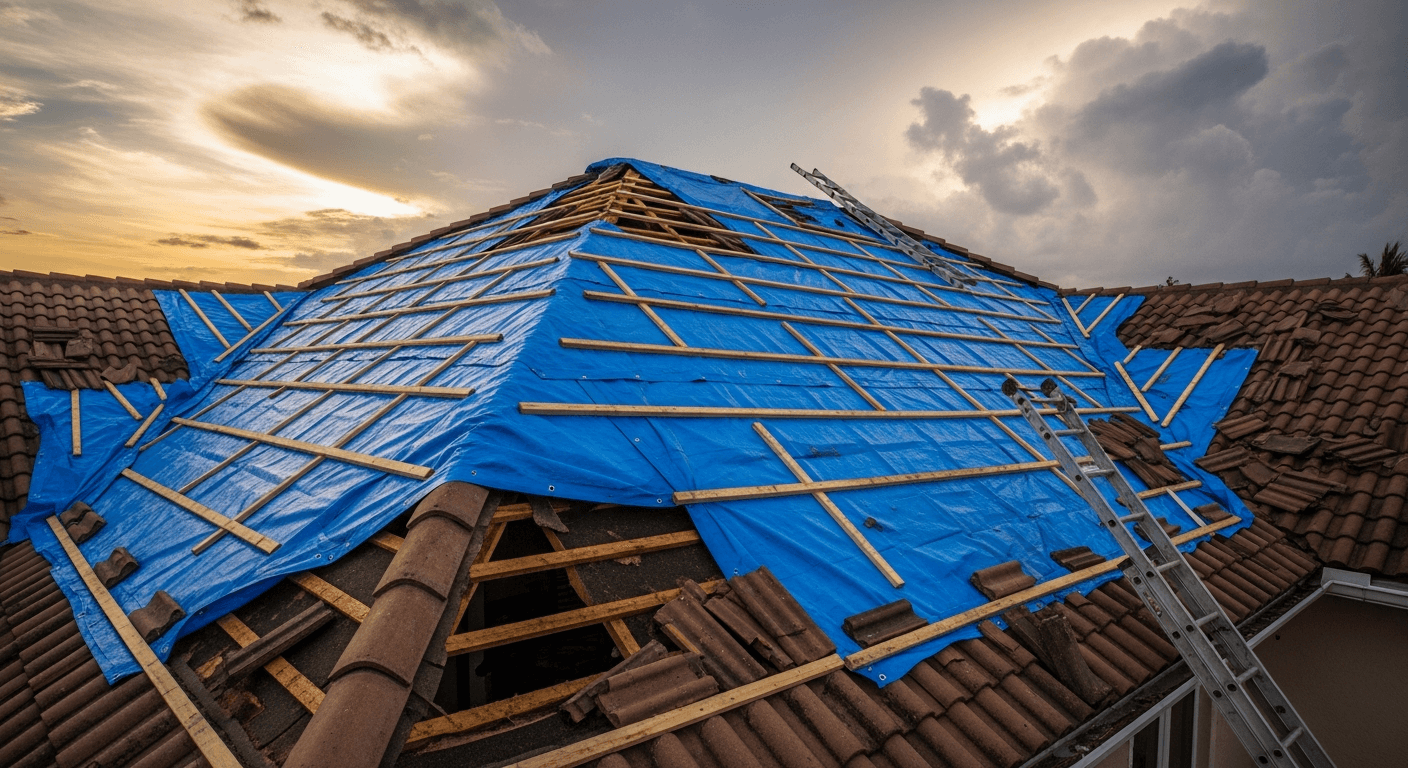
Everything you need to know about emergency roof tarping in Miami, costs, methods, DIY vs. professional, FEMA Blue Roof program, and how to ensure your tarp survives until permanent repairs.
Read More