
Hurricane Roof Damage in Miami: Identifying, Documenting, and Repairing Storm Damage
What Hurricane Damage Actually Looks Like on a Miami Roof
I've inspected hundreds of hurricane-damaged roofs across Miami-Dade after Irma in 2017, Michael in 2018, and Ian in 2022. The damage isn't always what homeowners expect. It can range from obvious catastrophic loss (entire sections of roof peeled off) to subtle damage that's nearly invisible from the ground but still voids your warranty and compromises your roof's performance in the next storm.
Understanding what hurricane damage actually looks like on Miami roofs is the first step toward filing a successful insurance claim and getting the right repairs done. A lot of the damage I find on post-hurricane inspections didn't make it into the original insurance claim because the homeowner didn't know to look for it. That becomes a problem 6 months later when a new leak shows up and the carrier denies the supplemental claim.
This post walks through the specific damage patterns I look for on every post-hurricane inspection, broken down by roofing material: what's visible from the ground, what requires a roof walk, and what only shows up in the attic or after the next storm.
Types of Hurricane Roof Damage in Miami
Hurricane-force winds do not damage every roof the same way. The type, age, and installation quality of your roofing material, combined with your home's specific wind exposure, determine which damage patterns you will see after a storm.
Wind Uplift Damage
Wind uplift is the primary mechanism of hurricane roof damage. During a hurricane, wind flowing over and around your roof creates negative pressure (suction) on the leeward side and at edges and corners. This suction force tries to pull roofing materials, and sometimes the entire roof structure, upward and away from the building.
Signs of wind uplift damage include:
- Lifted, curled, or creased shingles that are no longer flat against the deck
- Displaced or shifted tiles that have moved from their original position
- Exposed underlayment where roofing materials have been partially or fully removed
- Lifted flashing around vents, chimneys, skylights, and roof edges
- Ridge cap displacement along the peak of the roof
Wind uplift damage is most severe in the three high-pressure zones defined by building engineers: roof corners (highest pressure), perimeter edges, and the ridge line. If you see damage concentrated in these areas, your roof experienced textbook hurricane wind forces.
Impact Damage From Debris
Flying debris during a hurricane acts like projectiles, and the impact energy increases exponentially with wind speed. At 130 mph, a standard roof tile weighs the equivalent of a bowling ball in terms of kinetic energy.
Common impact damage includes:
- Cracked or shattered tiles from falling tree limbs or airborne debris
- Punctured shingles or decking from nails, wood fragments, or metal
- Dented metal roofing from large hail or debris strikes
- Damaged or destroyed roof vents, turbines, and skylights
- Bent or torn gutters and fascia from branch strikes
Impact damage is often random across the roof surface, unlike wind uplift which follows predictable patterns at edges and corners. A single large branch can cause $5,000 to $15,000 in localized damage even if the rest of the roof is intact.
Water Intrusion Damage
Every breach in your roof surface during a hurricane becomes an entry point for water. Miami hurricanes routinely dump 6 to 12 inches of rain in a 12-hour period, and wind-driven rain can force water upward and sideways through gaps that would never leak under normal rainfall.
Water intrusion damage includes:
- Saturated attic insulation that has absorbed water and lost its thermal value
- Water-stained ceilings and walls in rooms below the damage
- Swollen or delaminated roof decking (particularly OSB, which deteriorates rapidly when wet)
- Mold growth that begins within 24 to 48 hours in Miami's tropical humidity
- Electrical system damage where water contacts wiring, outlets, or panels
Water intrusion damage often costs more than the roof damage itself. A $3,000 roof repair can easily generate $15,000 to $30,000 in interior water damage if not addressed within the first 48 hours.
Structural Damage
Structural damage occurs when hurricane forces overwhelm the roof framing system. This is the most serious and expensive category of damage.
- Broken or displaced trusses that have shifted under wind load
- Failed roof-to-wall connections where hurricane straps or clips have pulled loose
- Sagging roofline visible from the ground
- Partial or complete roof loss where large sections of the roof structure have been torn away
- Collapsed sections where water weight on damaged decking caused failure
Structural damage almost always requires a complete re-roofing project rather than spot repairs, and it typically triggers the Miami-Dade County 25% rule requiring full code compliance.
How to Inspect Your Roof After a Hurricane
Ground-Level Assessment (Safe for Homeowners)
Never climb on your roof after a hurricane. Instead, perform a thorough ground-level inspection:
- Walk the perimeter of your home and photograph all four sides of the roofline
- Look for missing materials, gaps in the tile or shingle pattern, exposed dark underlayment, or visible decking
- Check for debris on the roof including tree branches, neighbor's building materials, or other objects
- Examine the gutters for detached sections, bending, or blockage
- Inspect soffits for cracks, holes, or complete panel loss
- Look at the ground for roofing materials, nails, flashing pieces, or tile fragments
Attic Inspection (Proceed With Caution)
If it is safe to access your attic:
- Look for daylight penetrating through the roof deck, any visible light means a breach exists
- Check for water stains on the underside of the decking or on truss members
- Feel the insulation for moisture
- Look for shifted or cracked trusses
- Note any sagging in the roof deck between supports
Professional Inspection
A licensed roofing contractor should perform a complete roof inspection within one to two weeks of any hurricane. Professional inspections include:
- Drone or aerial assessment for safe, comprehensive roof surface evaluation
- Moisture mapping using infrared scanning to detect trapped water
- Structural evaluation of the decking, trusses, and connections
- Written damage report with measurements, photos, and repair recommendations
- Cost estimates for both repair and replacement options
At Extreme Roofing Inc., our post-hurricane inspections include a detailed written report with photo documentation that is formatted for insurance submission. We have performed thousands of storm damage assessments across Miami-Dade County since 2004.
Documenting Hurricane Roof Damage for Insurance
Thorough documentation is the difference between a fair insurance settlement and a denied or underpaid claim. Follow this protocol:
Before Temporary Repairs
| Documentation Step | Details |
|---|---|
| Wide-angle exterior photos | All four sides of your home showing full roofline |
| Close-up damage photos | Each damaged area with a ruler or coin for scale |
| Interior damage photos | Water stains, wet insulation, damaged belongings |
| Video walkaround | Continuous narrated video with date spoken aloud |
| Written damage list | Room-by-room inventory of all visible damage |
| Receipts and records | Previous inspection reports, maintenance receipts |
After Temporary Repairs
- Photograph the temporary repair (tarp, patch, board-up)
- Keep all receipts for materials and labor
- Document the date and time of temporary repairs
- Note who performed the work and their contact information
Insurance Filing Tips
- File your claim within 24 to 48 hours of the storm, even if you have not assessed all damage
- Request your adjuster's name, direct phone number, and claim number in writing
- Do not accept a final settlement until all damage has been identified
- Consider hiring a public adjuster for claims exceeding $20,000
Repair vs. Replacement: Making the Right Decision
When Repair Is Appropriate
Targeted repairs make sense when:
- Damage is limited to less than 25% of the total roof area
- The roof structure (decking, trusses, connections) is intact
- Your roof is less than 10 years old with significant remaining lifespan
- Matching materials are available for a seamless repair
- The existing roof was properly installed to current code
Typical repair costs for hurricane damage in Miami-Dade County:
- Shingle repair (per square): $350 to $700
- Tile replacement (per square): $600 to $1,200
- Flashing repair: $200 to $800 per area
- Ridge cap replacement: $15 to $30 per linear foot
- Vent or skylight repair: $300 to $1,500
When Replacement Is Necessary
A full roof replacement is required when:
- Damage exceeds 25% of the total roof area (triggering Miami-Dade's code compliance rule)
- Structural damage has compromised the deck or truss system
- The roof was already near end-of-life before the hurricane
- Multiple previous repairs have created a patchwork that cannot be reliably sealed
- Your insurance settlement covers replacement and you want maximum long-term value
Full replacement costs in Miami-Dade County (2025-2026):
| Roofing Material | Cost Per Sq Ft | 2,000 Sq Ft Home |
|---|---|---|
| Impact-resistant shingles | $6 - $12 | $12,000 - $24,000 |
| Concrete tile | $10 - $18 | $20,000 - $36,000 |
| Standing seam metal | $12 - $22 | $24,000 - $44,000 |
| Clay tile | $14 - $25 | $28,000 - $50,000 |
Working With Your Insurance Company
Florida homeowner insurance claims after hurricanes follow a specific process:
- File immediately, do not wait for a complete damage assessment
- Document everything before making temporary repairs
- Get multiple contractor estimates (minimum two)
- Attend the adjuster inspection with your contractor if possible
- Review the adjuster's estimate line by line against your contractor's assessment
- Negotiate if underpaid, you have the right to dispute and supplement claims
- Understand your hurricane deductible, typically 2% to 5% of dwelling coverage in Florida
If your claim is denied or significantly underpaid, you have several options: filing a complaint with the Florida Department of Financial Services, hiring a public adjuster (10% to 15% of claim value), or consulting with a property damage attorney.
Protect Your Miami Home
Hurricane roof damage is not a question of if, but when, for South Florida homeowners. The homes that recover fastest are those with pre-storm documentation, quality roofing materials, and a relationship with a trusted local contractor who will be available when the storm passes.
Whether you need a post-hurricane inspection, storm damage repair, or a consultation on upgrading to hurricane-resistant materials, Extreme Roofing Inc. has been protecting Miami-Dade homeowners since 2004.
Call Extreme Roofing Inc. at 305-225-1535 or request a free estimate to schedule your roof assessment.
Frequently Asked Questions
How do I know if my roof has hurricane damage that I cannot see from the ground?
Many types of hurricane roof damage are invisible from the ground, including lifted shingle tabs, hairline tile cracks, loosened flashing seals, and compromised underlayment. A professional inspection using drone assessment and infrared moisture mapping can detect hidden damage. Signs to watch for inside include new water stains, musty odors, or daylight visible in the attic. Schedule a professional inspection within two weeks of any hurricane.
How much does hurricane roof damage repair cost in Miami?
Hurricane roof repair costs in Miami-Dade County range from $500 to $5,000 for minor repairs like replacing a few tiles or shingles, $5,000 to $15,000 for moderate repairs involving multiple areas and flashing work, and $15,000 to $50,000 or more for major repairs or full replacement. Your actual cost depends on the extent of damage, roofing material, roof size, and whether the 25% replacement rule is triggered.
Will my insurance cover hurricane roof damage in Florida?
Most Florida homeowners insurance policies cover wind damage from hurricanes, subject to a separate hurricane deductible typically ranging from 2% to 5% of your dwelling coverage. Coverage may be limited for roofs over 15 years old or those not meeting current building codes. Document all damage thoroughly before making temporary repairs and file your claim within 48 hours of the storm.
What is the 25% rule for roof replacement in Miami-Dade County?
The Miami-Dade County 25% rule states that if roof repairs or replacement involve more than 25% of the total roof area, the entire roof must be brought up to current Florida Building Code standards. This can significantly increase the scope and cost of a repair project, but it also means your entire roof will meet the latest HVHZ wind resistance and impact requirements.
Need Roofing Help?
Whether you need an inspection, repair, or full replacement, our team of licensed roofing professionals is ready to help. Serving South Florida since 2004.
Related Articles
Everything Miami homeowners need to know about storm damage roof repair, from emergency response and insurance claims to choosing a licensed contractor and understanding repair timelines.
Read MoreYour Miami roof is leaking or damaged, here is exactly what to do. Step-by-step emergency roof repair guide covering safety, temporary fixes, insurance, and finding a licensed contractor fast.
Read More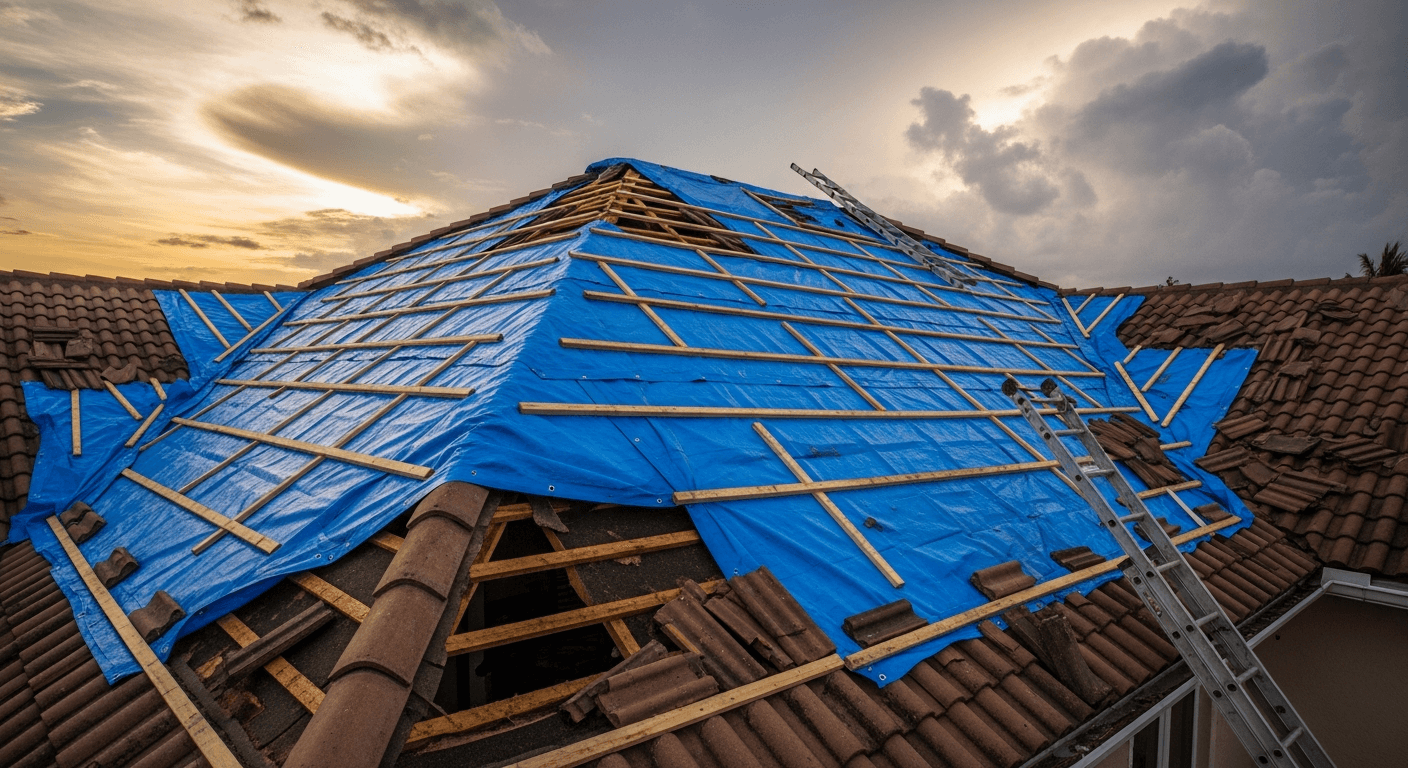
Everything you need to know about emergency roof tarping in Miami, costs, methods, DIY vs. professional, FEMA Blue Roof program, and how to ensure your tarp survives until permanent repairs.
Read More