Miami-Dade Approved Roofing Materials: NOA Requirements and Product Guide
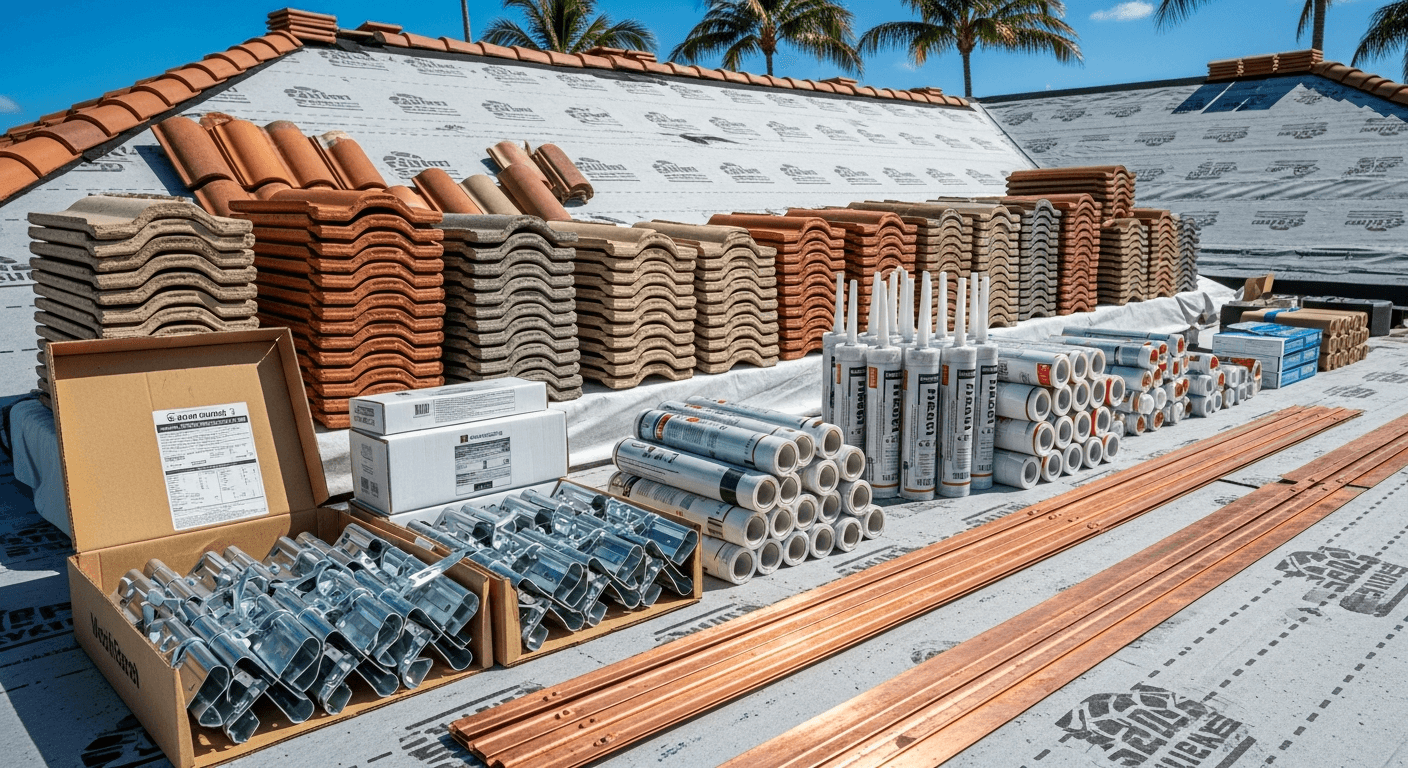
How to Verify Your Miami Roofing Materials Are NOA-Approved
Miami-Dade has the strictest roofing material approval system in the United States. Every product installed on a Miami-Dade roof (from the deck nails to the ridge cap to the underlayment to the main roofing surface) needs a Notice of Acceptance (NOA) from the county's Product Control Division. The NOA confirms the product was tested, meets the HVHZ wind and impact standards, and is legally installable within Miami-Dade.
Here's what most Miami homeowners don't realize: contractors can and do use non-NOA products on jobs and hope the inspector doesn't catch it. When they do get caught, the homeowner pays for the tear-off and re-install. When they don't get caught, the homeowner has a roof that's not legally compliant, won't qualify for insurance credits, and may not perform as advertised in the next hurricane.
This post covers exactly how the NOA system works in 2026, how to verify any product has a valid current NOA, the specific NOA numbers for the most common Miami-Dade approved products, and what happens when contractors use non-NOA materials.
What Is the Notice of Acceptance (NOA)?
The NOA is Miami-Dade County's proprietary product testing and approval system. It is separate from and more stringent than the standard Florida Product Approval (FL number) that applies to the rest of the state.
How a Product Earns an NOA
- Application: The manufacturer submits their product for evaluation by the Miami-Dade County Product Control Division
- Independent testing: The product undergoes testing at an accredited laboratory, not the manufacturer's own facility
- Wind resistance testing: Products must withstand design pressures calculated for 180+ mph wind speeds
- Impact testing: Products must survive large-missile impact (a 9-lb 2x4 lumber piece fired at 50 ft/sec)
- Cyclic loading: Products are tested under repeated pressure cycles simulating sustained hurricane conditions
- Documentation review: Installation instructions, material specifications, and quality control procedures are evaluated
- Approval and publication: If all criteria are met, the NOA is issued and published in the county's searchable database
What an NOA Document Contains
Each NOA specifies:
- Product identification: Exact manufacturer, product name, model numbers, and approved variations
- Approved applications: Building types, roof slopes, height limitations, and zone locations where the product may be used
- Design pressures: Maximum positive and negative pressures the product can withstand in field, perimeter, and corner zones
- Installation requirements: Exact fastener types, fastener spacing, attachment patterns, and substrate requirements
- Compatible components: Which underlayments, sealants, fasteners, and accessories may be used with the product
- Expiration date: NOAs must be renewed periodically; expired NOAs are invalid
NOA vs. Florida Product Approval (FL Number)
| Feature | NOA (Miami-Dade) | FL Number (Rest of Florida) |
|---|---|---|
| Testing standard | HVHZ-specific protocols | Standard FBC protocols |
| Wind speed design | 180+ mph | 130-160 mph (varies by location) |
| Impact testing | Large-missile required | Required in WBDR only |
| Cyclic testing | Required | Not always required |
| Where valid | Miami-Dade + South Broward | All of Florida |
| Renewal | Periodic expiration | Periodic renewal |
Key point : An FL number is not valid in the HVHZ. A product must have a specific NOA for Miami-Dade County installation.
NOA-Approved Roofing Materials by Category
Roof Covering Materials
Standing Seam Metal Panels
Top NOA-approved standing seam metal products for residential use:
- Englert Series 2000: NOA available, rated 160+ mph, 24-gauge steel or aluminum
- ATAS International Standing Seam: Multiple profiles with HVHZ approval
- Berridge S-Series: Concealed clip system with documented HVHZ performance
- PAC-CLAD Snap-Clad: Available in steel and aluminum with HVHZ NOA
Concrete Roof Tiles
Major NOA-approved concrete tile manufacturers:
- Boral Roofing: Wide range of profiles (flat, S-tile, barrel) with HVHZ approval
- Eagle Roofing Products: Multiple NOA-approved profiles for HVHZ installation
- MonierLifetile: Extensive product line with specific HVHZ installation details
Asphalt Shingles
Select NOA-approved shingle product lines:
- GAF Timberline HDZ: Available with HVHZ approval in specific configurations
- Owens Corning Duration Series: Select products carry NOA for HVHZ
- Atlas StormMaster: Engineered for high-wind applications with NOA availability
- CertainTeed Landmark: Select premium products with NOA documentation
Single-Ply Membranes (Flat Roofs)
- Carlisle SynTec TPO/PVC: Multiple fully adhered systems with HVHZ NOA
- GAF EverGuard: TPO and PVC systems with documented HVHZ performance
- Firestone Building Products: UltraPly TPO with HVHZ-specific installation details
Underlayment and Secondary Water Barrier
The underlayment system is just as critical as the roof covering. NOA-approved options include:
- Self-adhering modified bitumen sheets: Full deck coverage (e.g., GAF WeatherWatch, Tamko TW Metal & Tile)
- Self-adhering tape for panel joints: Minimum 4-inch width applied to all deck seams
- Synthetic underlayment: NOA-approved synthetics for use as primary underlayment over the SWB
- Hot-applied modified bitumen: For specific commercial and flat roof applications
Fasteners and Accessories
Every fastener and accessory must also carry NOA approval:
- Ring-shank nails: Specific sizes and materials approved for deck attachment
- Tile wire ties and clips: Manufacturer-specific systems matched to the tile NOA
- Metal clips for standing seam: Must match the panel manufacturer's NOA specifications
- Pipe boots and vent flashings: NOA-approved products from companies like Perma-Boot and Oatey
- Drip edge and flashing metals: Specific gauges and profiles approved for HVHZ
- Ridge vent products: Hurricane-rated ridge vents with baffles (e.g., Air Vent ShingleVent II)
- Roofing cement and sealants: HVHZ-approved adhesive products
How to Verify an NOA
Online Verification
You can verify any product's NOA status through the Miami-Dade County Product Control Search:
- Visit the Miami-Dade County Product Control website (miamidade.gov)
- Search by manufacturer name, product name, or NOA number
- Verify the NOA is current (not expired)
- Confirm the approved application matches your intended use
- Download the NOA document for your records
What to Look for on the NOA Document
- Active status: The NOA must not have expired
- Correct application: The product must be approved for your roof type (slope, height, zone)
- Installation method: The specified installation method must be followed exactly
- Compatible products: Only use underlayment, fasteners, and accessories listed on the NOA
Common NOA Mistakes
- Expired NOA: The manufacturer let the approval lapse. The product is no longer HVHZ-approved even if it was when manufactured.
- Wrong application: Using a product approved for field zones in a corner zone where higher pressures occur.
- Incompatible components: Using a fastener or underlayment not specified on the product's NOA.
- Older version: Installing an older product version when the NOA was updated for a newer version.
Consequences of Using Non-Approved Materials
Code Enforcement
- Failed inspections: The building department will reject non-NOA materials at any inspection stage
- Stop-work orders: Work must halt until compliant materials are installed
- Mandatory removal: Non-approved materials must be torn off and replaced at the contractor's expense
- Fines: Daily fines of $250 to $500 for unpermitted or non-compliant work
- Contractor penalties: License suspension or revocation for repeated violations
Insurance Impact
- Claim denial: If your roof is damaged and the insurer discovers non-NOA materials were used, they can deny the claim
- Policy cancellation: Some insurers cancel policies upon discovering non-code-compliant roofing
- No wind mitigation credits: Non-NOA roofing does not qualify for premium-reducing wind mitigation credits
- Higher premiums: Without wind mitigation credits, premiums remain at their highest levels
Financial Impact Example
For a typical Miami-Dade homeowner:
| Scenario | Annual Insurance Cost | 20-Year Cost |
|---|---|---|
| NOA-compliant roof with full credits | $4,000 - $8,000 | $80,000 - $160,000 |
| Non-compliant roof, no credits | $7,000 - $15,000 | $140,000 - $300,000 |
| Difference | $3,000 - $7,000/year | $60,000 - $140,000 |
The insurance savings from using NOA-approved materials often exceed the cost difference between compliant and non-compliant products.
Resale Impact
- Home inspection failures: Buyers' inspectors will flag non-NOA materials
- Title complications: Unpermitted work creates title issues
- Reduced value: Buyers discount homes with non-compliant roofs
- Retroactive compliance: You may need to replace the roof before selling
Working With an HVHZ-Qualified Contractor
Not all roofing contractors understand the NOA system. An HVHZ-qualified contractor:
- Specifies NOA products on every estimate and permit application
- Verifies current NOA status before ordering materials
- Follows NOA installation methods exactly as documented
- Uses only NOA-compatible components (fasteners, underlayment, accessories)
- Provides NOA documentation to the building inspector at each milestone
- Keeps copies of all NOAs for your records and insurance verification
Questions to Ask Your Contractor
- Can you provide the NOA number for every product you plan to install?
- Have you verified that each NOA is current and not expired?
- Will you follow the installation method specified in the NOA exactly?
- Are all fasteners and accessories also NOA-approved?
- Will you provide copies of all NOA documents for my records?
If a contractor cannot answer these questions clearly, they may not have the HVHZ experience required for your project.
Staying Current With NOA Updates
The Miami-Dade County Product Control Division regularly updates its requirements. Products may lose their NOA if:
- The manufacturer does not renew by the expiration date
- Testing reveals performance issues in newer evaluations
- The product formulation or design changes without re-certification
- New testing standards are adopted that the product does not meet
Contractors and homeowners should verify NOA status at the time of material purchase, not just at the time of estimate. An NOA that was valid when you got your estimate may have expired by the time materials are ordered.
Extreme Roofing Inc. uses only current NOA-approved materials on every project in Miami-Dade and Broward counties. We maintain updated records of all product approvals and provide complete documentation to the building department and to you for insurance verification.
Call 305-225-1535 or request a free estimate to ensure your roof meets Miami-Dade's HVHZ requirements.
Frequently Asked Questions
What is the difference between NOA-approved and Florida Product Approved roofing?
A Notice of Acceptance (NOA) is Miami-Dade County's proprietary testing standard, which is more rigorous than the standard Florida Product Approval (FL number). NOA testing requires 180+ mph wind resistance and large-missile impact testing, while standard Florida approval requires only 130-160 mph and may not require the same impact testing. A standard FL number is not valid for installation in the Miami-Dade HVHZ.
How do I check if roofing materials are Miami-Dade approved?
Search the Miami-Dade County Product Control database at miamidade.gov using the manufacturer name, product name, or NOA number. Verify that the NOA is current (not expired), the approved application matches your roof type, and the installation specifications align with your project. Your contractor should provide NOA numbers for every product before work begins.
What happens if my roofer uses non-approved materials in Miami-Dade County?
Using non-NOA materials in the HVHZ can trigger failed building inspections, stop-work orders, mandatory removal and replacement, daily fines of $250 to $500, contractor license penalties, and insurance claim denial. The financial impact extends to losing wind mitigation insurance credits worth $3,000 to $7,000 per year. Always verify your contractor uses current NOA-approved products.
Do NOA approvals expire?
Yes, NOAs have expiration dates and must be renewed by the manufacturer. An expired NOA means the product is no longer approved for installation in the HVHZ, even if it was approved when originally manufactured. Your contractor should verify NOA status at the time of material purchase, not just at the time of the estimate. The Miami-Dade Product Control database shows current approval status.
Are Miami-Dade approved roofing materials more expensive?
NOA-approved materials typically cost 5% to 15% more than non-approved equivalents due to the additional testing and certification costs. However, the insurance wind mitigation credits from using NOA-approved materials save $3,000 to $7,000 per year in Miami-Dade County, which far exceeds the upfront cost difference within the first one to two years. Using non-approved materials is significantly more expensive in the long run.
Need Roofing Help?
Whether you need an inspection, repair, or full replacement, our team of licensed roofing professionals is ready to help. Serving South Florida since 2004.
Related Articles
Compare hurricane resistant roofing options for Miami homes including standing seam metal, concrete tile, and impact shingles. Real wind ratings, costs, and installation requirements for the HVHZ.
Read MoreLearn how to identify hurricane roof damage in Miami, document it properly for insurance claims, and choose the right repair strategy for your South Florida home.
Read MoreEverything Miami homeowners need to know about storm damage roof repair, from emergency response and insurance claims to choosing a licensed contractor and understanding repair timelines.
Read More