
Spanish Tile & Clay Roof Installation in South Florida
Real Spanish Tile Installation Costs in South Florida
Spanish tile is the most common premium roofing material in South Florida, and I install it across Miami-Dade, Broward, and Palm Beach counties every week. Most homeowners get confused by online pricing because different sources quote "per square foot," "per roofing square" (100 sq ft), or "total project cost" without specifying what's included in each number.
Here's the straight answer for 2026: for a fully-loaded Spanish tile roof installation on a 2,200 square foot home in South Florida including tear-off, deck re-nail, self-adhered underlayment, foam-adhered tile installation, ridge and hip detailing, flashing, permit, and inspection, expect $28,000 to $42,000 for concrete S-tile and $32,000 to $48,000 for clay S-tile. Barrel profiles run 10 to 20 percent higher. Two-piece Mission clay runs 25 to 35 percent higher than one-piece.
This post breaks down the real 2026 pricing by tile type, home size, and installation method, plus walks through how the installation process actually works and what to look for when hiring a Spanish tile contractor.
Spanish tile is more than a roofing material in South Florida . it is an architectural identity. From the Mediterranean Revival mansions of Coral Gables to the barrel-tiled bungalows of Coconut Grove, from the Spanish Colonial estates of Pinecrest to the oceanfront villas of Key Biscayne, tile roofing defines the visual character of the region. This guide provides everything South Florida homeowners need to know about selecting, installing, and maintaining a Spanish tile or clay roof in one of the most demanding climates in the United States.
History and Architectural Context
The Mediterranean Revival Movement
South Florida's love affair with tile roofing began during the Florida Land Boom of the 1920s, when architects George Merrick, Addison Mizner, and their contemporaries designed entire communities in the Mediterranean Revival style. Merrick's master-planned city of Coral Gables . with its mandatory architectural standards . established barrel tile roofing as the defining element of South Florida's built environment.
The Mediterranean Revival style drew from Spanish, Italian, Moorish, and Venetian architectural traditions, all of which featured clay tile roofing as a functional and aesthetic necessity. In the Mediterranean climate, clay tile provided natural ventilation through its curved profile, reflected solar heat, and withstood centuries of weather exposure. These same properties make clay tile ideally suited to South Florida's similar subtropical climate.
Spanish Colonial Influence
While Mediterranean Revival dominated the 1920s through 1940s, the closely related Spanish Colonial style has maintained a continuous presence in South Florida architecture. Spanish Colonial homes feature simpler lines than Mediterranean Revival but share the signature barrel tile roof, stucco walls, and arched openings. Many post-war homes in Hialeah, Miami Springs, and unincorporated Miami-Dade County adopted Spanish Colonial elements, including clay or concrete tile roofing.
Modern Applications
Today, tile roofing remains the most popular residential roofing material in Miami-Dade and Broward counties. While modern installations increasingly use concrete tile as a cost-effective alternative to clay, the visual effect is nearly identical, and both materials meet the same building code requirements. Approximately 60% to 70% of single-family homes in South Florida's established neighborhoods have tile roofs.
Types of Tile Roofing in South Florida
Barrel Tile (S-Tile)
Barrel tile . also commonly called S-tile due to its S-shaped cross-section . is the most widely installed tile profile in South Florida. Each tile features a concave and convex curve that creates the characteristic rolling wave pattern across the roof surface.
Characteristics:
- Profile: Alternating concave (channel) and convex (cover) curves
- Weight: 9 - 11 lbs per square foot (concrete), 7 - 9 lbs per square foot (clay)
- Coverage: Approximately 85 - 95 tiles per roofing square
- Wind resistance: 120 - 150 mph when properly installed with mechanical fasteners
- Best for: Mediterranean Revival, Spanish Colonial, Tuscan, and contemporary designs
Barrel tile is available in both one-piece (monopiece) and two-piece configurations. One-piece S-tile is a single molded piece that creates the barrel shape, while two-piece systems use a flat pan tile topped with a separate convex cover tile. One-piece S-tile has largely replaced two-piece installations in South Florida due to lower labor costs and improved wind performance.
Flat Tile
Flat tile (also called flat shake, flat profile, or slate-style tile) has a low-profile design with minimal curvature. It creates a clean, modern appearance while maintaining the durability and weather protection of tile roofing.
Characteristics:
- Profile: Flat or slightly textured surface
- Weight: 8 - 10 lbs per square foot (concrete), 6 - 8 lbs per square foot (clay)
- Coverage: Approximately 95 - 110 tiles per roofing square
- Wind resistance: 130 - 160 mph (flat tiles interlock more tightly than barrel profiles)
- Best for: Contemporary, modern farmhouse, and transitional architectural styles
Flat tile has gained popularity in new South Florida construction because its lower profile reduces wind uplift compared to barrel tile, and its tighter interlock creates a more weather-resistant assembly. Several luxury home builders in Miami-Dade County now specify flat concrete or clay tile as their standard roofing material.
Mission Tile
Mission tile uses separate convex cover tiles installed over a flat or slightly concave channel tile. It creates a more pronounced barrel effect than S-tile, with deeper shadow lines and a more traditional appearance.
Characteristics:
- Profile: Pronounced half-cylinder cover tiles over flat channels
- Weight: 10 - 12 lbs per square foot (concrete), 8 - 10 lbs per square foot (clay)
- Coverage: Approximately 75 - 90 tiles per roofing square
- Wind resistance: 110 - 140 mph
- Best for: Historic reproductions, Spanish Mission style, upscale custom homes
Mission tile is less common in new construction due to its higher labor cost (two-piece installation) and lower wind resistance compared to one-piece S-tile. It is most frequently used in restoration projects on historic homes and in luxury custom construction where the aesthetic premium is justified.
French Tile (Marseilles Pattern)
French tile features a flat profile with a pronounced interlock rib and a slight concavity. It resembles flat tile but with more visual depth and better water channeling.
Characteristics:
- Profile: Flat with interlocking ribs and subtle curves
- Weight: 8 - 10 lbs per square foot
- Coverage: Approximately 100 - 115 tiles per roofing square
- Wind resistance: 130 - 155 mph
- Best for: French Provincial, French Country, and European transitional styles
---
Get your free roofing estimate today. Extreme Roofing Inc. has served South Florida since 2004 with over 20 years of certified expertise. Call 305-225-1535 or request your free estimate online.
---
Clay vs. Concrete Tile: Material Comparison
Choosing between clay and concrete tile is one of the first decisions South Florida homeowners face. Both materials perform well in the local climate, but they differ in cost, appearance, weight, and longevity.
| Feature | Clay Tile | Concrete Tile |
|---|---|---|
| Cost per square | $400 - $700 | $300 - $500 |
| Weight | 7 - 10 lbs/sq ft | 9 - 12 lbs/sq ft |
| Lifespan | 50 - 100+ years | 30 - 50 years |
| Color retention | Excellent (through-body color) | Fair (surface color fades over 10-20 years) |
| Algae resistance | Good (low porosity) | Poor (porous surface promotes growth) |
| Breakage under foot traffic | Moderate (brittle when walked on) | Low (more impact resistant) |
| Freeze-thaw resistance | N/A in South Florida | N/A in South Florida |
| Availability | Limited (fewer local suppliers) | Wide (multiple South Florida manufacturers) |
The Color Retention Factor
The most visible difference between clay and concrete tile over time is color retention. Clay tile gets its color from natural mineral pigments in the clay body or from kiln-fired glazes that are integral to the tile. The color cannot fade because it runs through the entire thickness of the tile.
Concrete tile, by contrast, receives its color from a surface coating (slurry or paint) applied after molding. Over 10 to 20 years in South Florida's intense UV environment, concrete tile surfaces fade, chalk, and develop an uneven appearance. This is purely cosmetic and does not affect waterproofing, but it is the primary aesthetic complaint about concrete tile roofs in South Florida.
When to Choose Clay
- Budget allows the premium ($100 - $200 more per square than concrete)
- Color consistency and appearance over decades are priorities
- The home is in a historic district (Coral Gables, Coconut Grove, Miami Beach) where architectural standards may require clay
- The homeowner plans to stay in the home for 30+ years and wants maximum lifespan
When to Choose Concrete
- Budget is the primary consideration
- The roof will be replaced on a 30 to 40-year cycle
- The home's architecture does not demand the visual distinction of clay
- Structural load capacity is sufficient for the heavier concrete tile weight
Installation Process: How Spanish Tile Roofs Are Built
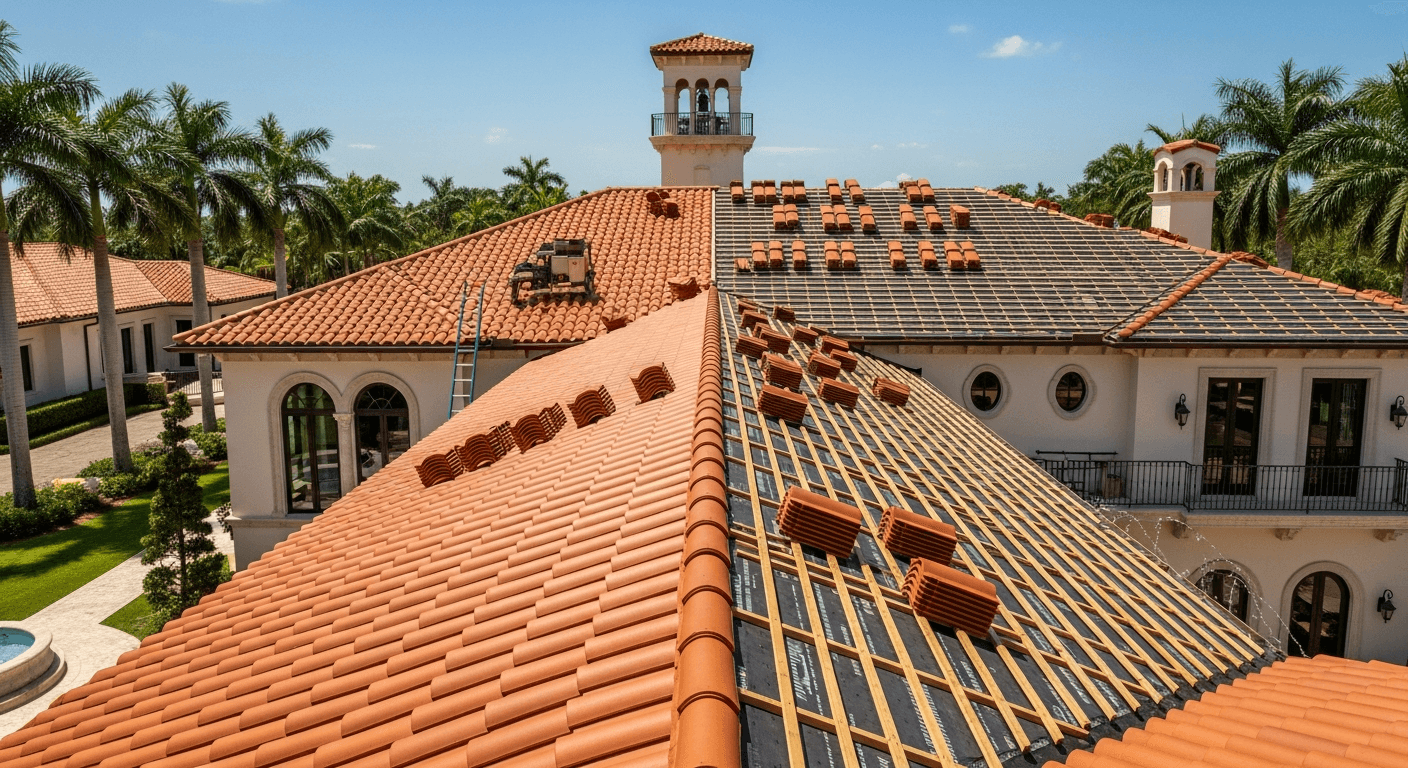
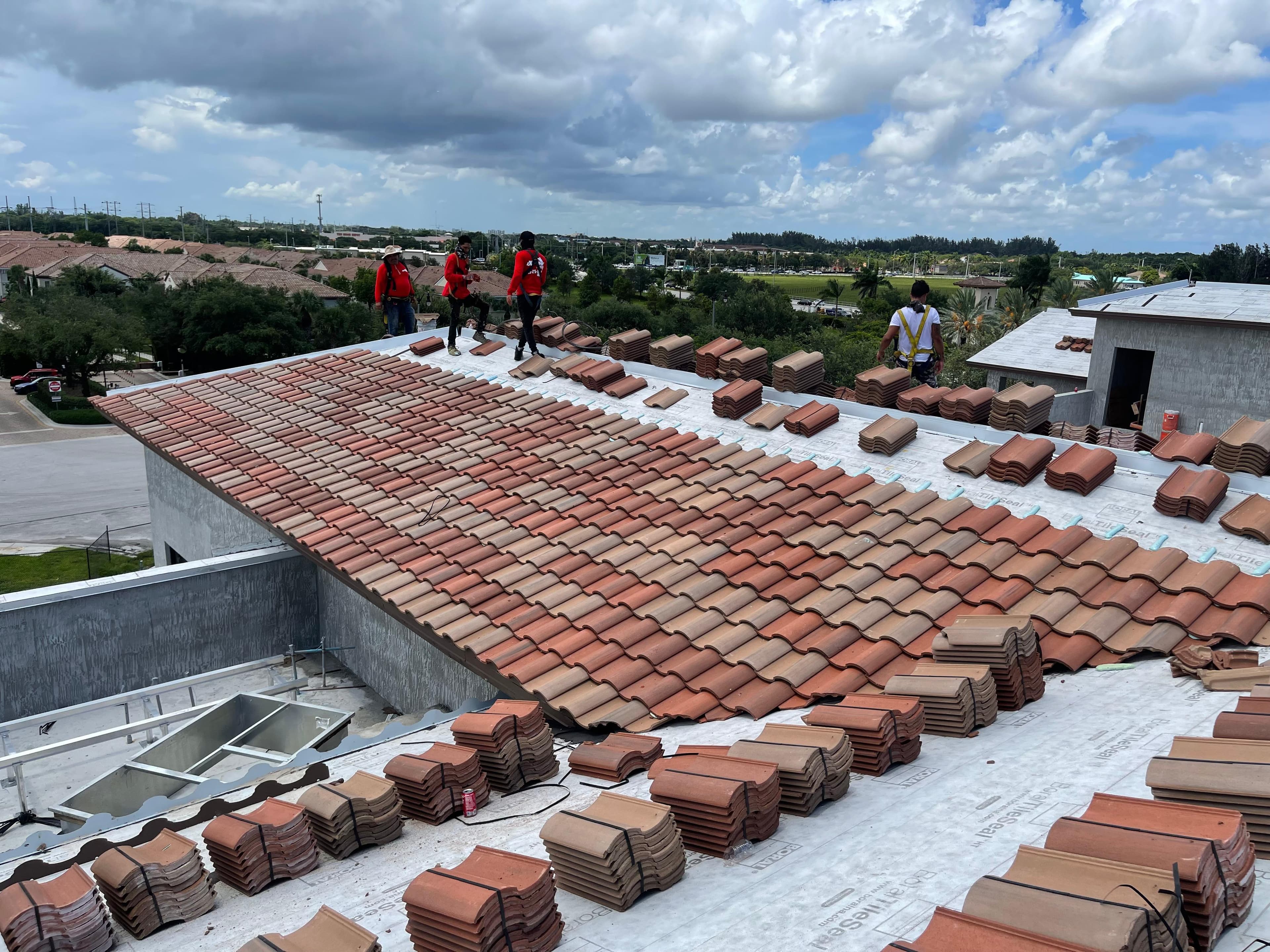
Tile roof installation is among the most labor-intensive and technically demanding roofing processes. Each component . from the underlayment to the ridge cap . must be installed correctly to achieve the system's rated wind resistance and weather protection.
Step 1: Underlayment System
The underlayment is the primary waterproof barrier of a tile roof. Unlike shingle roofs where the shingles themselves are the waterproofing layer, tile roofing systems rely on the underlayment to keep water out. The tiles provide physical protection for the underlayment, aesthetic appearance, and additional weather resistance.
Underlayment options for South Florida tile roofs:
- Hot-mopped asphalt (traditional): Two layers of #30 felt mopped with hot asphalt. This has been the standard underlayment for tile roofs in South Florida for decades. Cost: $1.50 - $2.50 per square foot.
- Self-adhering modified bitumen: Peel-and-stick membrane (e.g., GAF WeatherWatch, Owens Corning WeatherLock) applied directly to the deck. Qualifies as secondary water resistance for wind mitigation credits. Cost: $2.00 - $3.50 per square foot.
- Synthetic underlayment: High-strength polymer fabric (e.g., GAF FeltBuster, Owens Corning ProArmor). Lighter and faster to install than hot-mopping. Cost: $0.75 - $1.50 per square foot.
For maximum protection and insurance savings, Extreme Roofing Inc. recommends self-adhering modified bitumen underlayment on all tile roof installations. It provides secondary water resistance (SWR) for wind mitigation credits and eliminates the fire hazard and fumes associated with hot-mopping.
Step 2: Batten and Counter-Batten System
Battens are horizontal wood or composite strips installed over the underlayment to which the tiles are fastened. Counter-battens are vertical strips installed beneath the battens to create an elevated air space.
Batten functions:
- Provide a nailing surface for tile attachment
- Create an air gap between the underlayment and tiles for ventilation and drainage
- Elevate the tiles slightly off the underlayment to prevent water capillary action
In Miami-Dade County's HVHZ, battens must be installed with corrosion-resistant fasteners (stainless steel or hot-dipped galvanized) at specified spacing per the tile manufacturer's NOA installation instructions.
Step 3: Tile Fastening Methods
Florida Building Code requires every tile to be mechanically fastened in the High-Velocity Hurricane Zone. The old practice of mortar-setting tiles (embedding them in a bed of mortar without mechanical fasteners) is not permitted for new installations or re-roofing in Miami-Dade County.
Approved fastening methods:
- Nail attachment: Each tile nailed through a pre-formed hole to the batten using corrosion-resistant nails. Minimum one nail per tile in the HVHZ, with additional nails at perimeters and high-wind zones.
- Screw attachment: For enhanced wind resistance, tiles can be secured with screws. Screws provide approximately 30% to 50% more uplift resistance than nails.
- Wire-tied with adhesive: Tiles secured with stainless steel wire ties combined with adhesive at the head and tail. Common for barrel tile installations.
- Clip systems: Some flat tile profiles use interlocking clips that secure the tile to the batten without penetrating the tile body.
Step 4: Hip and Ridge Treatment
Hips (the external angles where two roof planes meet) and ridges (the peak of the roof) require specialized tile and fastening to prevent water intrusion and wind damage.
Hip and ridge options:
- Mortar-set ridge tile: Traditional method using mortar to bed the ridge tiles on top of flexible flashing. Still common but being replaced by mechanical methods.
- Dry ridge systems: Ridge tiles secured with mechanical fasteners and flexible underlayment without mortar. More durable and wind-resistant than mortar-set applications.
- Hip starter tiles: Specially cut tiles at the hip base that create a weather-tight transition
Cost Breakdown: Complete Tile Roof Project
A complete tile roof replacement in South Florida includes many cost components beyond the tiles themselves:
| Component | Cost per Sq Ft | % of Total |
|---|---|---|
| Tile material (concrete S-tile) | $2.50 - $4.00 | 25-30% |
| Underlayment (self-adhering SWR) | $2.00 - $3.50 | 15-20% |
| Battens and fasteners | $0.75 - $1.50 | 5-10% |
| Labor (installation) | $4.00 - $6.00 | 35-40% |
| Tear-off and disposal | $1.50 - $2.50 | 10-15% |
| Flashings, edge metal, ridge | $0.75 - $1.50 | 5-10% |
| Permits and inspections | $0.25 - $0.50 | 2-3% |
| Total (concrete S-tile) | $11.75 - $19.50 | 100% |
| Total (clay barrel tile) | $14.00 - $24.00 | 100% |
For a 2,500-square-foot roof:
- Concrete S-tile total: $29,375 - $48,750
- Clay barrel tile total: $35,000 - $60,000
Miami-Dade NOA Requirements for Tile Roofing
All tile roofing products installed in Miami-Dade County must carry a current Notice of Acceptance (NOA) from the Miami-Dade County Product Control Division. The NOA certifies that the product has been tested and approved for use in the High-Velocity Hurricane Zone.
What the NOA Covers
- Wind uplift resistance of the installed tile assembly (not just the tile alone)
- Fastening requirements specific to the approved assembly
- Underlayment compatibility . the NOA specifies which underlayment systems are approved with the tile
- Installation instructions that must be followed exactly for the approval to be valid
Major Tile Manufacturers With Miami-Dade NOA
- Eagle Roofing Products . Miami-based, South Florida's largest concrete tile manufacturer
- Boral Roofing . Extensive concrete and clay product lines with full HVHZ approval
- Ludowici Roof Tile . Premium clay tile, popular for luxury and historic applications
- MCA Clay Tile . Mission, barrel, and flat profiles with comprehensive NOA coverage
- Verea Clay Tile . Spanish-imported clay tile with Florida product approval
The Critical Installation Detail
A Miami-Dade NOA is only valid when the complete assembly is installed as tested. This means the specific tile, the specific underlayment, the specific battens, and the specific fasteners listed in the NOA documentation must all be used together. Substituting a different underlayment or fastener type . even if the substitute product has its own NOA . can invalidate the assembly approval and result in a failed inspection.
Maintenance: Keeping Your Tile Roof in Top Condition
Regular Maintenance Schedule
Annually:
- Walk inspection (by a qualified roofer . homeowners should not walk on tile roofs) to identify cracked, shifted, or missing tiles
- Gutter and downspout cleaning to ensure proper drainage
- Flashing inspection at walls, chimneys, vents, and other penetrations
- Tree trimming to maintain minimum 6-foot clearance from the roof surface
Every 3-5 Years:
- Professional cleaning to remove algae, mold, and lichen growth (pressure washing at appropriate PSI, or chemical soft wash)
- Re-sealing of ridge and hip mortar joints where cracking is observed
- Underlayment assessment by a qualified roofer if the roof is over 20 years old
Every 15-20 Years: - Underlayment evaluation . the tiles may have decades of life remaining, but the underlayment beneath them deteriorates over time. The most common reason for tile roof "replacement" in South Florida is underlayment failure, not tile failure.
Broken Tile Replacement
Individual broken tiles can and should be replaced promptly to prevent water intrusion. A qualified roofer can replace a single tile in under an hour. The process involves:
- Carefully lifting the surrounding tiles to access the broken tile
- Removing the broken tile's fastener
- Installing the replacement tile with a new corrosion-resistant fastener
- Re-seating the surrounding tiles
Cost for individual tile replacement : $150 - $350 per tile (including service call, labor, and material)
Important : Always keep a supply of matching replacement tiles from your original installation. If your tile manufacturer discontinues the exact profile or color, finding replacements later can be extremely difficult and expensive. Extreme Roofing recommends ordering 5% to 10% extra tiles at the time of installation and storing them in a dry location.
Common Tile Roof Issues in South Florida
#### 1. Cracked Tiles From Foot Traffic
Roof tiles . particularly clay tiles . are not designed to bear concentrated foot loads. HVAC technicians, satellite dish installers, and pressure washing crews frequently crack tiles by stepping directly on the barrel rather than on the supported edge where the tile overlaps the batten. Every contractor who accesses your tile roof should know how to walk on tile without causing damage.
#### 2. Underlayment Deterioration
As described above, the underlayment beneath tile roofs has a shorter lifespan than the tiles themselves. After 20 to 30 years, hot-mopped underlayment begins to dry out, crack, and lose waterproofing integrity. The roof may show no visible problems from the exterior while water is actively leaking through deteriorated underlayment. This is the most common scenario requiring tile roof "replacement" . in reality, the tiles are removed, the underlayment is replaced, and the same tiles are reinstalled.
#### 3. Algae and Biological Growth
South Florida's humidity and warm temperatures create ideal conditions for algae (Gloeocapsa magma), mold, lichen, and moss growth on tile roofs. While primarily cosmetic, heavy biological growth can retain moisture against the tile surface, accelerate deterioration, and create an unsightly black or green appearance. Regular cleaning every 3 to 5 years prevents heavy buildup.
#### 4. Mortar Joint Failure
Ridge and hip tiles bedded in mortar are vulnerable to cracking and separation over time. Thermal expansion and contraction, wind vibration, and settling can cause mortar joints to open, allowing water intrusion at the highest points of the roof. Annual inspection of mortar joints and prompt re-pointing prevents this common issue.
Historical District Considerations
Coral Gables
Coral Gables has the most stringent architectural standards in South Florida. The City's Board of Architects reviews all exterior modifications, including roofing. For properties in Coral Gables, particularly those in the historic residential districts, the following requirements apply:
- Clay tile is preferred and in some cases required for contributing structures in historic districts
- Barrel tile (S-tile) profile must match the existing or original roof profile
- Color must complement the approved exterior color palette for the property
- Concrete tile may be permitted as a replacement for non-contributing structures, subject to board review
Coconut Grove
Coconut Grove's historic areas (including the Bay Heights Historic District) have preservation guidelines that address roofing materials. While less prescriptive than Coral Gables, replacement roofing on designated historic properties should:
- Match the original material (clay vs. concrete) and profile where possible
- Use colors consistent with the historic period of the home
- Avoid modern profiles (flat tile) on homes originally built with barrel tile
Miami Beach
Properties within the Miami Beach Art Deco Historic District and other designated areas must comply with the Historic Preservation Board's design guidelines. Many Art Deco buildings in Miami Beach originally had flat concrete roofs, but Spanish Colonial and Mediterranean Revival homes in the North Beach and La Gorce neighborhoods feature tile roofing subject to preservation review.
Why Proper Installation by Certified Contractors Matters
Tile roofing installation errors are among the most costly and difficult to remediate in the roofing industry. Unlike shingle roofs where a mistake affects a small area, tile roof installation errors can compromise the entire system because the tiles, underlayment, battens, and fasteners must all work as an integrated assembly.
Common installation errors that lead to premature failure:
- Insufficient fastener penetration . nails that do not fully seat in the batten allow tiles to lift in high winds
- Wrong underlayment . using incompatible underlayment voids the tile manufacturer's NOA
- Improper headlap . inadequate overlap between tile courses allows wind-driven rain to reach the underlayment
- Missing or incorrect flashing . valley, wall, and penetration flashings that do not integrate properly with the tile coursing
- Mortar misuse . using mortar where mechanical fasteners are required, or vice versa
Extreme Roofing Inc. has been installing tile roofs across South Florida since 2004. Our GAF, Owens Corning, and CertainTeed certifications and Florida State Certified license (CCC# 1326021) ensure every tile roof we install meets manufacturer specifications, Miami-Dade NOA requirements, and the Florida Building Code. We have completed tile roof projects in Coral Gables, Coconut Grove, Pinecrest, Key Biscayne, Aventura, and throughout Miami-Dade and Broward counties.
Get a Free Estimate
Whether you are replacing an aging tile roof, building a new home, or restoring a historic property, Extreme Roofing Inc. provides expert tile roof installation throughout South Florida. Call [305-225-1535](tel:305-225-1535) or visit our free estimate page for a free on-site consultation and written estimate. We work with all major tile manufacturers including Eagle, Boral, Ludowici, and MCA to deliver the perfect tile roof for your South Florida home.
Frequently Asked Questions
How much does a Spanish tile roof cost in South Florida?
A Spanish tile roof in South Florida costs $300 to $500 per roofing square for concrete tile or $400 to $700 per roofing square for clay tile (material only). A complete installed project including tear-off, underlayment, battens, labor, and permitting costs $11.75 to $19.50 per square foot for concrete S-tile or $14.00 to $24.00 per square foot for clay barrel tile. For a 2,500-square-foot roof, expect a total project cost of $29,375 to $48,750 for concrete or $35,000 to $60,000 for clay.
How long do clay tile roofs last in South Florida?
Clay tile roofs in South Florida can last 50 to 100+ years. The tiles themselves are extremely durable and maintain their color indefinitely due to through-body pigmentation. However, the underlayment beneath the tiles typically needs replacement every 20 to 30 years. During an underlayment replacement, the existing clay tiles are carefully removed, the new underlayment is installed, and the original tiles are reinstalled . extending the roof's life for another 20 to 30 years.
Can I replace individual broken roof tiles?
Yes, individual broken tiles can be replaced by a qualified roofer, typically in under an hour per tile at a cost of $150 to $350 including the service call. The roofer lifts surrounding tiles, removes the broken tile's fastener, installs the replacement, and re-seats the surrounding tiles. It is strongly recommended to keep 5% to 10% extra matching tiles from your original installation, as discontinued profiles and colors can be very difficult to source later.
What is the difference between clay and concrete tile?
The primary differences are cost, weight, lifespan, and color retention. Clay tile costs 25% to 40% more than concrete but lasts 50 to 100+ years versus 30 to 50 years for concrete. Clay is lighter (7-10 lbs per sq ft vs. 9-12 lbs for concrete) and maintains its color permanently through through-body pigmentation, while concrete tile surface color fades over 10 to 20 years in South Florida's UV environment. Concrete tile is more impact-resistant and widely available from local manufacturers.
Do tile roofs need a Miami-Dade NOA in South Florida?
Yes, all tile roofing products installed in Miami-Dade County must carry a current Notice of Acceptance (NOA) from the Miami-Dade County Product Control Division. The NOA covers the complete assembly . tile, underlayment, battens, and fasteners . not just the tile alone. Using products without a valid NOA or substituting components not listed in the approved assembly will result in a failed inspection and potential permit revocation.
Why do tile roofs in South Florida need to be replaced if the tiles are still good?
The most common reason for tile roof replacement in South Florida is underlayment deterioration, not tile failure. The waterproof underlayment beneath the tiles . typically hot-mopped asphalt felt or modified bitumen . has a lifespan of 20 to 30 years. When it fails, water leaks through to the roof deck even though the tiles above appear intact. The solution is to remove the tiles, replace the underlayment, and reinstall the existing tiles if they are still in good condition.
Are barrel tile roofs good in hurricanes?
When properly installed with mechanical fasteners per Miami-Dade NOA specifications, barrel tile roofs are rated for 120 to 150 mph winds . adequate for most hurricane events. Flat tile profiles perform slightly better at 130 to 160 mph due to their tighter interlock. The key is proper installation: every tile must be mechanically fastened in the HVHZ, not just mortar-set. Tile roofs installed to current Florida Building Code standards provide reliable hurricane protection for South Florida homes.
Need Roofing Help?
Whether you need an inspection, repair, or full replacement, our team of licensed roofing professionals is ready to help. Serving South Florida since 2004.
Related Articles
Clay and concrete tile roofs last 50-100 years in Miami. This complete guide covers costs, styles, wind ratings, maintenance, and building code requirements.
Read More
Barrel tile roofs define Miami's Mediterranean architecture. Learn about styles, costs, wind ratings, and finding experienced installers in South Florida.
Read More