
Flat Roof Repair in Miami: Common Problems and Solutions
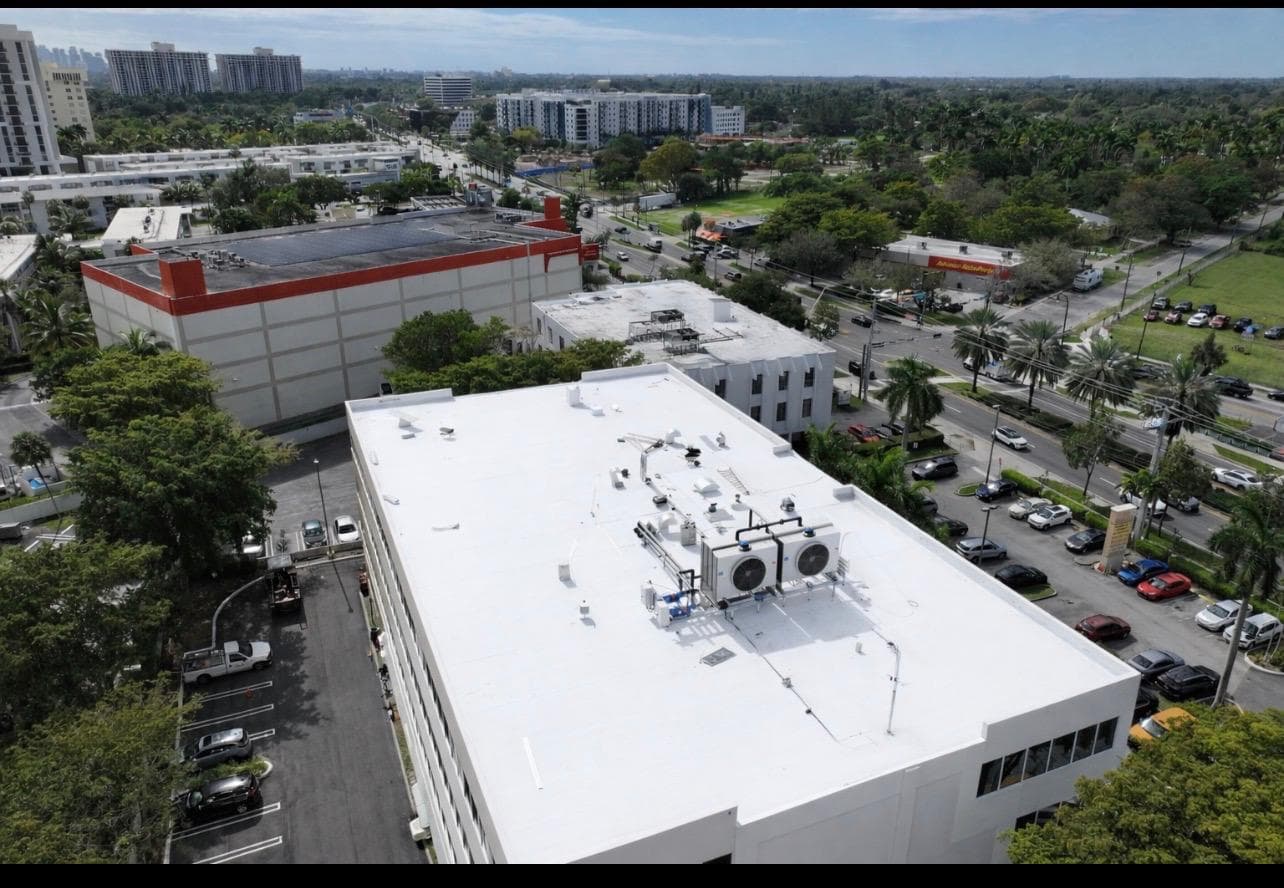
The Seven Things That Cause Almost Every Flat Roof Leak in Miami
I've been diagnosing flat roof leaks on Miami commercial buildings, warehouses, retail strips, and multi-family properties since 2004. In 20+ years, I can count the truly weird leaks on one hand. The vast majority of flat roof failures in Miami come down to the same seven issues, and most of them can be fixed without replacing the whole roof if you catch them early.
If your flat roof is leaking right now, you're probably dealing with one of these: ponding water that's degrading the membrane, a puncture from HVAC tech foot traffic, a failed flashing at a parapet or pipe penetration, a separated seam on a TPO or EPDM roof, a blistered area that cracked open, clogged drains causing water to back up, or age-related membrane shrinkage pulling seams apart. Let me walk you through each one, what it looks like, what it actually costs to fix, and when you need a full replacement instead.
1. Ponding Water: The Root Cause of Premature Failure
Ponding water is any standing water that stays on the roof for more than 48 hours after rain. In Miami, with 62 inches of annual rainfall and summer storms that dump 2 to 4 inches in an hour, ponding is the single most common flat roof problem I see.
Here's why it matters so much: a flat roof membrane was engineered for continuous UV exposure and thermal cycling, not for constant submersion. When water sits in a low spot for weeks at a time, it accelerates UV degradation (focused light reflection), promotes algae and biological growth that eats through certain membranes, creates thousands of pounds of dead load in a single pond (water weighs 5.2 pounds per gallon), and attacks the seams and flashings with a constant moisture gradient.
What causes ponding:
- Inadequate slope from original design (code requires 1/4 inch per foot minimum toward drains)
- Clogged drains and scuppers (90% of the ponding calls I get are just clogged drains)
- Structural deflection from rooftop HVAC units added after the original build
- Previous roof layers adding dead load and causing deck sag
- Building settling altering the roof plane
How to fix it, in order of cost:
| Fix | Cost | When to Use |
|---|---|---|
| Clear drains and scuppers | $200 to $500 | Clog-only ponding, quarterly maintenance |
| Add crickets or tapered insulation | $3 to $6 per sq ft affected | Slope deficiency in localized areas |
| Install additional drains | $600 to $2,500 per drain | Undersized drainage for roof area |
| Roof coating with built-up slope | $2 to $4 per sq ft | Widespread minor ponding, older roof |
| Tear-off and re-slope with new insulation | $7 to $11 per sq ft | Systemic slope failure on aging roof |
If you're calling me about ponding, the first thing I do is walk the roof with a measuring stick and map the ponding footprint. If it's just drain clogs, it's a $300 fix. If the slope is wrong across the whole roof, we're talking $15,000 to $40,000 to correct it.
2. Membrane Punctures and Tears
TPO, PVC, EPDM, and modified bitumen membranes are all vulnerable to punctures. The most common causes I see on Miami commercial roofs:
- HVAC techs walking to rooftop units without walk pads
- Tenant contractors dropping tools during equipment work
- Debris from storms or nearby construction impacting the membrane
- Tree branches scraping during windstorms (common near Coconut Grove, Miami Shores, and older neighborhoods with mature oaks)
- UV-brittled membrane that cracks under foot traffic it used to handle
A single small puncture on a flat roof is a big problem because water doesn't drain away from it. It pools, the puncture widens, and water migrates through the roofing system toward wherever the deck has low spots or openings. By the time you see interior damage, the roof has usually been leaking for months.
Fix options:
- Small puncture under 6 inches: Hot-air welded patch (TPO/PVC) or adhesive patch (EPDM). Cost runs $200 to $500 per patch, and a good patch should last the remaining life of the roof.
- Large puncture 6 to 24 inches: Cut out and replace the damaged section. Cost runs $600 to $1,800 depending on access.
- Multiple punctures on same roof: Consider a full inspection. Multiple punctures usually signal either UV brittleness (time for replacement planning) or chronic foot-traffic damage that needs walk pads added.
- Walk pad installation: $5 to $10 per linear foot. I install walk pads on every route to rooftop equipment after any puncture repair.
3. Flashing Failures Around Pipes, Curbs, and Parapets
Every flat roof has dozens of flashing transitions. Plumbing stacks, vent pipes, HVAC curbs, skylight curbs, parapet walls, expansion joints, drain clamps. Each one is a potential leak point. Over time, Miami's UV degrades exposed sealants within 3 to 5 years, thermal cycling pulls flashings away from substrates, and wind-driven rain finds its way into any gap.
Flashing failures are the second most common source of flat roof leaks after ponding water. If I'm chasing an interior leak on a Miami commercial roof and the ponding looks okay, my second check is every flashing transition.
What I look for:
- Cracked or separated sealant at termination bars
- Counterflashing pulled away from parapet walls
- Pipe boots with brittle, UV-cracked rubber
- HVAC curb flashing with gaps at the corners
- Expansion joint covers that have shifted or torn
Fix options:
- Re-seal flashing terminations: Remove old sealant, clean, apply new NovaFlex or Sika Flex-1 polyurethane sealant. Cost $250 to $700 per location.
- Replace pipe boots: Cut out old boot, install new field-fabricated boot or stock boot with welded or sealed edges. Cost $300 to $600 per penetration.
- Re-flash HVAC curbs: Strip old flashing back, install new membrane flashing extending up curb and sealed at top with termination bar. Cost $600 to $1,400 per curb.
- Counterflashing replacement: Remove failing metal counterflashing, install new reglet-cut counterflashing with fresh sealant. Cost $12 to $20 per linear foot.
I tell every commercial client the same thing: inspect every flashing twice a year, budget $1,500 to $3,000 annually for flashing maintenance, and you'll extend the life of your roof by 5 to 10 years.
4. Seam Separation on TPO and EPDM Roofs
Seams are where two sheets of membrane meet. On TPO and PVC roofs, the seams are hot-air welded together. On EPDM roofs, they're glued with adhesive or seam tape. Both types can fail over time.
TPO seam failures usually come from either insufficient heat during original installation (improper welder temperature) or age-related shrinkage pulling welds apart. EPDM seam failures usually come from the seam tape drying out or the adhesive losing grip as the rubber ages.
The tricky part about seam failures: they're hard to detect from above. The seam looks fine on the surface, but water is wicking in between the sheets. You usually find out because of an interior leak that doesn't correspond to any visible damage on the roof.
How to fix it:
- Re-weld TPO/PVC seams: Clean the seam area, run a hot-air welder along the open section, test the weld with a probe. Cost $6 to $12 per linear foot.
- Apply new EPDM seam tape: Clean and prime the seam area, apply new QuickSeam or similar EPDM seam tape, roll firmly. Cost $5 to $10 per linear foot.
- Cover strip over failing seam: If the existing seam is too degraded for a clean repair, apply a cover strip of matching membrane welded or adhered over the full seam length. Cost $8 to $15 per linear foot.
- Section replacement: For seams that run through multiple failure points, cut out and replace the full section. Cost varies widely.
If you're seeing multiple seam failures on a TPO or EPDM roof that's 15+ years old, you're usually past the point of spot repairs. That's replacement territory.
5. Blistering and Bubbling
Blisters are raised areas where the membrane has separated from the substrate, trapping air or moisture between layers. On a modified bitumen or BUR roof, blisters look like little domes. On a TPO roof, they look like waves or bubbles.
What causes them:
- Moisture trapped during installation (common when Miami roofs are installed during summer humidity)
- Poor adhesion between membrane and insulation substrate
- Outgassing from VOCs in insulation or adhesives (temperature-driven)
- Thermal cycling in Miami's intense heat, expanding and contracting the membrane until it pulls loose
A single stable blister under 4 inches is usually not urgent. Opening it can introduce more moisture than it solves. But a growing blister, a blister that cracks open during a storm, or a field of blisters across a large area needs professional intervention.
Fix options:
- Monitor small stable blisters: Photograph, measure, check quarterly. Cost: $0 (preventive).
- Cut and patch large blisters: Cut the blister open, dry the substrate, apply adhesive, press the membrane flat, patch over the cut. Cost $250 to $700 per blister.
- Systemic blistering: If blisters are appearing across 10%+ of the roof, you have an adhesion problem that won't be solved by patching. Time to plan for replacement.
6. Drainage System Failures
Beyond ponding from clogged drains, the entire drainage system on a commercial flat roof can fail. Internal drain pipes collapse, parapet scuppers get blocked by debris or wasp nests, overflow scuppers get retrofitted out of existence during renovations, and gutters on the perimeter of low-slope roofs get crushed or pull away.
Common drainage issues I see:
- Original drains undersized for the roof area (common on 1970s and 1980s Miami commercial buildings)
- Internal drain piping corroded or collapsed inside walls
- Scupper through-wall penetrations blocked by debris, vegetation, or insect nests
- Missing overflow scuppers (required by code for backup drainage)
- Gutters on perimeter metal edges pulled loose or clogged
Fix options:
- Drain cleaning: $200 to $500. First thing to try on any drainage issue.
- Drain retrofit: Replace undersized original drains with larger units. Cost $900 to $3,000 per drain.
- Internal drain piping replacement: If internal piping is collapsed or corroded, it needs replacement. Cost varies widely depending on access, often $2,000 to $10,000.
- Add overflow scuppers: Cut new through-wall openings for emergency drainage. Cost $500 to $1,200 per scupper. Required by current Miami-Dade code and often missing on older buildings.
7. Age-Related Membrane Shrinkage
This is the one nobody wants to hear about. Every flat roof membrane has a lifespan in Miami's climate, and it's shorter than most property owners expect:
| Membrane | Expected Miami Lifespan | What Fails First |
|---|---|---|
| TPO (60 mil) | 18 to 25 years | Shrinkage at seams, surface crazing |
| TPO (80 mil) | 22 to 30 years | Shrinkage at seams, surface crazing |
| EPDM (60 mil) | 15 to 25 years | Shrinkage, seam tape failure |
| PVC (60 mil) | 20 to 30 years | Seam welds, plasticizer migration |
| Modified bitumen | 15 to 22 years | Granule loss, blistering, cracking |
| BUR (built-up) | 15 to 25 years | Flood coat cracking, gravel loss |
| SPF (spray foam) | 15 to 20 years | Topcoat degradation, physical damage |
Manufacturers in cooler climates can quote 30 to 35 year lifespans on the same products. Miami cuts that back by 5 to 10 years because of the UV intensity, the 170+ degree surface temperatures during summer, and the humidity.
When a membrane is at end of life, no amount of patching will keep it from failing. You'll patch one leak and three more will open up within a year. This is the point where I tell clients to stop spending money on repairs and start budgeting for replacement.
The Repair vs Replacement Decision
Here's my simple decision framework:
Repair is the right call when:
- The roof is less than 70% of the way through its expected lifespan
- The damage is localized to specific areas or failure modes
- Insulation under the membrane tests dry (confirmed by infrared scan or core samples)
- Total repair cost is less than 25% of full replacement cost
- The roof hasn't been repeatedly patched without solving the underlying issue
Replacement is the right call when:
- The roof is past 80% of expected lifespan
- Multiple different failure modes are happening simultaneously
- Insulation is wet throughout (failed infrared scan)
- You've spent more than 15% of replacement cost on repairs in the last 2 years and leaks keep coming back
- Code changes require a full tear-off (Florida's 25% rule: if you repair more than 25% of the roof in 12 months, the whole thing has to come up)
- You're adding significant rooftop equipment that changes the roof design
2026 Commercial Flat Roof Pricing in Miami-Dade
Here's what I'm quoting right now on commercial flat roof repair and replacement work:
Repair costs:
| Repair | Typical Cost |
|---|---|
| Drain cleaning | $200 to $500 |
| Single puncture patch | $250 to $600 |
| Flashing re-seal | $250 to $700 |
| Pipe boot replacement | $300 to $600 |
| HVAC curb re-flash | $600 to $1,400 |
| Blister repair | $250 to $700 |
| Section replacement (under 100 sq ft) | $800 to $2,500 |
| Emergency tarping (storm response) | $400 to $1,200 |
Replacement costs (fully loaded):
| System | Cost per Sq Ft |
|---|---|
| TPO 60 mil (Carlisle, GAF, Versico) | $6 to $9 |
| TPO 80 mil | $7.50 to $11 |
| EPDM 60 mil | $5.50 to $8 |
| Modified bitumen 2-ply (SBS or APP) | $7 to $10 |
| PVC 60 mil (Sika Sarnafil, Duro-Last) | $8 to $12 |
| Spray polyurethane foam (SPF) with silicone topcoat | $6 to $9 |
| Silicone restoration coating (recoat existing) | $3.50 to $6 |
These include tear-off, insulation, membrane, flashings, drains, permits, and inspection. Add-ons include tapered insulation for slope correction ($3 to $6 per sq ft), cover board ($1.50 to $3 per sq ft), and walk pads ($5 to $10 per linear foot).
The Maintenance Program That Saves You Money
Commercial flat roofs need maintenance. Not optional, not "nice to have," mandatory. Here's the schedule I set up for every commercial client:
Quarterly (every 3 months):
- Clear all drains, scuppers, and gutters
- Walk the roof and check for ponding water, debris, or visible damage
- Photograph the roof condition for records
Semi-annually (April and October, bracketing hurricane season):
- Inspect all flashings, seams, and penetrations
- Check sealant at every termination bar and counterflashing
- Clean walk pads and check for wear
- Test drain flow rates
Annually:
- Professional inspection with written report
- Infrared moisture scan (optional but valuable)
- Clean full roof surface of biological growth
- Re-seal any deteriorating terminations
- Verify warranty compliance if under manufacturer warranty
After every major storm:
- Inspect within 48 hours for debris impacts and displaced membrane
- Clear all drains immediately
- Document any damage with dated photos for insurance
A proper maintenance program runs $800 to $2,500 per year for a typical commercial flat roof in Miami. That might sound like money you don't want to spend, but I've watched clients skip maintenance for 5 years and end up with $30,000 to $80,000 in repairs that could have been prevented.
Ready for a Real Inspection?
Call us at 305-225-1535 or request a free estimate. We'll walk your commercial flat roof, identify every failure mode we find, give you a prioritized list of repairs with real costs, and tell you honestly whether your roof is worth repairing or whether you need to start planning a replacement. If you're dealing with an active leak, we can get a crew out for emergency tarping within 24 hours.
Frequently Asked Questions
How much does flat roof repair cost in Miami?
Flat roof repairs in Miami typically cost $300 to $1,500 depending on the type and extent of damage. Simple membrane patches run $150 to $400, flashing repairs cost $200 to $800, and section replacements cost $500 to $1,500. Full flat roof replacement costs $5.50 to $12 per square foot installed.
What causes ponding water on a flat roof?
Ponding water is caused by inadequate roof slope, clogged drains and scuppers, structural deflection from heavy equipment, or building settlement. In Miami, where summer storms can drop several inches of rain in an hour, even minor drainage issues lead to significant ponding. Water that remains for more than 48 hours accelerates membrane degradation.
How do I know if my flat roof needs repair or replacement?
Repair is appropriate when the membrane is under 15 years old, damage is localized, and underlying insulation is dry. Replacement is needed when the membrane has exceeded its lifespan, multiple areas are failing simultaneously, insulation is saturated, or the roof has been repeatedly patched without resolving leaks.
How long does a flat roof last in Miami?
Flat roof lifespan in Miami depends on the membrane type: TPO and PVC last 20 to 30 years, EPDM lasts 15 to 25 years, modified bitumen lasts 15 to 20 years, and built-up roofing lasts 15 to 25 years. Miami's intense UV, heat cycling, and heavy rainfall are harder on flat roofs than moderate climates, so proper maintenance is essential to achieving full lifespan.
Can a flat roof leak be repaired without replacing the whole roof?
Yes, most flat roof leaks can be repaired without full replacement if the damage is localized and the surrounding membrane and insulation are in good condition. Repairs include membrane patches, flashing re-sealing, seam re-welding, and drain improvements. A professional inspection with moisture testing can determine whether repair or replacement is the better investment.
Need Roofing Help?
Whether you need an inspection, repair, or full replacement, our team of licensed roofing professionals is ready to help. Serving South Florida since 2004.
Related Articles
Florida insurance rates are dropping for the first time since 2015. Learn how combining market rate decreases with strategic roof upgrades can save Miami homeowners $1,400-$2,600 per year on premiums.
Read More
My Safe Florida Home Grant 2026: Get Up to $10,000 for Roof Hardening (Before Funding Runs Out)
The My Safe Florida Home program has $270 million available for roof hardening grants up to $10,000, but the legislature has not approved new funding for 2027. Learn how to apply and maximize your grant.
Read More