Miami-Dade Roofing Code Requirements: What Homeowners Must Know in 2026
What Miami-Dade Homeowners Need to Know About HVHZ Code Right Now
If you own a home in Miami-Dade or southern Broward County, you're in the strictest building code zone in the United States. That's not an exaggeration. The Miami-Dade High Velocity Hurricane Zone (HVHZ) was written in 1994 after Hurricane Andrew destroyed Homestead, and it has been tightened multiple times since. Today, every roofing product installed here has to pass tests that products for the rest of Florida (let alone the rest of the country) don't have to meet.
Why does this matter to you? Three reasons. First, cheap out-of-state products can't be legally installed on your roof. Second, your contractor has to document compliance at every step, which means more paperwork, more inspections, and higher costs than non-HVHZ roofing work. Third, your insurance carrier expects you to have a code-compliant roof, and a roof without proper NOA documentation can trigger coverage disputes after a claim.
I've been installing roofs under HVHZ code since 2004, through multiple code updates (2002, 2007, 2010, 2014, 2017, 2020, 2023). Here's everything a Miami-Dade homeowner needs to understand before starting any roofing project.
What the HVHZ Actually Covers
The HVHZ is a geographic designation under the Florida Building Code that covers all of Miami-Dade County and the southern portion of Broward County (roughly south of the I-595 corridor). It was established after Hurricane Andrew in 1992 exposed catastrophic weaknesses in pre-1992 building codes. Andrew destroyed Homestead and flattened 25,000 homes in a single day. The code rewrite that followed created HVHZ as a separate tier with stricter testing, product approval, and installation requirements than anywhere else in Florida.
For a Miami-Dade homeowner, HVHZ means your roofing project needs products and installation methods that go above and beyond normal Florida building code.
HVHZ vs Standard Florida Code: The Key Differences
If you're comparing HVHZ requirements to standard Florida building code (what applies in Orlando, Tampa, Jacksonville, Naples, and the rest of the state), here's what's different:
| Requirement | Standard Florida Code | Miami-Dade HVHZ |
|---|---|---|
| Product approval | Florida Product Approval | Miami-Dade Notice of Acceptance (NOA) |
| Basic design wind speed | 130 to 160 mph | 180+ mph |
| Impact testing | Required in wind-borne debris region | Large missile impact (9 lb 2x4 at 50 ft/sec) required |
| Deck attachment | 8d nails at 6 inch spacing | Ring-shank nails at enhanced HVHZ schedule |
| Underlayment | Minimum one layer | Self-adhered secondary water barrier full deck coverage |
| Permit requirements | Standard building permit | HVHZ-specific permit with product documentation |
| Inspections | Standard progress inspections | Enhanced inspections at deck, dry-in, and final |
The practical result: products that are legal in Orlando aren't necessarily legal in Miami-Dade. Contractors from outside HVHZ often don't know this and try to use cheaper products that fail inspection. The homeowner ends up paying for the tear-off and re-install.
The Notice of Acceptance (NOA) System Explained
The NOA is Miami-Dade County's proprietary product testing and approval system. It's more rigorous than the standard Florida Product Approval, and it covers every roofing product installed within the HVHZ: roofing materials, underlayment, fasteners, sealants, flashing, and accessories.
Every NOA document specifies:
- The exact product (name, manufacturer, model numbers, all approved variations)
- Approved applications (roof slope range, building height, zone location)
- Wind resistance ratings (maximum design pressure the product can handle)
- Impact test results (large-missile and small-missile testing outcomes)
- Installation requirements (specific methods, fastener types, spacing, attachment patterns)
- Limitations (maximum building height, slope restrictions, geographic constraints within HVHZ)
How to verify any NOA yourself: Go to the Miami-Dade Product Control Search portal at miamidade.gov. Search by manufacturer name, product name, or NOA number. Every legitimate HVHZ-approved product has a current, verifiable NOA on file. If your contractor can't produce an NOA number for a product they're quoting, that's a red flag.
NOAs expire every 5 years and have to be renewed. An expired NOA means the product is no longer legally installable in HVHZ, even if it was approved when originally manufactured. Your contractor has to verify NOA status at the time of installation, not just at the time of quoting.
Why NOA Compliance Matters to Homeowners
Three concrete reasons you should care about NOA compliance as a Miami-Dade homeowner:
- Insurance claims. Your insurer can deny claims if damage involves non-NOA products. They will check during the adjuster inspection. A single non-compliant product on your roof can void coverage on a significant portion of the claim.
- Resale transactions. Home inspectors in Miami check for NOA documentation. Buyers and their lenders can require code-compliant roofing as a condition of closing. Non-compliant roofing can kill a sale or force a late-stage renegotiation.
- Building department enforcement. The building department rejects permit applications specifying non-NOA products. Work done without proper permits triggers stop-work orders, daily fines of $250 to $500, mandatory removal, and contractor license penalties.
Florida Building Code 2023 (8th Edition) Changes
The Florida Building Code updates on a 3-year cycle. The 8th Edition (FBC 2023) went into effect December 31, 2023, and governs every roofing permit applied for after that date. For Miami-Dade homeowners, the key changes are:
Updated wind speed maps. FBC 2023 incorporates the ASCE 7-22 wind speed maps with updated meteorological and risk data. Miami-Dade's basic wind speed remains at 180 mph for standard residential buildings, but some coastal exposure category changes affect calculated design pressures.
Deck attachment schedules. Ring-shank nails at 6 inches on edges and 6 inches in the field (or tighter per NOA requirements). Perimeter and corner zones often require 4-inch spacing. This is stricter than previous editions and means most pre-1994 Miami homes need a full deck re-nail during any re-roof.
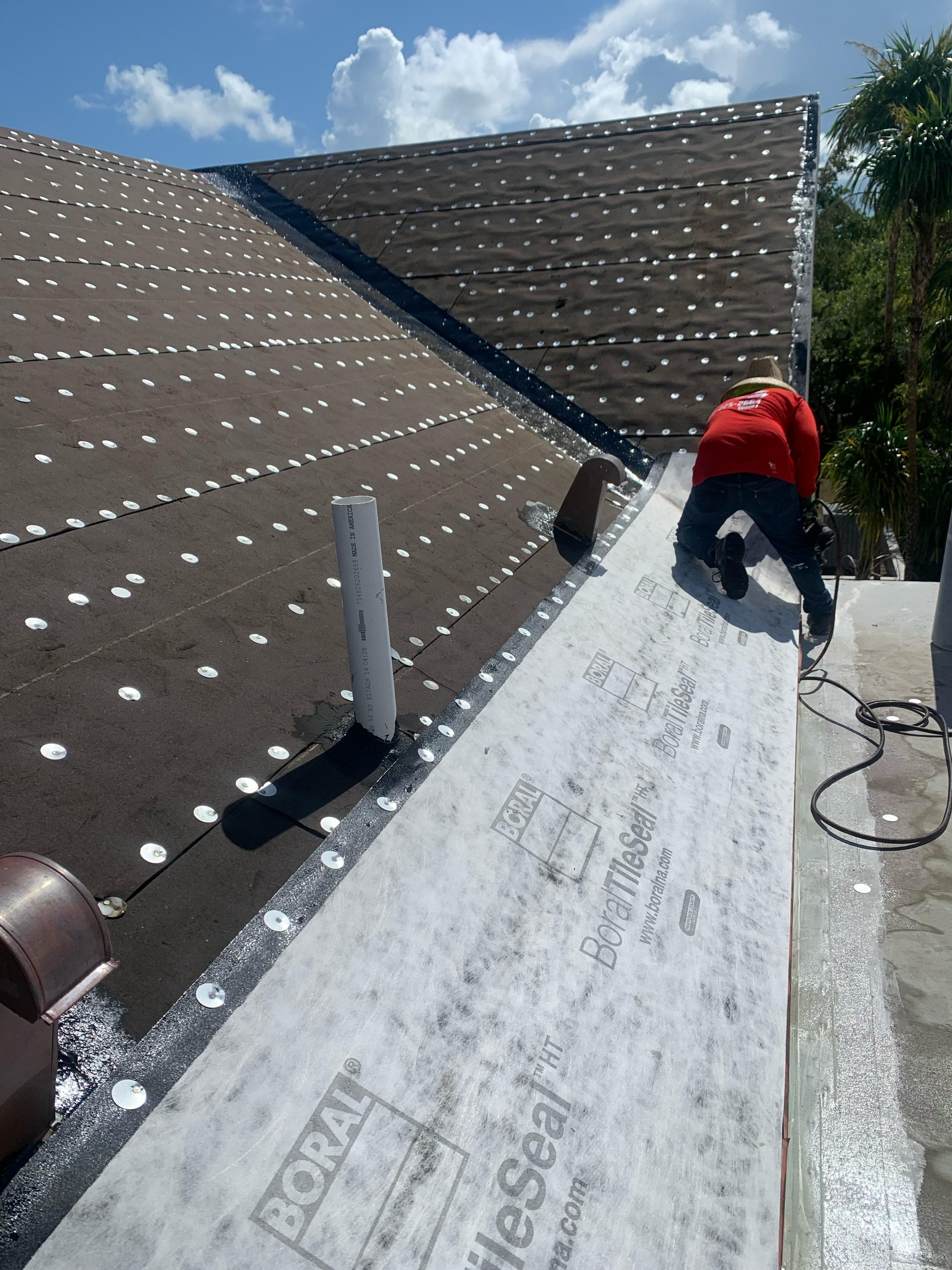
Secondary water barrier mandate. Every new roof and re-roof in HVHZ requires a self-adhered secondary water barrier across the full deck. Approved methods include Polyglass Polystick TU-P Plus, Grace Ice and Water Shield HT, GAF StormGuard, and equivalent Miami-Dade NOA products. Budget synthetic underlayments without self-adhesive backing don't comply.
Roof-mounted equipment. Rooftop solar installations, HVAC condensers, and antenna mounts all need valid NOAs now. Mounting penetrations must meet HVHZ flashing standards, and equipment has to be rated for the same wind speed as the roof system. Structural calculations must account for the additional wind load of mounted equipment.
Energy code integration. FBC 2023 includes energy efficiency requirements for roofing: minimum insulation R-values on new construction, cool roof requirements on certain building types, and reflectivity standards that influence material and color selection.
The Miami-Dade Permit Process Step by Step
Every roofing project in Miami-Dade County requires a building permit. The threshold for requiring a permit is lower than most homeowners realize. Here's what triggers it:
- Full roof replacement (always)
- Re-roofing or overlay (always)
- Any structural work involving the deck, trusses, or rafters (always)
- Repairs covering more than one roofing square (100 sq ft) generally require a permit
- Any repair involving more than 25 percent of total roof area triggers the 25 percent rule
Your contractor files the permit application. The application requires:
- NOA numbers for all materials being installed
- Manufacturer-specified installation instructions
- Signed and sealed engineering for any structural modifications
- Contractor's active Florida license, workers comp, and general liability insurance certificates
- Site plan showing the building location and work areas
After permit approval, Miami-Dade requires three inspections during the project:
- Deck inspection: After old roofing is removed and before new underlayment goes on. Inspector verifies deck condition, moisture content, and nailing schedule.
- Dry-in inspection: After underlayment and secondary water barrier are installed, before roof covering. Inspector verifies product is NOA-compliant and correctly installed.
- Final inspection: After all materials, flashing, and accessories are installed. Inspector signs off on the completed work and closes out the permit.
Failing an inspection means work stops until the problem is fixed and re-inspected. This is why contractor experience with HVHZ matters. Out-of-area contractors often fail the deck inspection because they don't know the ring-shank requirement, and the homeowner loses 2 to 5 days waiting for re-inspection.
Insurance Credits for Code-Compliant Roofs
Here's the upside to Miami-Dade's strict code: it unlocks the biggest wind mitigation insurance credits of any market in Florida. A fully code-compliant HVHZ roof earns premium reductions of 20 to 45 percent off the wind portion of your homeowners policy.
Breakdown of credits available for HVHZ-compliant features:
- Roof covering credit (NOA-approved materials): 15 to 25 percent off wind premium
- Roof deck attachment credit (ring-shank 6-inch schedule): 5 to 10 percent off wind premium
- Roof-to-wall connection credit (hurricane straps documented): 10 to 25 percent off wind premium
- Secondary water resistance credit (self-adhered SWB full deck): 3 to 5 percent off wind premium
- Roof geometry credit (hip roof): 5 to 10 percent off wind premium
- Opening protection (impact-rated windows and doors): 3 to 10 percent off wind premium
Combined total: 25 to 55 percent reduction in wind premium on a fully optimized HVHZ home.
On a typical Miami-Dade policy with a $5,500 to $7,500 annual premium (wind portion runs 55 to 65 percent of that), full HVHZ compliance saves $1,200 to $2,500 per year. Over the 40-year lifespan of a quality roof, that's $48,000 to $100,000 in cumulative insurance savings.
The Real Cost of Non-Compliance
People sometimes ask me if they can save money by hiring a non-HVHZ contractor who uses cheaper non-NOA products. The answer is no, and here's the math on what happens when homeowners try:
- Stop-work order from building department: project delayed 1 to 4 weeks
- Daily fines for unpermitted work: $250 to $500 per day
- Mandatory removal of non-compliant materials: $8,000 to $25,000 in tear-off costs
- Re-install with compliant materials: full cost of the original job plus 20 percent premium
- Insurance coverage dispute on any future claim: thousands in denied claims
- Resale problem: home fails inspection, buyer backs out or requires price reduction
I've watched homeowners save $3,000 on the initial quote and spend $30,000 fixing the mess. Hiring a legitimate HVHZ contractor isn't optional in Miami-Dade. It's the only way the job actually gets done legally.
How to Verify Your Contractor Knows HVHZ
Ask any contractor you're interviewing these five questions. If they can't answer all of them quickly, they don't work in HVHZ regularly:
- What NOA number is the specific roofing product you're quoting? They should have it on the bid sheet.
- What's your ring-shank deck re-nail schedule for my home? Answer should be "6 inches on edges, 6 inches in the field" or tighter.
- Which self-adhered underlayment product are you specifying, and what's its Miami-Dade NOA? Should name a specific product.
- How many HVHZ inspections will the county require on my project? Answer is three (deck, dry-in, final).
- Can you show me your active Florida CCC or CRC license and Miami-Dade Certificate of Competency? Both documents should be readily available.
If they hesitate on any of these, they're either lying or don't actually work in HVHZ. Find a different contractor.
Ready for a Code-Compliant Quote?
Call us at 305-225-1535 or request a free estimate. Every quote we provide specifies the exact NOA numbers for every product, the deck re-nail schedule, the underlayment specification, and the expected inspection timeline. We've been working within Miami-Dade HVHZ since 2004 through six code editions (2002, 2007, 2010, 2014, 2017, 2020, 2023). We know what the inspectors look for, and we pass first inspection on every project.
Frequently Asked Questions
What is a Notice of Acceptance (NOA) and why does it matter for my roof?
A Notice of Acceptance is Miami-Dade County's proprietary product testing and approval system that is more rigorous than standard Florida Product Approval. All roofing materials installed in the HVHZ must carry a valid NOA, which certifies the product has passed testing for wind resistance and impact performance at HVHZ standards. Using non-NOA products can void your insurance coverage and require costly removal.
Do I need a permit to repair my roof in Miami-Dade County?
Yes, most roofing work in Miami-Dade County requires a building permit. Full replacements, re-roofing, structural repairs, and repairs exceeding approximately 100 square feet require permits. If the repair area exceeds 25% of your total roof, the entire roof must be brought up to current FBC 2023 standards. Working without a permit can result in daily fines, mandatory removal, and insurance complications.
What is the difference between HVHZ requirements and standard Florida Building Code?
The HVHZ requires products with a Miami-Dade NOA rather than just standard Florida Product Approval, designs for 180+ mph wind speeds versus 130-160 mph elsewhere, mandatory large-missile impact testing, enhanced roof deck attachment schedules, and more rigorous permitting and inspection processes. These stricter standards apply to all of Miami-Dade County and southern Broward County.
How does a code-compliant roof lower my insurance premiums in Florida?
Florida law requires insurers to offer wind mitigation discounts for hurricane-resistant features. A fully code-compliant HVHZ roof with proper deck attachment, hurricane straps, and a secondary water barrier can reduce your wind insurance premium by 20% to 45%. On a typical Miami-Dade policy, that translates to $1,000 to $6,750 in annual savings, which accumulates significantly over the roof's lifespan.
What happens if my roofing contractor uses non-approved materials in Miami-Dade?
Using non-NOA-approved materials in the HVHZ can trigger stop-work orders, daily fines of $250 to $500, mandatory removal and reinstallation with compliant materials, and contractor license penalties. Additionally, your insurance company may deny any future wind damage claims involving the non-compliant roofing. Always verify that your contractor is using current NOA-approved products before work begins.
Need Roofing Help?
Whether you need an inspection, repair, or full replacement, our team of licensed roofing professionals is ready to help. Serving South Florida since 2004.
Related Articles
Florida insurance rates are dropping for the first time since 2015. Learn how combining market rate decreases with strategic roof upgrades can save Miami homeowners $1,400-$2,600 per year on premiums.
Read More
My Safe Florida Home Grant 2026: Get Up to $10,000 for Roof Hardening (Before Funding Runs Out)
The My Safe Florida Home program has $270 million available for roof hardening grants up to $10,000, but the legislature has not approved new funding for 2027. Learn how to apply and maximize your grant.
Read More