How Your Roof Affects Home Insurance Rates in Florida
How Your Roof Can Cut Your Florida Insurance Bill by $2,000 a Year
Your roof is the biggest single factor affecting what you pay for homeowners insurance in Florida. I'm not exaggerating. A new Miami-Dade NOA-approved roof with proper wind mitigation credits can cut 20 to 40 percent off your annual premium, which in 2026 translates to $1,200 to $2,800 per year on a typical Miami home with a $5,500 to $7,500 base premium.
Florida insurance has been in crisis since 2022. Premiums are up across the state, carriers are non-renewing policies, and the insurance companies that stayed in the market are underwriting more strictly than ever. In this environment, the roof is the single lever that can save you the most money on insurance without changing anything else about your home.
I've helped hundreds of Miami homeowners capture these savings by timing roof replacements strategically. Here's exactly how the Florida wind mitigation credit system works, which roof upgrades unlock the biggest discounts, and how to make sure you capture every credit you're entitled to.
Why Your Roof Matters More Than Anything Else to Insurers
Florida insurance companies pay more in roof-related claims than any other type of property damage. Hurricanes, tropical storms, severe thunderstorms, and even regular afternoon rain events all hit the roof first. When the roof fails, everything inside the home is exposed to water damage, which multiplies the total claim cost exponentially.
From an underwriting perspective, your roof represents:
- The primary defense against the most common and most expensive peril in Florida: wind-driven rain
- The largest single building component by surface area and replacement cost
- The most variable risk factor that the homeowner can directly control
- The strongest predictor of claim severity during a hurricane event
This is why Florida insurers weight roof characteristics more heavily than almost any other factor when calculating your premium.
Roof Age and Insurance Premiums
Your roof's age has a direct and measurable impact on your insurance rate:
New Roof Premium Benefits
A new roof installed within the past five years typically qualifies for the best available rates. Insurance companies view a new roof as the lowest-risk scenario because:
- Materials are at peak performance with no weather degradation
- Installation meets the most current building code requirements
- Manufacturer warranties are fully active
- The risk of hidden defects discovered during a claim is minimal
How Premiums Change as Your Roof Ages
| Roof Age | Typical Premium Impact | Coverage Type |
|---|---|---|
| 0 - 5 years | Lowest available rate | Full Replacement Cost |
| 5 - 10 years | Slight increase (5-10%) | Full Replacement Cost |
| 10 - 15 years | Moderate increase (10-25%) | Replacement Cost (may require inspection) |
| 15 - 20 years | Significant increase (25-50%) | May shift to Actual Cash Value |
| 20+ years | Highest rates or declination | ACV only or coverage unavailable |
Replacement Cost vs. Actual Cash Value
The shift from Replacement Cost Value (RCV) to Actual Cash Value (ACV) coverage is one of the most significant financial impacts of roof aging:
- RCV pays to replace your damaged roof with a new one of like kind and quality, minus your deductible
- ACV pays the depreciated value of your roof at the time of the loss, minus your deductible
For a 15-year-old shingle roof that originally cost $20,000, the ACV might be only $5,000 to $8,000. If that roof is destroyed in a hurricane, the homeowner with ACV coverage faces a gap of $12,000 to $15,000 that comes out of pocket.
How Roofing Material Affects Your Florida Insurance Rate
Your roofing material directly affects your premium because different materials deliver dramatically different wind and impact resistance. Florida insurers offer premium credits for materials that meet the UL 2218 Class 4 impact test or carry a Miami-Dade NOA with large-missile impact approval.
Here's how the common materials compare in 2026:
| Material | Wind Rating | Typical Insurance Discount |
|---|---|---|
| Aluminum standing seam metal | 160 to 180+ mph | 28 to 35% off wind premium |
| Galvalume standing seam metal | 160 to 180 mph | 25 to 32% off wind premium |
| Clay barrel or Mission tile | 150 mph | 18 to 24% off wind premium |
| Concrete S-tile or barrel | 150 mph | 15 to 22% off wind premium |
| Class 4 impact-resistant shingles | 130 to 150 mph | 22 to 28% off wind premium |
| Standard architectural shingles | 110 to 130 mph | 5 to 10% off wind premium |
| Standard 3-tab shingles | 60 to 80 mph | No discount (baseline) |
| Fully-adhered TPO (flat) | 120 to 140 mph | 5 to 15% off wind premium |
Standing seam metal consistently earns the highest insurance credits because it combines the best wind rating, impact resistance, and longevity. Aluminum standing seam on a coastal Miami home is the gold standard for insurance optimization.
Why Roof Shape Matters to Insurance
The geometric shape of your roof significantly affects its wind performance, and Florida carriers reward or penalize accordingly.
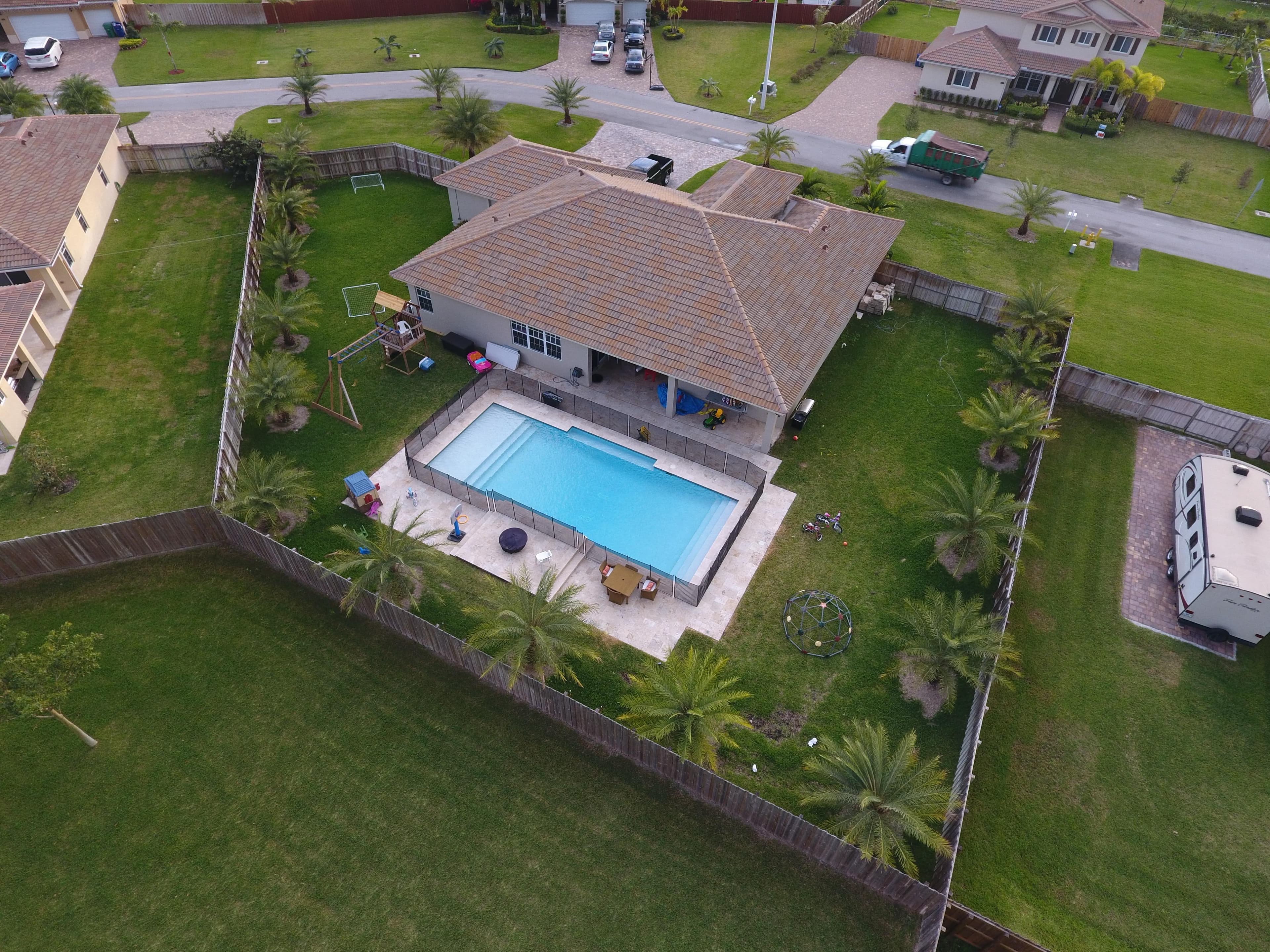
Hip roofs have four sloping sides that meet at a ridge with no vertical gable ends. This is the most wind-resistant common roof shape. Wind flows over the slopes rather than hitting flat gable walls, and the four-sided design distributes wind loads evenly. Hip roofs earn 5 to 15 percent discounts on the wind portion of your premium compared to gable roofs.
Gable roofs have two sloping sides meeting at a ridge with flat triangular gable ends. Gable ends catch wind like a sail. High pressure on the gable end can push the entire end wall inward, and failed gable ends often cause complete roof collapse. Gable roofs pay baseline rates unless gable end bracing has been added.
Flat roofs have unique wind dynamics. Uplift forces concentrate at edges and corners. Standing water adds weight that stresses the structure. Edge metal and parapet design significantly affects performance. Insurance impact varies widely based on specific construction details.
Gable end bracing. If you have a gable roof, installing diagonal bracing and additional fasteners at the gable end framing helps close the insurance gap with hip roofs. Cost runs $500 to $2,500, and the premium savings usually pay for the work within 1 to 3 years.
The 7-Point Wind Mitigation Inspection That Unlocks Credits
The Florida OIR-B1-1802 wind mitigation inspection is the single most powerful tool for reducing your homeowners insurance premium. It evaluates 7 specific features of your home and roof that affect wind damage risk, and each feature earns a potential credit.
1. Building code year. When your roof was built or last replaced determines which building code applied. Roofs built after the 2002 Florida Building Code took effect qualify for the best credits because 2002 was the first code to incorporate comprehensive hurricane standards. Savings: 10 to 25 percent of wind premium.
2. Roof covering. The type of roofing material and whether it meets Florida Building Code or Miami-Dade HVHZ requirements. Savings: 5 to 25 percent of wind premium.
3. Roof deck attachment. How the roof deck (plywood or OSB sheathing) is attached to the rafters or trusses. The strongest rating is ring-shank nails at 6-inch spacing, which is the current HVHZ code requirement. Savings: 5 to 15 percent of wind premium.
4. Roof-to-wall connection. How the roof structure connects to the walls, from weakest to strongest:
- Toe nails (nails driven at an angle): minimal credit
- Clips (metal connectors with one nail per side): moderate credit
- Single wraps (metal straps wrapping over the truss): good credit
- Double wraps (metal straps wrapping over and around the truss): maximum credit
Savings: 10 to 30 percent of wind premium. This is the single largest credit category.
5. Roof geometry. Hip, gable, flat, or combination. Hip roofs earn the best credit. Savings: 5 to 15 percent of wind premium.
6. Secondary water resistance (SWR). Whether a self-adhered modified bitumen barrier is installed over the entire roof deck. This prevents water intrusion if the outer roofing material is blown off. Savings: 3 to 10 percent of wind premium.
7. Opening protection. Whether all openings (windows, doors, garage doors, skylights) have impact-rated glass or hurricane shutters. Savings: 5 to 20 percent of wind premium.
Total potential savings: With all features at their strongest ratings, Miami homeowners typically save 30 to 55 percent on the wind portion of their premium. For a Miami-Dade policy with a $5,500 to $8,500 annual premium (wind portion runs 55 to 65 percent), that's $900 to $3,000 per year in actual savings.
How to Get a Wind Mitigation Inspection Done Right
The inspection must be performed by a qualified Florida professional:
- Licensed home inspectors
- Licensed general, building, or residential contractors
- Licensed professional engineers
- Licensed architects
The process:
1. Schedule the inspection (30 to 60 minutes on site)
2. Provide access to your attic, exterior roof, and all openings
3. Inspector evaluates each of the 7 categories and documents with photos
4. Inspector completes and signs the OIR-B1-1802 form
5. You submit the form to your insurance carrier
Cost: $125 to $250 in South Florida. Given the typical $900 to $3,000 annual savings, this is the highest-ROI $200 you can spend as a Miami homeowner.
When to get inspected:
- Immediately after any roof replacement or major roof work
- When shopping for new insurance
- 60 to 90 days before your current policy renews
- After adding hurricane shutters or impact windows
- If you've never had one done
Real Savings by Improvement Type
Here's what specific roof improvements actually save Miami-Dade homeowners on annual premiums in 2026:
| Improvement | Typical Cost | Annual Premium Savings | Payback Period |
|---|---|---|---|
| Wind mitigation inspection only | $125 - $250 | $500 - $2,500 | Immediate (1 to 2 months) |
| Adding hurricane straps/clips | $1,500 - $5,000 | $600 - $2,000 | 1 to 5 years |
| Secondary water barrier installation | $3,300 - $6,600 | $300 - $900 | 4 to 11 years |
| Gable end bracing | $500 - $2,500 | $200 - $800 | 1 to 4 years |
| Full roof replacement (shingle to Class 4 shingle) | $16,500 - $20,900 | $800 - $1,800 | 10 to 15 years |
| Full roof replacement (shingle to tile) | $30,800 - $48,400 | $1,200 - $2,400 | 15 to 20 years |
| Full roof replacement (shingle to aluminum metal) | $39,600 - $55,000 | $1,800 - $3,200 | 14 to 20 years |
These payback periods don't factor in the avoided cost of the next roof replacement (which the new roof pushes out by 20 to 40 years depending on material) or the added resale value.
ROI Example: Replacing a 17-Year-Old Shingle Roof With Metal
Here's a realistic scenario I walk clients through:
Current situation:
- Home value: $500,000
- Current insurance premium: $7,500 per year
- Current roof: 17-year-old architectural shingles
- Coverage type: ACV (due to roof age, carriers have pushed this to depreciated value)
After replacement with aluminum standing seam metal:
- Replacement cost: $42,000
- New insurance premium: $4,900 per year (35 percent reduction)
- Annual savings: $2,600
- Coverage upgraded to: Full Replacement Cost Value
10-year cumulative analysis:
| Year | Cumulative Insurance Savings | Net Position (Savings minus Upfront Cost) |
|---|---|---|
| 1 | $2,600 | -$39,400 |
| 3 | $7,800 | -$34,200 |
| 5 | $13,000 | -$29,000 |
| 10 | $26,000 | -$16,000 |
| 15 | $39,000 | -$3,000 |
| 16 | $41,600 | +$1,600 |
The roof pays for itself through insurance savings alone by year 16. That calculation doesn't include:
- Avoided emergency replacement cost if the old shingle roof had failed (ACV coverage means you'd pay $15,000+ out of pocket)
- Property value increase from the new metal roof (3 to 6 percent on a $500,000 home = $15,000 to $30,000)
- Maintenance savings (new metal roof requires virtually no maintenance for 25+ years)
- Energy savings from cool roof coatings (10 to 25 percent reduction in Miami cooling costs)
When you factor those in, the real payback period drops to 7 to 10 years.
Florida Laws That Protect Your Insurance Credits
Several Florida statutes directly affect how your roof impacts your insurance rate:
Florida Statute 626.0629(1)(d): Requires insurers to provide premium discounts for construction techniques that reduce windstorm damage. This is the legal basis for wind mitigation credits and ensures carriers can't ignore your roof improvements when setting your rate.
Florida Statute 627.711: Specifically addresses the wind mitigation inspection program. Requires insurers to:
- Accept the standard OIR-B1-1802 form
- Apply all applicable credits within 30 days of receiving a valid inspection
- Provide written explanation if any credits are denied
My Safe Florida Home Program: State-funded program providing free wind mitigation inspections and matching grants up to $10,000 for hurricane-hardening improvements including roof upgrades. Requires a site-built, homestead-exempted home valued under $500,000 and built before 2008. Current funding cycle expires in 2026 and hasn't been renewed. Apply immediately if eligible.
Ready to Stop Overpaying Your Insurance?
Call us at 305-225-1535 or request a free estimate. We offer free roof inspections with full wind mitigation documentation for any Miami-Dade homeowner. If you have an existing roof that qualifies for credits you're not claiming, we'll tell you. If replacement makes financial sense based on insurance math, we'll show you the numbers. No pressure, just honest cost-benefit analysis.
Frequently Asked Questions
How much can a new roof save on homeowners insurance in Florida?
A new roof in Florida can reduce homeowners insurance premiums by 20% to 40% or more depending on the material, installation method, and wind mitigation features. For a Miami-Dade homeowner paying $6,000 annually, that could mean $1,200 to $2,400 per year in savings. Over a 15-year period, total savings can reach $18,000 to $36,000.
What is a wind mitigation inspection in Florida?
A wind mitigation inspection evaluates seven specific features of your home that reduce wind damage risk, including building code year, roof covering, roof deck attachment, roof-to-wall connection, roof geometry, secondary water barrier, and opening protection. The inspection uses the standard OIR-B1-1802 form and costs $75 to $150. The resulting credits can save $500 to $5,000 or more per year on insurance.
Does roof shape affect insurance rates in Florida?
Yes. Hip roofs, which have four sloping sides with no vertical gable ends, receive the best insurance credits because they are the most wind-resistant common roof shape. Hip roofs can earn 5% to 15% discounts compared to gable roofs. If you have a gable roof, adding gable end bracing for $500 to $2,000 can help reduce your premium.
Is a metal roof worth it for insurance savings in Florida?
Standing seam metal roofs offer the highest insurance favorability in Florida due to their superior wind resistance (160-200+ mph), impact resistance, and longevity (40-70 years). They typically earn 15% to 25% premium discounts compared to standard shingles. Combined with their 40+ year lifespan, the cumulative insurance savings often offset the higher upfront cost within 5 to 10 years.
What are the My Safe Florida Home program benefits for roofing?
The My Safe Florida Home program offers free wind mitigation inspections and matching grants up to $10,000 for hurricane-hardening improvements including roof upgrades. Eligible homeowners must have a site-built, homestead-exempted home valued under $500,000 and built before 2008. The grants can cover a significant portion of improvements like hurricane straps, secondary water barriers, and roof upgrades.
Need Roofing Help?
Whether you need an inspection, repair, or full replacement, our team of licensed roofing professionals is ready to help. Serving South Florida since 2004.
Related Articles
Florida insurance rates are dropping for the first time since 2015. Learn how combining market rate decreases with strategic roof upgrades can save Miami homeowners $1,400-$2,600 per year on premiums.
Read More
My Safe Florida Home Grant 2026: Get Up to $10,000 for Roof Hardening (Before Funding Runs Out)
The My Safe Florida Home program has $270 million available for roof hardening grants up to $10,000, but the legislature has not approved new funding for 2027. Learn how to apply and maximize your grant.
Read More