
Standing Seam Metal Roofing in Miami: Cost, Benefits, and Wind Rating
What Standing Seam Actually Costs in Miami Right Now
I'm going to cut through the marketing and tell you exactly what a standing seam metal roof costs in Miami-Dade in 2026, broken down by material and roof complexity, based on jobs I've personally bid and installed this year. You'll get real numbers, real gauge and alloy recommendations by neighborhood, and a full walk-through of the installation process so you know what you're buying before any contractor walks your driveway.
I've been installing standing seam across Miami since 2004. The price has shifted a lot in the last five years (tariffs on steel, aluminum volatility, labor costs), so outdated guides online will steer you wrong. Let's get into the numbers.
2026 Pricing by Material and Gauge
Here's the cost range you should actually expect on a standing seam project in Miami-Dade this year. These are fully-loaded numbers including tear-off, deck re-nail to code, synthetic high-temp underlayment, panels, clips, trim, permit, and final inspection.
| Material / Gauge | Installed Cost per Sq Ft | Where I'd Recommend It |
|---|---|---|
| 26-gauge Galvalume steel | $14 - $17 | Budget-conscious projects in Doral, Miami Lakes, Hialeah, Homestead |
| 24-gauge Galvalume steel | $16 - $19 | Standard residential inland, Kendall, Palmetto Bay, most of Miami-Dade |
| .032 aluminum | $18 - $22 | Coastal zones: Key Biscayne, Bal Harbour, Sunny Isles, Fisher Island, waterfront Coconut Grove |
| .040 aluminum | $20 - $25 | High-end coastal, luxury homes with larger panel spans |
| Zinc (.032) | $24 - $32 | Architectural statement homes, boutique projects |
| Copper (20 oz) | $28 - $42 | Historic restoration, Coral Gables estates, Miami Beach boutique hotels |
For a typical 2,200 square foot Miami home with a hip roof and standard complexity, a Galvalume 24-gauge installation runs $35,000 to $42,000 total. The same home in aluminum .032 runs $40,000 to $48,000. Copper would run $62,000 to $92,000.
If a contractor quotes you under $13 per square foot for "standing seam metal," they're either installing exposed-fastener R-panel and calling it standing seam (different product, different wind rating) or they're skipping something critical. Walk away.
The Five Cost Drivers Most Homeowners Don't Understand
Two houses of the same square footage on the same block in Kendall can have a $15,000 difference in metal roof pricing. Here's what drives that gap.
1. Roof complexity. Simple hip or gable roofs with few penetrations install fast. Roofs with lots of valleys, dormers, hips meeting other hips, skylights, chimneys, and multiple slopes take 2 to 3 times longer per square foot. Every valley and flashing detail has to be custom-fabricated, hand-formed, and sealed. A cut-up roof can add 20 to 35 percent to the total cost.
2. Gauge thickness. Lower gauge numbers mean thicker metal. A 26-gauge panel is thinner than 24-gauge, which is thinner than 22-gauge. Thicker metal costs more per square foot but holds up better to hail, debris impact, foot traffic during maintenance, and thermal cycling. For Miami-Dade HVHZ, I recommend 24-gauge minimum on Galvalume and .032 minimum on aluminum. Going to 22-gauge or .040 aluminum costs about 15 percent more but delivers a noticeably more rigid roof.
3. Panel profile and seam type. Mechanically-seamed panels (the seamer crimps the seam shut after panels are set) cost 10 to 15 percent more than snap-lock panels but carry higher wind ratings. On homes in Miami-Dade HVHZ where we need the 180 mph uplift ratings, I spec mechanically-seamed. On inland homes in Homestead or Doral where 150 mph is sufficient, snap-lock is fine.
4. Kynar 500 finish vs standard. Kynar 500 (also called PVDF) is the PPG fluoropolymer coating that resists fading for 30+ years. Budget metal panels use polyester coatings that fade within 8 to 12 years in Miami sun. Kynar 500 costs about $1.50 to $2 more per square foot but it's the difference between a roof that looks new at year 20 and a roof that looks tired at year 10.
5. Deck condition and re-nailing. Miami-Dade code requires the deck to be re-nailed to a specific fastener schedule (typically 6 inches on edges, 6 inches in the field for HVHZ). If your existing decking is soft, rotted, or was installed with inadequate nails (common on homes built before 2002), it has to be repaired or replaced before the underlayment goes on. Deck repairs run $2 to $4 per square foot of affected area. I've seen deck repairs add $3,000 to $8,000 on 1960s-era homes.
The Installation Process, Day by Day
This is what actually happens on a standing seam job. I'm including this because most homeowners have no idea what they're paying for, and knowing the sequence helps you verify your contractor is doing it right.
Day 1: Tear-off and deck inspection. We strip the existing roof down to bare decking, haul away the old material, and inspect every square inch of the deck. Any rotten wood, delaminated plywood, or questionable areas get marked for repair. The crew photographs everything before moving on.
Day 2: Deck repair and re-nail. Bad decking gets replaced. Existing decking gets re-nailed to the Miami-Dade HVHZ fastener schedule (ring-shank nails at 6-inch spacing on edges and in the field). This is an inspection hold point in many Miami-Dade jurisdictions.
Day 3: Underlayment installation. A high-temperature self-adhering synthetic underlayment gets installed across the entire deck. I spec products like Grace Ice & Water Shield HT or Polyglass Polystick TU-P Plus, both of which carry Miami-Dade NOAs. This is your secondary water barrier. If a panel is ever damaged in a storm, the underlayment is what keeps water out of your attic.
Day 4: Drip edge, underlayment inspection. Drip edge flashing and starter trim get installed along all eaves and rakes. The Miami-Dade inspector comes out to sign off on the underlayment before we start setting panels.
Days 5 through 8: Panel installation. Panels get roll-formed on-site using a portable roll former parked in your driveway. Each panel is cut to length, carried to the roof, set on concealed clips, and locked to the adjacent panel. On a mechanically-seamed system, a powered seaming machine walks each seam and crimps it closed. We work from the low corners up to the ridge, keeping the panels aligned square to the eave.
Day 9: Trim, flashing, and penetrations. Custom-formed ridge caps, hip caps, valley flashing, chimney flashing, pipe boots, and skylight curbs all get installed and sealed. This is the part that separates good metal roofers from mediocre ones. Sloppy flashing work is where almost all leaks start.
Day 10: Final cleanup and inspection. Crew pulls the magnet sweeper across the driveway and lawn to pick up stray metal chips and fasteners. Miami-Dade final inspector signs off. Permit closes out.
A typical 2,200 square foot hip roof takes 8 to 12 days start to finish. Rain delays add a day or two per weather event. Custom fabrication for complex roofs (scalloped valleys, multiple dormers, architectural details) can push the timeline to 14 to 18 days.
Why Galvalume Rusts in Some Miami Zip Codes
I get asked this constantly. Galvalume is an aluminum-zinc coated steel. It resists corrosion well in most environments, but it has a known weakness: prolonged exposure to salt spray from the ocean causes accelerated rusting through the coating. In Miami, this matters a lot because our coastal zones experience constant airborne salt.
My rule for Galvalume in Miami:
- More than 2 miles from open water: Galvalume is fine. I've installed hundreds of these and they hold up for 40+ years.
- 1 to 2 miles from the coast: Galvalume works but I specify Kynar 500 finish and stainless steel fasteners. Expect 35 to 45 year lifespan.
- Within 1 mile of the coast: Switch to aluminum. No exceptions in Bal Harbour, Sunny Isles, Key Biscayne, Miami Beach, Fisher Island, Star Island, Hibiscus Island, Golden Beach, or Surfside.
- Directly waterfront or on a barrier island: Aluminum or copper only. Even high-end Galvalume will show corrosion within 10 years.
If a contractor quotes you Galvalume on a waterfront home and tells you it's fine, ask to see their last three waterfront Galvalume installs. I guarantee they don't have them, or the ones they show you will be less than 5 years old.
Wind Performance in Real Miami Storms
Standing seam tested to Miami-Dade TAS 125 achieves uplift resistance of 150 to 180+ mph depending on the system. But lab numbers are one thing. Real hurricane performance is another.
I've inspected dozens of standing seam roofs after Irma (2017), Michael (2018), and Ian (2022). Here's what I've seen consistently:
- Properly-installed standing seam with Miami-Dade NOA panels came through Cat 4 winds with zero damage. Zero.
- Damaged panels were always at improperly-flashed edges, ridges, or penetrations. The panel field itself never failed.
- Neighboring shingle roofs on the same block in Coconut Grove and Key Biscayne lost 30 to 60 percent of shingles during the same storm.
The lesson: the panel is never the weak point. The weak point is the installer. A Miami-Dade NOA product installed by a crew that cuts corners on clips, fasteners, or flashing will fail. The same product installed correctly will outlast the house.
How to Vet a Miami Metal Roofing Contractor
Standing seam is a specialty. Most Florida roofing contractors install shingles 80 percent of the time and metal as an occasional add-on. You want someone who does metal every week. Here's what to ask on every bid:
- How many standing seam jobs have you completed in Miami-Dade in the last 2 years? Look for 20+. If it's under 10, they're learning on your roof.
- What NOA number is the panel system you're quoting? Every bid should list the specific NOA number, product code, and panel profile. Generic "24-gauge standing seam" is not an answer.
- Do you roll-form panels on site or have them delivered pre-cut? Both work, but ask which and why. Long hip-to-eave runs need on-site roll-forming.
- What underlayment are you installing and what's its NOA number? I specify Grace HT or Polyglass Polystick. Cheap synthetic underlayments fail in Miami heat.
- What's your fastener schedule for the deck re-nail? The correct answer for HVHZ is 6 inches on edges, 6 inches in field, ring-shank nails.
- Can I see three metal jobs you completed in my zip code in the last 18 months? If they can't show you local references, they don't have them.
Also verify the Florida license number (CCC prefix for Certified Roofing Contractor), workers comp insurance, and general liability insurance. Call the DBPR and BBB for complaint history before signing anything.
When Standing Seam Is the Wrong Call
I'll tell you honestly: standing seam isn't the right roof for everyone. If any of these apply, consider a different material:
- Your HOA or architectural review board won't approve metal (common in Coral Gables, Gables Estates, Cocoplum, most of Pinecrest)
- Your home is a traditional Mediterranean Revival or Spanish Colonial where metal looks out of place architecturally
- You're planning to sell within 5 to 8 years (metal's long lifespan premium won't pay back in that window)
- Your budget caps out under $25,000 and your roof is over 2,000 square feet (in that case, Class 4 impact-resistant shingles are a better value)
For everyone else who can clear the HOA and the budget, standing seam is the most durable, lowest-maintenance, highest-performing residential roof you can buy in Miami.
Ready for a Real Quote?
Call us at 305-225-1535 or request a free estimate. We'll walk the roof, pull the right NOA for your specific zone, take into account your distance from salt water, and give you an itemized quote with the gauge, alloy, finish, and line-item pricing broken down the way I showed it above. No guesswork, no surprise change orders.
Frequently Asked Questions
How much does a standing seam metal roof cost in Miami?
A standing seam metal roof in Miami costs $10 to $35 per square foot installed, depending on the material. Galvalume steel starts around $10 to $16 per square foot, aluminum runs $15 to $25, and copper costs $25 to $35+. For a 2,000-square-foot home, expect a total investment of $20,000 to $70,000.
What wind rating does a standing seam metal roof have?
Most standing seam metal roofs are rated for 160 to 180 mph winds, with some premium systems exceeding 200 mph. This exceeds Miami-Dade's High Velocity Hurricane Zone requirements and provides protection well into Category 5 hurricane wind speeds.
How long does a standing seam metal roof last in Florida?
Standing seam metal roofs last 40 to 70 years in Florida depending on the material. Galvalume steel lasts 40 to 60 years, aluminum 50 to 70 years, and copper can exceed 100 years. This is two to four times the lifespan of asphalt shingles in our climate.
Will a metal roof make my house hotter in Miami?
No, the opposite is true. Metal roofs reflect 60% to 70% of solar radiation, significantly reducing heat transfer into your home. Studies show metal roofs reduce cooling costs by 20% to 25% compared to asphalt shingles. Light-colored metal panels with Energy Star certification provide the greatest savings.
Is standing seam or corrugated metal better for Miami homes?
Standing seam is significantly better for Miami homes. Its concealed fastener system provides wind ratings of 160+ mph versus 110 to 140 mph for corrugated, and eliminates the leak risk from degrading rubber washers on exposed screws. The higher upfront cost is justified by superior storm performance and a 40 to 70 year lifespan.
Need Roofing Help?
Whether you need an inspection, repair, or full replacement, our team of licensed roofing professionals is ready to help. Serving South Florida since 2004.
Related Articles
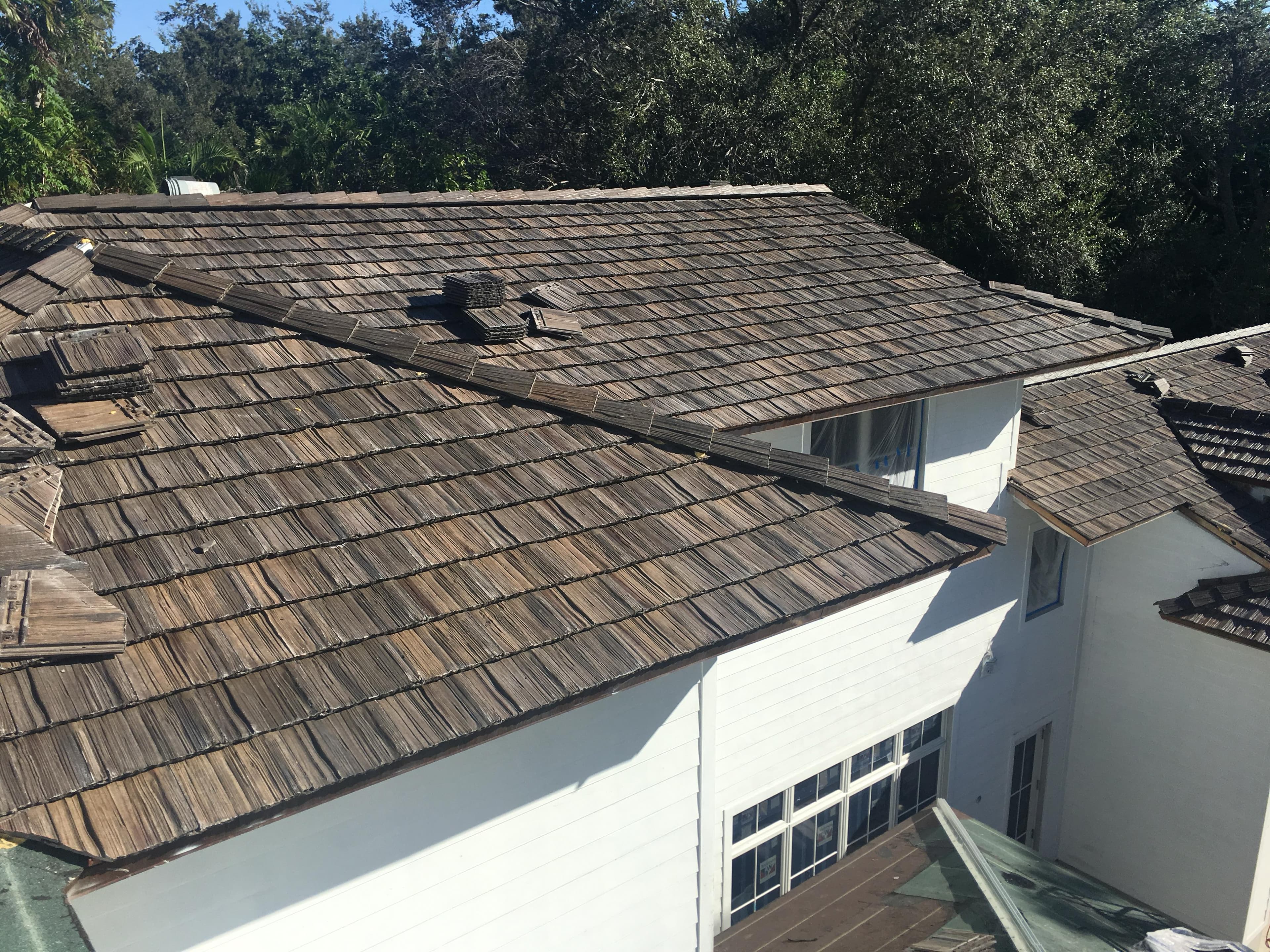
Compare metal, shingle, and tile roofs side by side for Miami homes. Costs, wind ratings, lifespans, and insurance savings explained.
Read More
Florida insurance rates are dropping for the first time since 2015. Learn how combining market rate decreases with strategic roof upgrades can save Miami homeowners $1,400-$2,600 per year on premiums.
Read More