TPO Roofing Contractors in Broward County: What to Know Before You Hire
How to Pick a TPO Contractor in Broward County
TPO is the dominant commercial flat roofing material in Broward County right now. Probably 50 percent of the new commercial flat roof work I see going up in Fort Lauderdale, Hollywood, Pembroke Pines, Davie, Pompano Beach, Deerfield Beach, and Coral Springs is TPO. And the installation quality varies wildly from contractor to contractor.
I've been installing TPO across South Florida since 2004. Good TPO work lasts 25 to 32 years. Bad TPO work starts leaking at year 8 to 12. The difference isn't the product, it's the contractor's experience with heat welding, seam pressure testing, insulation attachment, and Broward-specific code requirements.
This post walks through exactly how to vet a TPO contractor for your Broward County commercial property, what certifications matter, which manufacturers are worth specifying, and how to avoid the most common installation failures I see on 10-year-old TPO roofs across South Florida.
What Is TPO Roofing and Why Does It Dominate South Florida?
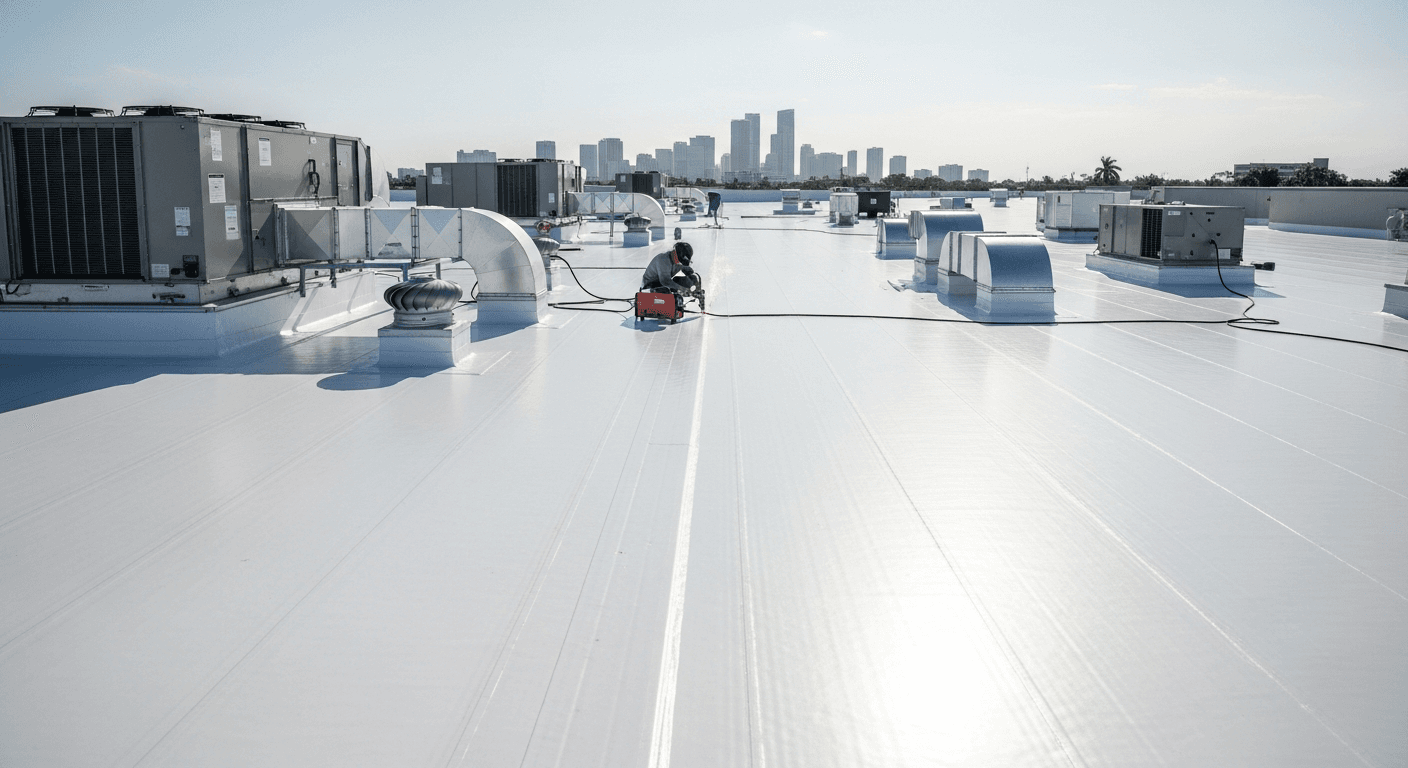
TPO is a single-ply thermoplastic roofing membrane manufactured from a blend of polypropylene and ethylene-propylene rubber, reinforced with a polyester or fiberglass scrim for dimensional stability and tear resistance. The membrane is produced in rolls (typically 6, 8, 10, or 12 feet wide) and installed in overlapping sheets with seams that are fused together using hot-air welding equipment.
Key Properties of TPO
| Property | Specification |
|---|---|
| Membrane thickness | 45 mil, 60 mil, or 80 mil |
| Standard color | White (also available in tan, gray, and custom colors) |
| Solar reflectance | 80-86% (white) |
| Thermal emittance | 90-92% |
| Elongation | 200-700% (absorbs building movement) |
| Seam strength | Heat-welded; stronger than the membrane itself |
| Chemical resistance | Excellent (oils, grease, bacterial growth, UV) |
| Fire classification | Class A (highest rating) |
Why TPO Dominates the South Florida Commercial Market
Several factors explain TPO's market dominance in Broward County and across South Florida:
- Energy efficiency: TPO's highly reflective white surface reduces rooftop temperatures by 50-80 degrees F compared to dark roofing membranes. In a market where commercial cooling costs represent the single largest utility expense, this translates to significant energy savings of 20-30% on cooling costs for buildings with TPO roofs.
- Hurricane performance: Properly installed TPO systems with mechanical attachment achieve wind uplift resistance ratings that meet and exceed Florida Building Code and HVHZ requirements. Heat-welded seams create a monolithic membrane that resists wind-driven rain penetration.
- Chemical resistance: South Florida's commercial environment includes restaurants, automotive facilities, and industrial properties that expose roofs to grease, oils, and chemical emissions. TPO resists degradation from these contaminants more effectively than EPDM.
- Cost competitiveness: TPO delivers premium single-ply performance at a lower price point than PVC (which offers similar performance at a 15-25% premium) and significantly less than built-up or modified bitumen systems.
- ENERGY STAR and LEED eligibility: White TPO qualifies for ENERGY STAR cool roof designation and contributes points toward LEED green building certification . increasingly important for commercial properties in Broward County's competitive real estate market.
TPO Roofing Cost Breakdown for Broward County
Commercial roofing pricing in Broward County reflects the region's higher labor costs, stringent code requirements, and the specialized materials needed for hurricane-zone construction.
Cost by Project Size
| Roof Size | Cost Range Per Sq Ft | Total Project Range |
|---|---|---|
| 2,000 – 5,000 sq ft (strip mall unit) | $6.00 – $8.00 | $12,000 – $40,000 |
| 5,000 – 10,000 sq ft (small commercial) | $5.50 – $7.50 | $27,500 – $75,000 |
| 10,000 – 25,000 sq ft (medium commercial) | $5.00 – $7.00 | $50,000 – $175,000 |
| 25,000 – 50,000 sq ft (large commercial) | $4.50 – $6.50 | $112,500 – $325,000 |
| 50,000+ sq ft (warehouse/industrial) | $4.00 – $6.00 | $200,000+ |
Economies of scale reduce per-square-foot costs on larger projects because fixed costs (mobilization, equipment, permitting) are spread across more area, and material purchasing in volume drives prices down.
---
Get your free roofing estimate today. Extreme Roofing Inc. has served South Florida since 2004 with over 20 years of certified expertise. Call 305-225-1535 or request your free estimate online.
---
Cost Components Breakdown
Understanding what makes up the total project cost helps you evaluate and compare contractor estimates:
| Component | % of Total Cost | Description |
|---|---|---|
| TPO membrane | 25-30% | Roll goods; 60-mil or 80-mil recommended for FL |
| Insulation | 15-20% | Polyisocyanurate (polyiso) board, R-value per code |
| Labor | 30-35% | Installation crew, equipment operation |
| Tear-off and disposal | 8-12% | Removal of existing roof, dumpster fees |
| Accessories and details | 5-8% | Penetration boots, edge metal, drains, scuppers |
| Permitting and inspections | 3-5% | Broward County building permits, sealed drawings |
| Overhead and profit | 8-12% | Contractor business operations and margin |
TPO vs. Alternative Commercial Membranes
| Membrane | Cost Per Sq Ft (Installed) | Lifespan | Best For |
|---|---|---|---|
| TPO | $5.00 – $8.00 | 20-30 years | Most commercial applications |
| PVC | $6.00 – $10.00 | 25-35 years | Restaurants, chemical exposure |
| EPDM | $4.50 – $7.50 | 20-30 years | Budget-conscious, low-traffic |
| Modified Bitumen | $5.50 – $9.00 | 15-25 years | High foot traffic areas |
| Built-Up (BUR) | $6.00 – $10.00 | 20-30 years | Heavy-duty industrial |
| Spray Foam (SPF) | $4.00 – $7.00 | 20-30 years | Irregular shapes, insulation focus |
TPO Installation Methods: What Matters
The installation method directly impacts the wind uplift performance, longevity, and warranty eligibility of a TPO roofing system. Broward County's hurricane exposure makes installation method selection particularly critical.
Mechanically Attached TPO
In a mechanically attached system, the TPO membrane is fastened to the roof deck through the insulation using screws and plates at specified intervals. The membrane is then draped over the fasteners, and seams are heat-welded to create the waterproof surface.
Advantages :
- Most common method for Broward County commercial roofs
- Cost-effective for most building types
- Performs well in high-wind environments when properly designed
- Easier to repair and modify than fully adhered systems
Considerations :
- Fastener pattern must be engineered for the specific wind zone and building height
- Perimeter and corner zones require tighter fastener spacing per ASCE 7 wind load calculations
- Requires a structural deck capable of holding fasteners (not suitable for lightweight metal decks without modification)
Fully Adhered TPO
In a fully adhered system, the TPO membrane is bonded to the insulation or substrate using adhesive applied to both surfaces. There are no mechanical fasteners penetrating the membrane.
Advantages :
- Cleaner appearance with no visible fastener rows
- Better performance over lightweight steel decks
- Reduced thermal bridging (no metal fasteners conducting heat)
- Slightly better acoustics
Considerations :
- 20-30% higher cost than mechanical attachment
- Adhesive application is temperature and humidity sensitive . challenging in South Florida's summer conditions
- Requires clean, dry substrate for proper bonding
- More difficult to repair sections compared to mechanically attached
Heat-Welded Seams: The Critical Quality Factor
Regardless of attachment method, seam welding quality is the most critical determinant of TPO roof performance. TPO seams are created by running a hot-air welding machine along the overlapping membrane edges at precisely controlled temperature and speed.
Proper seam welding requires:
- Temperature: 900-1,100 degrees F at the nozzle (varies by manufacturer)
- Speed: Calibrated to membrane thickness and ambient conditions
- Pressure: Consistent nip roller pressure to ensure full bonding
- Width: Minimum 1.5-inch welded seam width
- Testing: Seam probing with a blunt tool after cooling to verify bond integrity
Improperly welded seams are the number one cause of TPO roof failure . This is why contractor experience and quality control processes matter more than any other factor in TPO roofing. A contractor who has welded thousands of linear feet of TPO seams in Broward County's heat and humidity has the practical knowledge that classroom training alone cannot provide.
Broward County Code Requirements for Commercial Roofing
Commercial roof replacement in Broward County must comply with the Florida Building Code 7th Edition (2023) and, for properties within the HVHZ (which encompasses all of Broward County), the additional HVHZ-specific provisions.
Permitting Requirements
All commercial roof replacements in Broward County require a building permit. The permitting process includes:
- Application submission through the applicable jurisdiction (Broward County Building Division, or city building department for incorporated municipalities like Fort Lauderdale, Hollywood, Pompano Beach, etc.)
- Sealed engineering drawings may be required for commercial projects, particularly those involving structural modifications, drainage changes, or systems over 10,000 sq ft
- Product documentation: NOA numbers (for HVHZ) or Florida Product Approval numbers for all membrane, insulation, and attachment components
- Wind uplift calculations: Engineering analysis demonstrating the roofing system meets wind uplift requirements for the specific building location, height, and exposure category
- Energy code compliance: Insulation R-value must meet or exceed Florida Energy Code requirements (minimum R-20 for most commercial applications)
Inspection Requirements
Commercial roofing projects in Broward County require multiple inspections:
- Progress inspection: After insulation and membrane installation on initial sections, before the majority of the roof is completed
- Final inspection: After all work is complete, including penetration details, edge terminations, drainage, and rooftop equipment flashing
HVHZ-Specific Requirements
All of Broward County falls within the Miami-Dade/Broward HVHZ, which imposes additional requirements:
- Product approval: All membrane systems must carry a Miami-Dade NOA (Notice of Acceptance) or Broward County product approval, in addition to Florida Product Approval
- Enhanced wind uplift: Systems must be designed for the HVHZ design wind speeds, which can exceed 185 mph for certain building categories and exposure conditions
- Large missile impact testing: Not typically required for flat roof membranes (applies primarily to roof coverings in the plane of the roof accessible from the exterior), but all above-deck components must meet applicable testing standards
Common TPO Roof Problems and How to Prevent Them
Understanding the most common TPO failure modes helps building owners identify warning signs early and evaluate whether a contractor's proposed installation methods will prevent them.
Seam Failure
Cause : Improper heat welding . temperature too high (membrane burns), too low (insufficient bond), speed too fast (narrow weld width), or contaminated surfaces (dirt, moisture).
Prevention : Choose a contractor with documented TPO welding experience, verify they conduct seam testing (probe testing and/or peel testing) during and after installation, and ensure their crew includes certified TPO welders trained by the membrane manufacturer.
Warning signs : Seam edges visibly lifting, water stains on interior ceilings along seam lines, membranes separating at T-patches (three-way intersections).
Ponding Water
Cause : Inadequate roof slope, blocked or insufficient drainage, structural deflection, or improper installation of tapered insulation.
Prevention : Design the roofing system with a minimum 1/4 inch per foot slope using tapered polyiso insulation. Ensure all drains, scuppers, and gutters are properly sized and positioned. Some Broward County buildings have structural decks that have deflected over time, creating low spots . these must be addressed with tapered fill insulation.
Warning signs : Standing water visible 48+ hours after rainfall, algae or dirt rings marking ponding locations, membrane discoloration in ponding areas.
Membrane Shrinkage
Cause : TPO membrane can shrink over time, particularly lower-quality products or membranes installed under tension. Shrinkage pulls the membrane away from edges, curbs, and penetrations.
Prevention : Specify premium 60-mil or 80-mil TPO from established manufacturers (Carlisle, GAF, Firestone/Elevate, Johns Manville). Ensure the membrane is installed without excessive tension and that all edge terminations have adequate mechanical restraint.
Warning signs : Membrane pulling away from parapet walls, exposed fasteners at perimeter, wrinkles developing in previously smooth membrane.
Puncture Damage
Cause : Foot traffic from HVAC technicians, dropped tools, dragged equipment, and accumulated debris impact.
Prevention : Install walk pads along designated access routes to HVAC equipment, electrical panels, and other rooftop services. Include walk pad specifications in the roofing scope of work. Establish a building maintenance policy requiring protective measures when rooftop work is performed.
How to Evaluate TPO Roofing Contractors in Broward County
Selecting the right TPO contractor requires evaluating both their credentials and their practical experience with commercial flat roofing in the Broward County market.
Essential Contractor Qualifications
| Qualification | What to Verify | Where to Check |
|---|---|---|
| Florida roofing license | Active CCC or CRC license | myfloridalicense.com |
| Broward County registration | Registered to pull permits locally | County/city contractor database |
| General liability insurance | $2M+ per occurrence (commercial standard) | Request certificate of insurance |
| Workers' compensation | Active coverage for all crew | Verify with carrier directly |
| Manufacturer authorization | Certified installer for proposed TPO brand | Contact manufacturer rep |
| OSHA compliance | OSHA 30-hour certification for supervisors | Request documentation |
Manufacturer-Certified Installer Status
The leading TPO manufacturers . Carlisle, GAF, Firestone/Elevate, Johns Manville, and Versico . all maintain certified installer programs. These programs require the contractor to:
- Complete manufacturer-specific training on product installation
- Demonstrate a track record of successful installations
- Maintain minimum insurance and financial requirements
- Submit to periodic quality audits
Only manufacturer-certified installers can offer the manufacturer's full system warranty, which typically covers both material defects and installation workmanship for 15 to 30 years depending on the warranty tier. Non-certified installers can only offer the basic material-only warranty (typically 10-15 years) supplemented by their own workmanship guarantee.
Extreme Roofing Inc. maintains manufacturer certifications across multiple product lines and has been installing commercial TPO systems throughout Broward County since 2004. With Florida license CCC# 1326021 and experience on projects ranging from small retail units to large warehouse facilities, they bring the depth of HVHZ-compliant commercial roofing expertise that Broward County building owners require.
Questions to Ask TPO Contractors
- How many TPO roofs have you installed in Broward County in the past 24 months? (Look for 10+ projects)
- Who are your certified TPO welders, and what manufacturer training have they completed?
- What membrane thickness do you recommend for my building, and why? (60-mil minimum for South Florida; 80-mil for premium)
- Do you conduct seam testing during installation? What is your testing protocol?
- Will you provide sealed engineering drawings for the wind uplift design?
- What is your warranty structure . manufacturer system warranty tier and term?
- Can you provide references from Broward County commercial clients?
- Who will be the on-site project manager, and how many projects do they oversee simultaneously?
TPO Roofing Applications in Broward County
TPO is the preferred membrane for a wide range of Broward County commercial properties:
Retail and Strip Malls
Broward County's extensive retail landscape . from large shopping centers along University Drive and Federal Highway to neighborhood strip malls . relies heavily on TPO roofing. Key considerations for retail applications:
- HVAC penetration density: Retail buildings often have multiple rooftop units requiring individual penetration details
- Signage attachment: Structural attachments for signage must be properly flashed and integrated with the membrane
- Tenant improvements: Future modifications (new RTUs, exhaust fans) must be planned for in the initial roofing design
Warehouses and Distribution Centers
The warehouse and logistics sector in western Broward County (Sunrise, Coral Springs, Weston, Pembroke Pines) represents some of the largest TPO roofing projects in the market:
- Large open spans: Wide fastener patterns possible due to consistent deck conditions
- Minimal penetrations: Fewer detail areas reduce installation complexity and failure points
- Energy impact: The large roof area of warehouses means TPO's reflective properties generate the greatest absolute energy savings
Office Buildings
Multi-story and mid-rise office buildings throughout Fort Lauderdale, Hollywood, and Plantation increasingly specify TPO for:
- Aesthetic flexibility: TPO is available in white, tan, and gray to complement building facades
- Green building requirements: LEED and ENERGY STAR compliance for commercial tenants
- Warranty expectations: Corporate tenants expect long-term warranty documentation
HOA and Condominium Common Areas
HOA-managed flat roof areas . including clubhouses, pool decks, covered parking structures, and common buildings . are excellent TPO applications. The low-maintenance, long-warranty characteristics align well with HOA maintenance budgeting.
Maintenance Best Practices for TPO Roofs in Broward County
Proactive maintenance maximizes TPO service life and protects your warranty coverage. Most TPO manufacturer warranties require documented maintenance to remain valid.
Recommended Maintenance Schedule
| Frequency | Task |
|---|---|
| Biannual (spring + fall) | Full roof inspection by qualified contractor |
| After major storms | Post-storm damage assessment |
| Quarterly | Clear drains, scuppers, and gutters of debris |
| As needed | Trim overhanging vegetation, remove debris accumulation |
| Annually | Document roof condition with photos for warranty file |
What a TPO Inspection Should Cover
A thorough biannual inspection by a qualified roofing contractor should examine:
- All seam conditions (probing for adhesion)
- Membrane surface condition (checking for punctures, abrasion, discoloration)
- Penetration flashings (boots, curbs, pitch pans)
- Edge terminations and perimeter metal
- Drain flow and ponding conditions
- Walk pad condition and placement
- Rooftop equipment condition and flashing integrity
Extreme Roofing Inc. offers commercial roof maintenance programs for Broward County building owners, including biannual inspections, documentation, and priority scheduling for any identified repairs.
Get a Free Estimate
Whether you are replacing an aging flat roof, addressing storm damage, or planning a new commercial construction project in Broward County, the right TPO contractor makes all the difference between a 30-year asset and a 10-year problem.
Call [305-225-1535](tel:305-225-1535) or [request your free commercial roofing estimate online](/free-estimate) to schedule an on-site evaluation of your Broward County commercial property. Extreme Roofing Inc. has served South Florida's commercial roofing market since 2004, with Florida license CCC# 1326021, manufacturer certifications, and the HVHZ expertise that Broward County building owners require.
Frequently Asked Questions
What is TPO roofing?
TPO (Thermoplastic Polyolefin) is a single-ply reflective roofing membrane used primarily on flat and low-slope commercial roofs. It consists of a reinforced thermoplastic sheet that is heat-welded at the seams to create a continuous waterproof surface. TPO is the most widely installed commercial roofing membrane in the United States due to its combination of energy efficiency, chemical resistance, and competitive pricing.
How much does TPO roofing cost in Broward County?
TPO roofing in Broward County costs between $5.00 and $8.00 per square foot fully installed as of 2026. For a typical 5,000 sq ft commercial roof, total project cost ranges from $25,000 to $40,000. For larger installations over 10,000 sq ft, per-square-foot costs often drop to $4.50 to $6.50 due to economies of scale. Pricing includes membrane, insulation, fasteners, penetration details, permitting, and disposal of the existing roof system.
How long does a TPO roof last in Florida?
A properly installed TPO roof in South Florida typically lasts 20 to 30 years, depending on membrane thickness (mil gauge), UV exposure, and maintenance quality. Premium 80-mil TPO systems from manufacturers like Carlisle, GAF, or Firestone generally outperform 45-mil and 60-mil options by 5 to 10 years. Regular maintenance including biannual inspections and prompt repair of any seam issues maximizes TPO service life in Florida's demanding climate.
Is TPO better than EPDM for commercial roofs in Florida?
For most South Florida commercial applications, TPO outperforms EPDM. TPO offers superior energy efficiency (white reflective surface vs. EPDM's black), heat-welded seams that are stronger than EPDM's adhesive or tape seams, and better resistance to Florida's intense UV exposure. EPDM remains a viable option for roofs with heavy foot traffic or exposure to certain chemicals, but TPO has become the dominant commercial membrane in the South Florida market.
What are common TPO roof problems in South Florida?
The most common TPO roof problems in South Florida are seam failures from improper heat welding, ponding water from inadequate slope or drainage, membrane shrinkage causing edge pulling, and punctures from foot traffic or dropped equipment. Most of these issues result from poor installation or inadequate maintenance rather than material deficiencies. Choosing an experienced TPO contractor with documented Broward County projects is the best protection against these failure modes.
Does Broward County require permits for commercial roof replacement?
Yes, Broward County requires permits for all commercial roof replacements. Permits are issued through the Broward County Building Division or the local municipality depending on the property's location. Commercial roofing permits in Broward County require sealed engineering drawings for systems over certain size thresholds, and the completed installation must pass both a progress inspection and a final inspection. Your contractor should handle all permitting as part of their scope of work.
Can TPO be installed over an existing flat roof?
In some cases, TPO can be installed over an existing roof system (a roof-over or recover) without full tear-off, provided the existing roof has only one layer, the existing insulation and deck are in sound condition, and the added weight does not exceed structural capacity. Florida Building Code allows a maximum of two roof coverings. However, a full tear-off is generally recommended for Broward County projects to allow inspection of the deck and insulation and to ensure full code compliance.
Need Roofing Help?
Whether you need an inspection, repair, or full replacement, our team of licensed roofing professionals is ready to help. Serving South Florida since 2004.
Related Articles
Florida insurance rates are dropping for the first time since 2015. Learn how combining market rate decreases with strategic roof upgrades can save Miami homeowners $1,400-$2,600 per year on premiums.
Read More
My Safe Florida Home Grant 2026: Get Up to $10,000 for Roof Hardening (Before Funding Runs Out)
The My Safe Florida Home program has $270 million available for roof hardening grants up to $10,000, but the legislature has not approved new funding for 2027. Learn how to apply and maximize your grant.
Read More