TPO Roofing for Commercial Buildings: Benefits and Costs
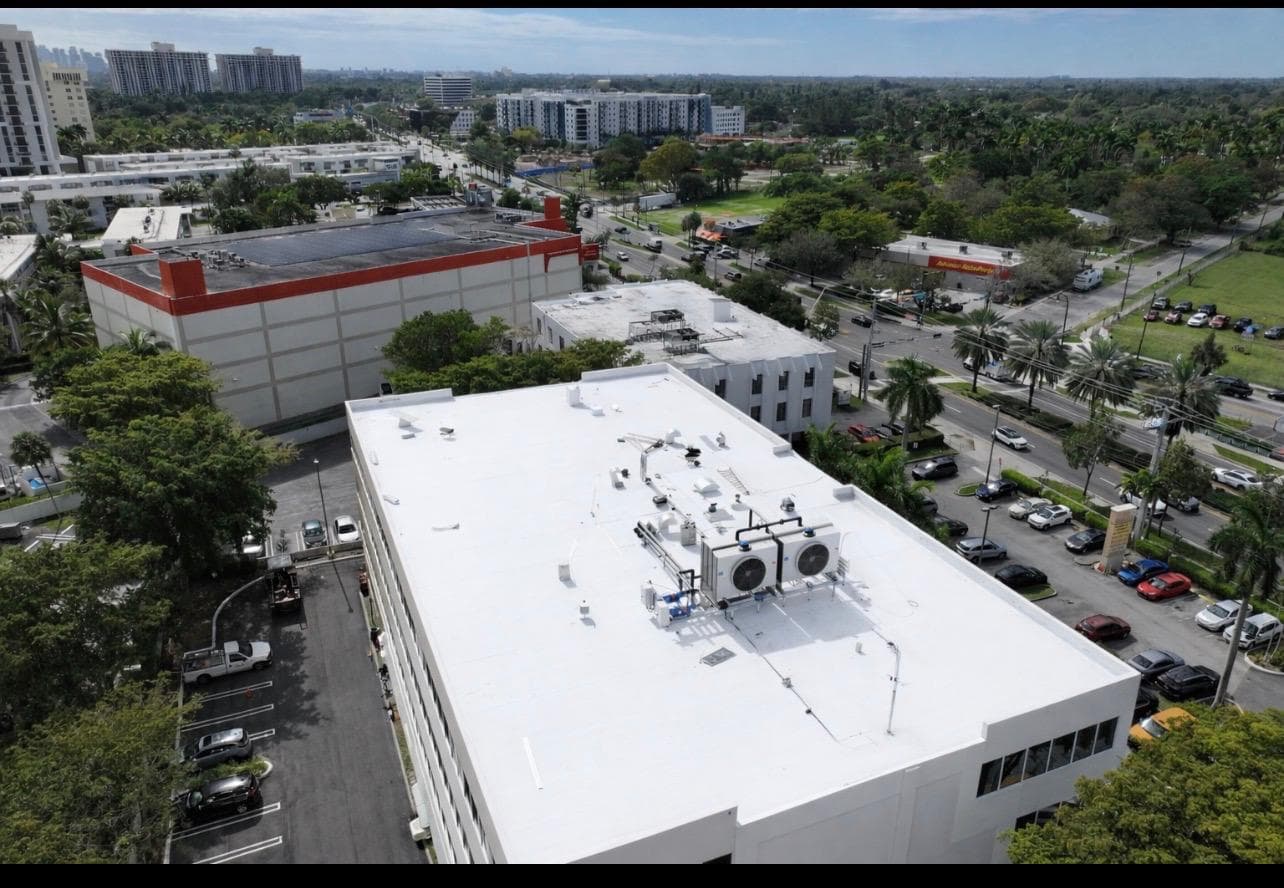
The Commercial Flat Roof Most Miami Building Owners Should Install
If you own a commercial building in Miami-Dade, TPO is probably the right answer for your next flat roof replacement. I've installed hundreds of TPO roofs on warehouses, retail strips, office buildings, restaurants, and mixed-use properties across the county since 2004, and the performance-to-cost ratio still beats every competing membrane in 2026.
This post covers everything a commercial property owner needs to know before committing to TPO: real Miami pricing, thickness and installation method tradeoffs, manufacturer recommendations, and honest comparison to EPDM and modified bitumen. If you want the residential flat roof perspective, read my flat roof repair residential post instead.
What TPO Actually Is and Why It Works in Miami
TPO is a thermoplastic rubber-polypropylene blend reinforced with a polyester scrim fabric. The membrane comes in rolls 10 to 12 feet wide in thicknesses from 45 mil to 80 mil. The white reflective surface bounces back 70 to 87 percent of solar radiation, keeping building interiors cooler and reducing air conditioning load. That reflective surface is the entire reason TPO took over the commercial roofing market in Florida starting around 2005.
The other key feature is heat-welded seams. TPO panels get welded together with a hot-air welder that chemically bonds the thermoplastic material. A properly welded TPO seam is stronger than the membrane itself. This is dramatically stronger than EPDM adhesive seams or modified bitumen torch seams, and it's why TPO outperforms every alternative in Miami's wind and rain conditions.
Three TPO Installation Methods (Pick the Right One)
There are three installation methods for commercial TPO. Choose wrong and you'll have problems down the line.
Mechanically attached. The TPO membrane is fastened to the deck using screws and plates along the seam overlaps. Least expensive method, fastest installation, widely used on large warehouse and distribution buildings. The downside: fastener penetrations create stress points that eventually fail, and wind can create billowing that fatigues the membrane. Wind rating typically FM 1-60 to 1-90. Acceptable on inland Miami buildings, not ideal for HVHZ high-exposure locations.
Fully adhered. The membrane is bonded directly to insulation or cover board with specialized adhesive. No fastener penetrations. The membrane stays flat even in hurricane winds. Wind rating FM 1-90 to 1-120. Costs 20 to 30 percent more than mechanically attached. This is what I recommend for most Miami commercial buildings, especially coastal zones and buildings with tenants or equipment inside.
Ballasted. Loose-laid membrane held down by river rock (10+ pounds per square foot). Cheapest to install but adds massive structural load and creates projectile risk in hurricanes. I don't recommend ballasted TPO for any Miami-Dade commercial building, and most HVHZ-rated contractors won't install it.
TPO Thickness: 60 Mil vs 80 Mil
TPO comes in three standard thicknesses. The right choice depends on how long you plan to own the building and how much foot traffic and equipment the roof handles.
45 mil. Budget-grade, 15 to 20 year Miami lifespan, below minimum for most manufacturer warranties. I don't install this on commercial buildings. Skip it.
60 mil. Industry standard, 20 to 25 year Miami lifespan, qualifies for 15 to 20 year system warranties. This is my default recommendation for most commercial work. Good balance of durability and cost.
80 mil. Premium grade, 25 to 32 year Miami lifespan, qualifies for 20 to 30 year system warranties. Essential for roofs with heavy foot traffic, lots of rooftop equipment, restaurants, or high-exposure locations. The 33 percent cost premium over 60 mil pays back through longer lifespan and better warranty.
For any building you plan to own 20+ years, spec 80 mil. For shorter ownership horizons, 60 mil is fine.
Real 2026 Commercial TPO Pricing in Miami
Here's what I'm actually quoting on commercial TPO projects across Miami-Dade right now. Numbers include tear-off, deck inspection, insulation, cover board if specified, membrane, perimeter fastening, heat-welded seams, flashings at penetrations and curbs, drains, permits, and inspection.
| Building Size | Mechanically-Attached 60 mil | Fully-Adhered 60 mil | Fully-Adhered 80 mil |
|---|---|---|---|
| 5,000 sq ft | $27,500 - $42,500 | $35,000 - $52,500 | $40,000 - $57,500 |
| 10,000 sq ft | $55,000 - $85,000 | $70,000 - $100,000 | $80,000 - $115,000 |
| 20,000 sq ft | $110,000 - $170,000 | $140,000 - $200,000 | $160,000 - $230,000 |
| 50,000 sq ft | $275,000 - $425,000 | $350,000 - $500,000 | $400,000 - $575,000 |
| 100,000 sq ft | $550,000 - $850,000 | $700,000 - $1,000,000 | $800,000 - $1,150,000 |
These don't include structural deck repairs (typically $3 to $6 per sq ft of affected area), tapered insulation for slope correction (add $3 to $6 per sq ft), or walk pads at high-traffic areas ($5 to $10 per linear foot).
TPO vs EPDM vs Modified Bitumen: The Honest Comparison
Here's how TPO compares to the other two common commercial flat roof membranes, based on 20+ years of installing all three across Miami.
| Feature | TPO | EPDM | Modified Bitumen |
|---|---|---|---|
| Installed cost per sq ft | $6 to $12 | $5.50 to $9 | $7 to $11 |
| Miami lifespan (60 mil) | 20 to 25 years | 15 to 22 years | 15 to 22 years |
| Surface color | White (standard) | Black (standard) | Black, white available |
| Solar reflectivity | Up to 87% | Under 10% (black) | 10 to 70% |
| Seam method | Heat-welded | Adhesive tape | Torch or cold adhesive |
| Seam strength | Excellent | Fair | Good |
| Puncture resistance | Good to excellent | Good | Excellent |
| Chemical resistance | Excellent | Fair | Moderate |
| Best for Miami? | Yes, default choice | Budget projects only | Heavy foot traffic roofs |
Choose TPO when you want the best combination of energy efficiency, wind resistance, and long-term value. This is the default choice for most Miami commercial buildings.
Choose EPDM only when budget is the primary concern and energy efficiency doesn't matter. Honestly, I rarely recommend EPDM anymore in Miami because the energy penalty from the black surface wipes out the small cost savings.
Choose modified bitumen when you have very heavy foot traffic, complex penetrations, lots of rooftop equipment, or want a multi-ply system for redundancy. Mod-bit excels on restaurants with heavy HVAC equipment and industrial buildings with frequent maintenance access.
TPO Maintenance Schedule That Doubles Lifespan
TPO is low-maintenance but not no-maintenance. A good maintenance program extends lifespan from 22 years to 30+ years. Here's the schedule I set up for every commercial TPO client:
Quarterly:
- Clear drains, scuppers, and gutters
- Walk the roof and document ponding, debris, or visible damage
- Photograph roof condition
Semi-annually (April and October):
- Inspect all seams, flashings, penetrations, and terminations
- Check sealant condition
- Test drain flow rates
- Clean full roof surface
Annually:
- Professional inspection with written report
- Infrared moisture scan (recommended)
- Re-seal any deteriorating terminations
- Warranty compliance check if under manufacturer warranty
After every major storm:
- Inspect within 48 hours for debris impacts
- Clear all drains immediately
- Document damage with dated photos for insurance
Commercial TPO maintenance contracts in Miami run $0.05 to $0.12 per square foot per year. On a 20,000 square foot building, that's $1,000 to $2,400 annually. It sounds like money you don't want to spend, but it saves $50,000+ in emergency repairs and premature replacement over the life of the roof.
TPO Warranty Options Worth Paying For
Major TPO manufacturers offer tiered warranty programs:
| Warranty Level | Coverage Period | What's Covered |
|---|---|---|
| Standard | 15 years | Material defects only |
| Enhanced system | 20 years | Material plus workmanship |
| NDL (No Dollar Limit) | 25 to 30 years | Full repair cost including labor, no depreciation |
NDL (No Dollar Limit) warranties are the gold standard for commercial roofing. They cover the full cost of repair or replacement including labor, with no depreciation over the warranty term. NDL warranties require installation by a manufacturer-certified contractor and typically require an annual inspection program.
For any commercial building worth $500K+, I recommend NDL warranty coverage. The additional upfront cost (typically $0.25 to $0.75 per sq ft) is far less than a single major repair outside of warranty coverage.
The Manufacturers I Specify Most
Quality varies significantly between TPO manufacturers. Products I install regularly on Miami commercial work:
- Carlisle Syntec Sure-Weld: Top-tier, excellent seam performance, strong FM ratings, 20 to 30 year NDL warranties available. Premium price. I recommend this on signature buildings and high-exposure locations.
- GAF EverGuard: Very good product with competitive pricing and strong Miami distributor network. 15 to 25 year warranties. Good default choice.
- Johns Manville JM TPO: Excellent fire ratings and algae resistance. 15 to 25 year warranties. I specify this on restaurants and food service buildings where grease and biological growth are concerns.
- Versico VersiWeld: Solid mid-tier product with good pricing. 15 to 20 year warranties. Good for warehouse and distribution work where budget matters.
- Holcim Elevate (formerly Firestone UltraPly): Recently rebranded. Good product but distributor network has shrunk.
Avoid off-brand TPO. The savings aren't worth the risk of a manufacturer going out of business during the warranty period.
Ready for a TPO Quote?
Call us at 305-225-1535 or request a free estimate. We'll walk your commercial roof, spec the right thickness and installation method for your specific building, pull manufacturer NOA documentation, and give you an itemized quote with warranty terms. We're certified installers for Carlisle, GAF, Johns Manville, and Versico, which means your warranty is backed by the manufacturer directly.
Frequently Asked Questions
How long does a TPO roof last in Miami?
A properly installed TPO roof in Miami lasts 20 to 30 years depending on membrane thickness, installation quality, and maintenance. A 60-mil TPO system with regular inspections and maintenance will typically reach 25 years. An 80-mil system with a manufacturer maintenance program can exceed 30 years.
Is TPO roofing good for hurricanes?
Yes, TPO is one of the best flat roof systems for hurricane resistance. Heat-welded seams are stronger than the membrane itself, and fully adhered TPO systems meet Miami-Dade HVHZ wind uplift requirements. TPO regularly passes TAS 125 wind testing protocols required for High Velocity Hurricane Zone approval.
What is the best thickness for TPO roofing?
For most commercial buildings in South Florida, 60-mil TPO is the industry standard and provides the best balance of performance and cost. Upgrade to 80-mil if your roof has heavy foot traffic, rooftop equipment, or you want the longest possible warranty. Avoid 45-mil for any new installation in Miami.
How much does a 10,000 sq ft commercial TPO roof cost?
A 10,000 square-foot commercial TPO roof installation in Miami costs between $55,000 and $90,000 including membrane, insulation, tear-off, labor, permits, and inspections. The exact cost depends on membrane thickness, installation method, insulation R-value, and building access requirements.
Can a TPO roof be repaired or does it need replacement?
TPO roofs can absolutely be repaired. Small punctures and tears are patched with TPO membrane and heat-welded to create a seamless repair. Seam separations can be re-welded. However, if your TPO roof has widespread damage, significant ponding, or is past its expected lifespan, a full replacement may be more cost-effective than ongoing repairs.
Need Roofing Help?
Whether you need an inspection, repair, or full replacement, our team of licensed roofing professionals is ready to help. Serving South Florida since 2004.
Related Articles
Florida insurance rates are dropping for the first time since 2015. Learn how combining market rate decreases with strategic roof upgrades can save Miami homeowners $1,400-$2,600 per year on premiums.
Read More
My Safe Florida Home Grant 2026: Get Up to $10,000 for Roof Hardening (Before Funding Runs Out)
The My Safe Florida Home program has $270 million available for roof hardening grants up to $10,000, but the legislature has not approved new funding for 2027. Learn how to apply and maximize your grant.
Read More